
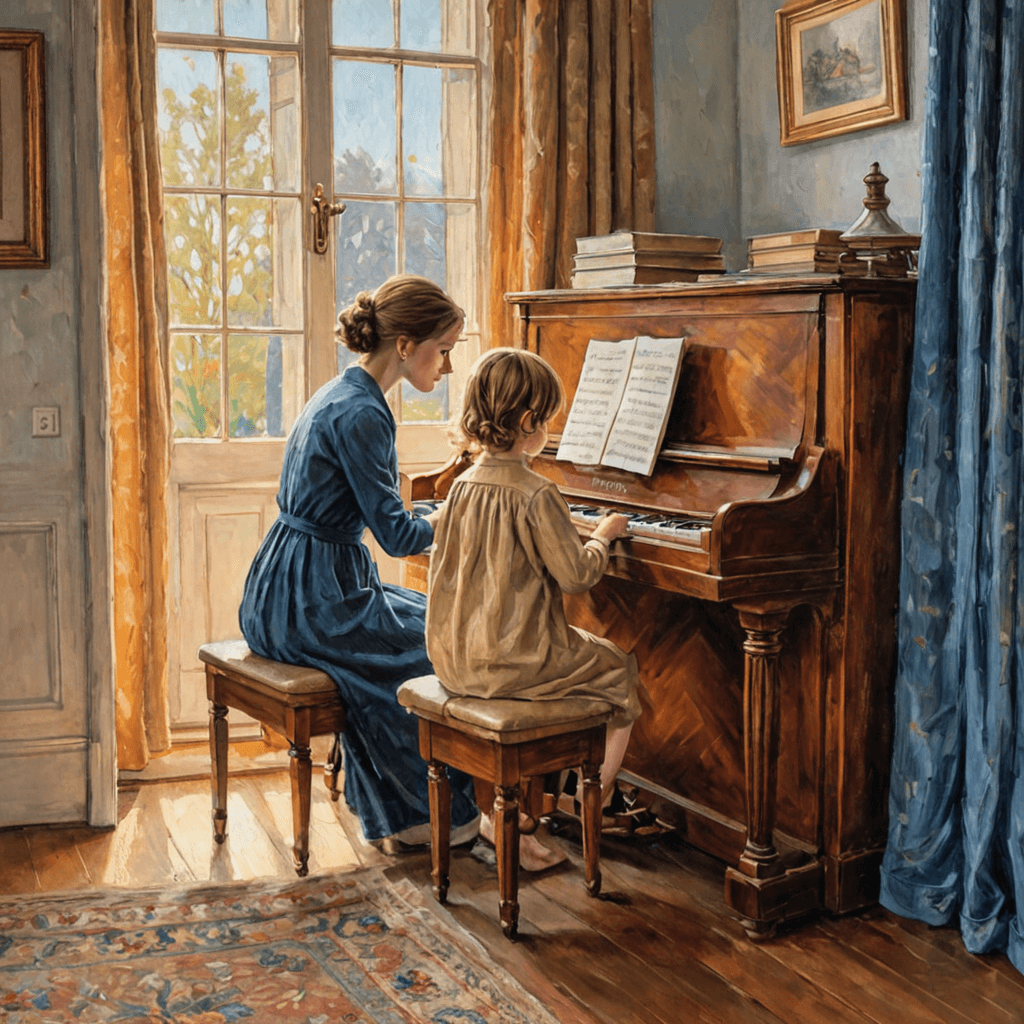
Adult Piano Restart in Etobicoke: What Parents Actually Face
Table of Contents
Most parents who sign a child up for piano sit through the first few lessons and think some version of the same thing: I used to play — I could probably pick this back up. That instinct is a good one, but the restart rarely unfolds the way returning adults expect, and the mismatch between expectation and reality is what makes people quit in month three. Here is what actually happens when a parent returns to the keyboard in the same year their child begins.
Why So Many Parents Restart in the Same Year Their Child Starts
There is a practical reason and an emotional one, and both are worth naming.
The practical reason is that the instrument is already in the house. A family that has just bought or borrowed a piano for a seven-year-old has removed the single largest barrier to adult learning — access. The bench is there. The lesson routine is already carved into the week. Adding a second learner to an existing schedule is a much smaller decision than starting from nothing.
The emotional reason is harder to admit out loud. A lot of adults who took lessons as children stopped at a point they still think of as unfinished. They quit at eleven or thirteen, usually because of a schedule conflict or a teacher who was a poor fit, and the memory sits there. Watching a child begin reopens the question. At Muzart Music and Art School, adult restarters are one of the steadiest parts of our enrolment, and the overwhelming majority describe their return in the language of unfinished business rather than new ambition.
That distinction matters, because it shapes what a realistic first year should look like.
The First Surprise: Your Hands Remember More Than Your Eyes Do
This is the single most consistent pattern we see with returning adults, and almost nobody predicts it in advance.
Adults who played as children generally find that the physical side of piano returns faster than they expected. Hand position, the feel of the octave span, the muscle memory for scales they drilled for years — a surprising amount of that comes back within a handful of weeks. Adults are also better at the mechanical work than children are. They understand why a fingering choice matters, they can isolate a difficult bar and repeat it deliberately, and they do not need to be persuaded that slow practice is worth the time.
What lags is reading. In our experience, returning adults consistently decode notation more slowly than they remember doing at twelve, and the gap between “I know what that note is” and “my hand goes there without thinking” is wider than they anticipate. The knowledge is intact; the automaticity is not. An adult can look at a bass-clef note, name it correctly, and still take a full beat to place the finger — a delay that simply did not exist when they were reading music every day.
This is not a sign of decline and it is not permanent. Reading fluency is a use-it-or-lose-it skill that rebuilds with exposure, and it rebuilds reasonably quickly once someone is reading a few times a week rather than once. But an adult who does not expect the lag will interpret it as evidence that they have lost something they can’t get back. Knowing it is coming changes how people respond to it entirely, which is why we raise it in the first lesson rather than the tenth.
The practical fix is unglamorous: short, frequent sight-reading at a level well below the pieces being studied. Five minutes of easy material read cold, most days, will rebuild fluency faster than an hour of grinding through one hard piece on the weekend.
Why “Helping at Home” Rarely Works When You’re Both Beginners
Here is the assumption that causes the most friction in the first few months, and it deserves a direct answer.
A lot of parents restart specifically so they can supervise their child’s practice. The logic seems sound — if I know what a quarter note is, I can keep her honest between lessons. In practice, when both people are genuinely beginners, this almost never works, and it often makes the household worse.
The problem is that a parent who is one week ahead of their child is not a teacher; they are a slightly better-informed peer. When they correct a mistake, they are correcting from partial knowledge, and children detect that immediately. Corrections that are 80 percent right introduce habits that then have to be undone in lessons. Worse, the practice session becomes a place where a parent is evaluating rather than accompanying, and for a lot of kids that turns the piano into a site of judgment.
The households where the dual-learner arrangement genuinely works are the ones where the parent explicitly gives up the supervisory role. They practise their own material at their own bench time. They let the teacher teach. What the child actually absorbs is not correction — it is the sight of an adult in their house being visibly bad at something and continuing anyway. That modelling is worth considerably more than accurate note-checking, and it is the part parents systematically undervalue.
If you want to help, the useful contributions are logistical rather than musical: protect the practice window, keep the instrument accessible and in tune, and ask what the piece is about rather than whether it was played correctly.
A Realistic Timeline for the First Year Back
Timelines vary with prior experience and practice frequency, but the shape is fairly consistent for an adult who played for several years as a child and practises four or five times a week.
Weeks one to six. Physical re-familiarisation. Scales, hand independence, and repertoire well below the level you finished at. Most restarters find this stretch frustrating precisely because it feels beneath them. It is not — it is where the reading rebuild happens.
Months two to four. Reading fluency starts closing the gap. This is usually when adults report the first genuine enjoyment, because playing stops requiring constant conscious translation. Repertoire moves up quickly here, often faster than the adult expects, because the underlying technique never left.
Months five to nine. Most returning adults land somewhere near, and often above, the level they abandoned as children. The practice quality of an adult brain is the reason. This is also the point where people start choosing repertoire deliberately rather than accepting what is assigned.
Months nine to twelve. The question shifts from recovery to direction — whether to pursue examination repertoire, accompany a choir, work on jazz voicings, or simply build a personal repertoire of pieces played well. For adults considering a structured path, our RCM examination preparation in Etobicoke programme is available to adult candidates, not only children.
Adults who never played at all follow a slower but more linear curve, without the frustration of the recovery phase.
How Parent and Child Lessons Run Side by Side
All of our music instruction is private and one-to-one, which makes the parent-and-child arrangement straightforward to schedule. The most common configuration is consecutive lesson slots on the same evening — the child plays, the parent plays, the family makes one trip. It halves the driving and it removes the most common reason adult learners drop out, which is that their lesson is the first thing sacrificed when the week gets tight.
A shared slot also solves a subtler problem. When a parent’s lesson is scheduled independently, it competes with everything else in their calendar and loses. When it is stapled to a commitment they were already making for their child, it survives.
On cost: a trial piano lesson is $35, and ongoing monthly instruction is $155 with all materials included. Families enrolling two learners are budgeting for two programmes, which is worth thinking through honestly before committing — the arrangement works best when the adult’s lessons are treated as a real commitment rather than an experiment attached to the child’s.
Our studio is a single location in Etobicoke near Cloverdale Mall, and our piano lessons in Etobicoke serve families across Etobicoke, west Toronto, and Mississauga.
What to Look For in a Teacher When You’re the Returning Adult
Adult restarters have different needs from adult beginners, and not every teacher distinguishes between them.
Ask whether the teacher will assess your actual current level rather than starting you at zero. Adults returning after twenty years usually need a diagnostic first lesson — what came back, what didn’t, where the reading sits — not a default beginner curriculum.
Ask how repertoire gets chosen. Adults have taste. A teacher who assigns method-book material for a year to someone who wants to play Chopin nocturnes will lose them, and a teacher who hands over a nocturne in week two will lose them differently. The right answer involves negotiation.
Ask what happens when you miss two weeks. Adult lives include work travel, illness, and family emergencies at a rate children’s lives do not. A studio with no realistic answer to that question will produce a lot of guilt and eventually a cancellation.
Finally, ask whether the teacher has taught adults recently. Teaching adults is a distinct skill — the pacing, the explanations, and the tolerance for a student who wants to know why are all different.
Frequently Asked Questions
How long should I have played as a child for a restart to be easier than starting fresh?
Roughly two or more years of consistent lessons tends to produce a noticeable advantage, mostly in technique and ear. Under a year, the restart looks much like beginning from scratch — which is entirely fine, just a different timeline.
Will my child and I need separate teachers?
Not necessarily. A single teacher handling both learners has useful visibility into the household’s practice dynamics. Some families prefer separate teachers so that the child’s lesson feels entirely their own, which is also a legitimate choice.
I never played as a child. Is a “restart” post relevant to me?
The timeline differs but most of this applies. True adult beginners progress more evenly, without the recovery-phase frustration, and typically reach comfortable playing of simple repertoire within the first year.
How much practice does an adult actually need?
Twenty to thirty minutes, four or five days a week, produces steady progress. Frequency matters more than duration — five short sessions beat one long one, particularly for rebuilding reading.
Can I take lessons if I don’t have an acoustic piano at home?
Yes. A weighted-key digital instrument with 88 keys is entirely workable for adult learners, and many restarters begin there before deciding whether to invest further.
Is it too late to work toward an examination?
No. Adult candidates take Royal Conservatory examinations regularly, and the structure suits people who want measurable milestones. Current syllabus requirements, fees, and session dates should be confirmed directly on the RCM’s official site, since they are updated each year.
Starting the Restart
The parents who succeed at this share one trait: they treat their own lessons as a real commitment rather than a bonus attached to their child’s. Book a trial piano lesson to find out where your playing actually sits, or request more informationabout scheduling consecutive lesson slots for a parent and child on the same evening.