
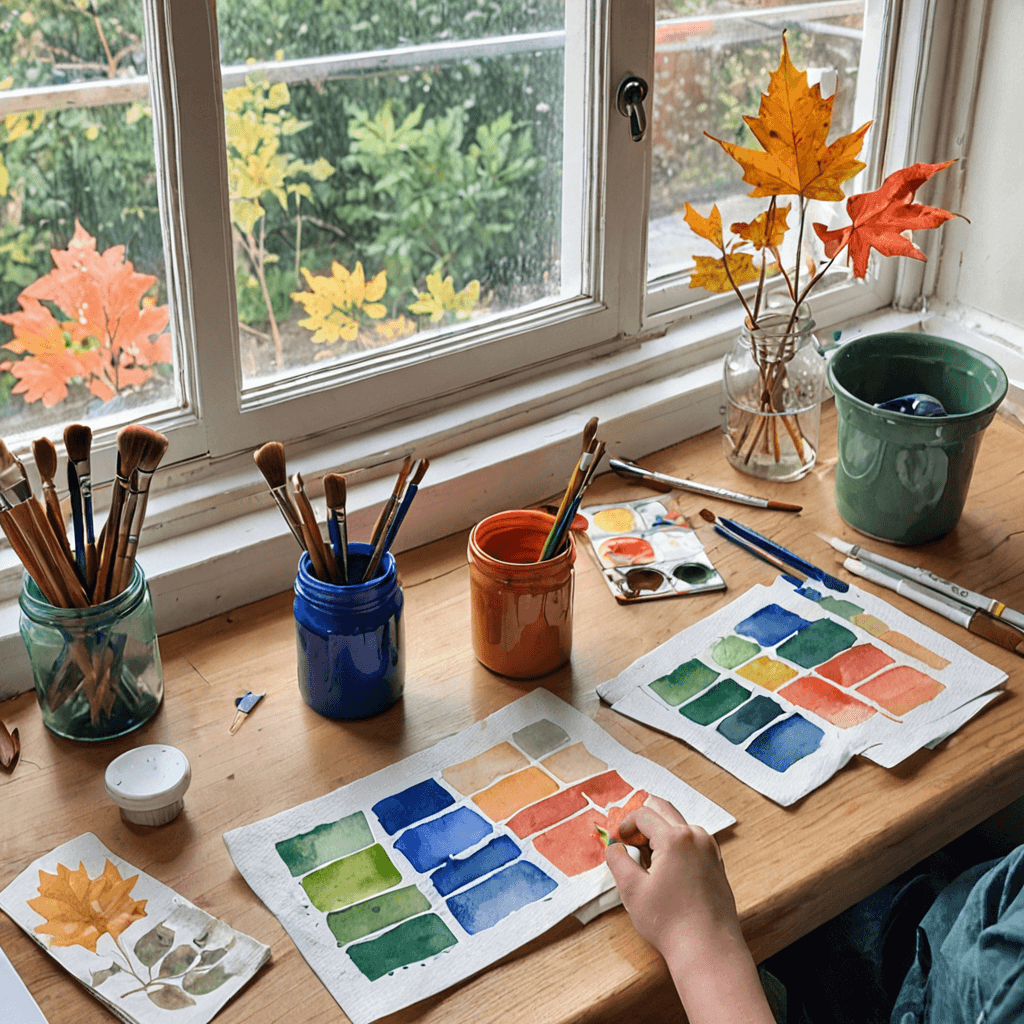
Back-to-School Art Classes for Kids: What Parents Book First
Table of Contents
Most families think about art classes the same week they think about backpacks and indoor shoes, and by then the September picture has already taken shape. This post walks through how children’s art enrollment actually works in the late-August window — what parents commit to first, how group and private classes differ in practice, and what a first term genuinely looks like. Here’s the part that surprises people most.
The September Timeline Nobody Explains
Children’s art enrollment follows a rhythm that has almost nothing to do with the school calendar and everything to do with parent decision-making.
The first wave arrives in mid-to-late August, when families are already in planning mode for the fall and are slotting activities into the week alongside school, sports, and music. These parents tend to book decisively, because they’re building the whole schedule at once and they can see where an art class fits.
The second wave arrives in late September and early October — after the school routine has settled and a gap has become obvious. Sometimes that gap is practical (one free afternoon), and sometimes it’s the parent noticing that their child has been drawing constantly and would clearly benefit from real instruction.
Both waves are perfectly reasonable. But the first wave chooses from a full schedule, and the second chooses from what’s left. If your child has a strong preference for a particular day, or you’re coordinating around a sibling’s activity, the August window is worth using.
At Muzart Music and Art School, our single Etobicoke location near Cloverdale Mall serves families across Etobicoke, Toronto, and Mississauga, and the pattern holds across all of them.
Group or Private: The Choice That Actually Matters
This is where most of the real decision-making happens, and the answer depends much less on your child’s talent than parents expect.
Group art classes for children work well for children who enjoy the social energy of making things alongside other kids. There’s a genuine benefit that’s hard to reproduce one-to-one: children see what a peer is doing at the next table, borrow ideas, and get pulled forward by comparison in a way that’s usually motivating rather than discouraging. For a child aged roughly five to twelve who’s exploring, group is the natural starting point.
Private art lessons make more sense when a child has a specific direction — they want to get better at drawing figures, they’re working toward a particular skill, or they’re the kind of learner who goes quiet in a group and needs the instructor’s attention to stay engaged. Private also suits older children and teens whose interests have narrowed enough that a general class no longer challenges them.
One clarification worth making, because it comes up constantly: group classes at Muzart exist only on the art side, and only for children. All music instruction — piano, guitar, drums, voice — is private and one-to-one. Private art lessons are available for all ages, including adults.
What a First Term Actually Contains
Parents often expect a children’s art class to be a series of disconnected craft projects. Structured instruction looks quite different.
A well-built term moves through fundamentals in a deliberate order — observational drawing before stylized drawing, basic colour relationships before ambitious palettes, and control of a medium before free experimentation with it. Children still make finished pieces they’re proud to bring home, but the pieces are the byproduct of skill-building rather than the point of the class.
Expect variety across mediums within a term: pencil and charcoal, watercolour, acrylic, and usually some mixed media or three-dimensional work. That range matters more at this age than depth in any single medium, because children discover what they actually enjoy by trying things, not by being assigned a specialty at seven.
Materials are included in the monthly fee, which removes a real friction point. Children’s art programs, including group classes, run $35 for a trial and $155 monthly with everything supplied — no supply list arriving in week two, no scramble for a specific brand of acrylic.
Choosing by Location and Schedule
Practical constraints usually decide more than programme philosophy does.
Families searching locally for art classes in Etobicoke are typically weighing drive time against class quality, and it’s worth being honest with yourself about which weekday you can genuinely sustain in November when it’s dark at 5:00. A class you can reach easily on a Saturday morning beats an ideal class on a Tuesday you’ll come to resent.
Families looking at art lessons in Mississauga face the same trade-off from the other direction. Proximity to home or to a sibling’s activity is frequently the deciding factor, and there’s nothing wrong with that — consistency of attendance drives more artistic progress in a nine-year-old than any curriculum difference between two decent programmes.
The one scheduling variable genuinely worth optimizing: pick a slot when your child isn’t already depleted. A child arriving straight from a full school day plus a late pickup will produce less and enjoy it less than the same child on a Saturday morning.
Signs Your Child Is Ready for Something More Structured
Some children are ready for real instruction earlier than their parents assume. A few reliable indicators:
They draw without being asked. Unprompted, self-directed making is the single strongest signal. It means the interest is theirs, not yours.
They get frustrated with their own work. A child who says “it doesn’t look right” has developed an eye ahead of their hand — exactly the gap instruction closes. Frustration here is a readiness signal, not a warning.
They repeat subjects. Drawing the same horse, dragon, or character over and over is early evidence of sustained investigation, which is the seed of everything that later becomes a portfolio.
They ask how. “How do you make it look far away?” is a technical question, and technical questions deserve technical answers rather than encouragement.
Telling a Structured Programme From a Craft Hour
Both exist, both are marketed similarly, and the difference only becomes obvious months in. A few questions sort them quickly.
“What will my child be able to do in June that they can’t do now?” A structured programme has an answer — specific skills, in a specific order. A craft hour will describe activities instead of capabilities.
“Does every child leave with the same picture?” If the answer is yes, the class is being taught as a template rather than as instruction. Twelve children learning the same technique should produce twelve visibly different results, because they’re applying a skill rather than following steps.
“How is drawing taught?” Drawing is the load-bearing skill underneath everything else in visual art. A programme that treats it as one activity among many, rather than as the foundation being built continuously, will produce children who paint pleasantly and draw poorly.
“What happens when a child finds something difficult?” The honest answer involves adjusting the task so the child can succeed at a slightly harder version — not removing the difficulty. Frustration handled well is where skill actually comes from.
There’s also a simpler test, which is to look at work from children who’ve been in the programme for a year rather than at the promotional images. Progress over time is visible and hard to fake.
None of this means a relaxed, playful class is a bad choice. For a five-year-old, joy matters more than technique, and a programme that makes art feel good is doing important work. But parents should know which one they’re buying, because a ten-year-old who wants to get genuinely better will lose interest in an hour of pleasant activities surprisingly fast.
Frequently Asked Questions
What age should a child start art classes?
Around five is a sensible floor for structured group instruction, since it requires enough attention span to follow a sequence of steps. Younger children benefit enormously from making art, but usually in a less formal setting. Between five and twelve, group classes suit most children well; from about eleven or twelve onward, some children benefit from moving toward private instruction as their interests sharpen.
Are group art classes available for adults?
No. Group art classes are for children only. Adults who want art instruction take private lessons, which are available for all ages and can be built entirely around whatever the adult wants to work on — drawing fundamentals, painting, or a specific project.
What does it cost to enroll a child in art classes?
A trial is $35, and monthly enrollment is $155 with all materials included. That applies to children’s group art classes as well as regular private instruction. Portfolio preparation, which is a distinct programme for teens working toward art school applications, is priced separately.
Does my child need to bring supplies?
No. Materials are included, which is deliberate — a nine-year-old shouldn’t be limited by whether the right brush made it into the bag that morning, and parents shouldn’t be decoding a supply list in September.
What if my child is shy in groups?
This is worth a conversation before enrolling rather than after. Many quiet children do very well in art groups specifically because the activity provides something to do with their hands and no requirement to perform socially. But if a child genuinely shuts down around peers, private lessons will produce far more progress, and that’s a legitimate choice rather than a fallback.
Can a child switch from group to private later?
Yes, and it’s a common trajectory. Children often start in a group at seven or eight, discover a direction by eleven or twelve, and move to private instruction to pursue it. Some later continue into portfolio preparation if they’re aiming at art school, though that’s a decision for the high school years rather than something to plan around in Grade 4.
Getting the Fall Sorted
Back-to-school art enrollment rewards families who decide in August and works out fine for families who decide in October — the difference is how much choice you have over the day and time. If your child has been drawing all summer, the signal is already there.
You can book a trial class to see how your child responds before committing to a term, or request more information if you’d like to talk through whether a group class or private lessons make more sense for your particular kid.