
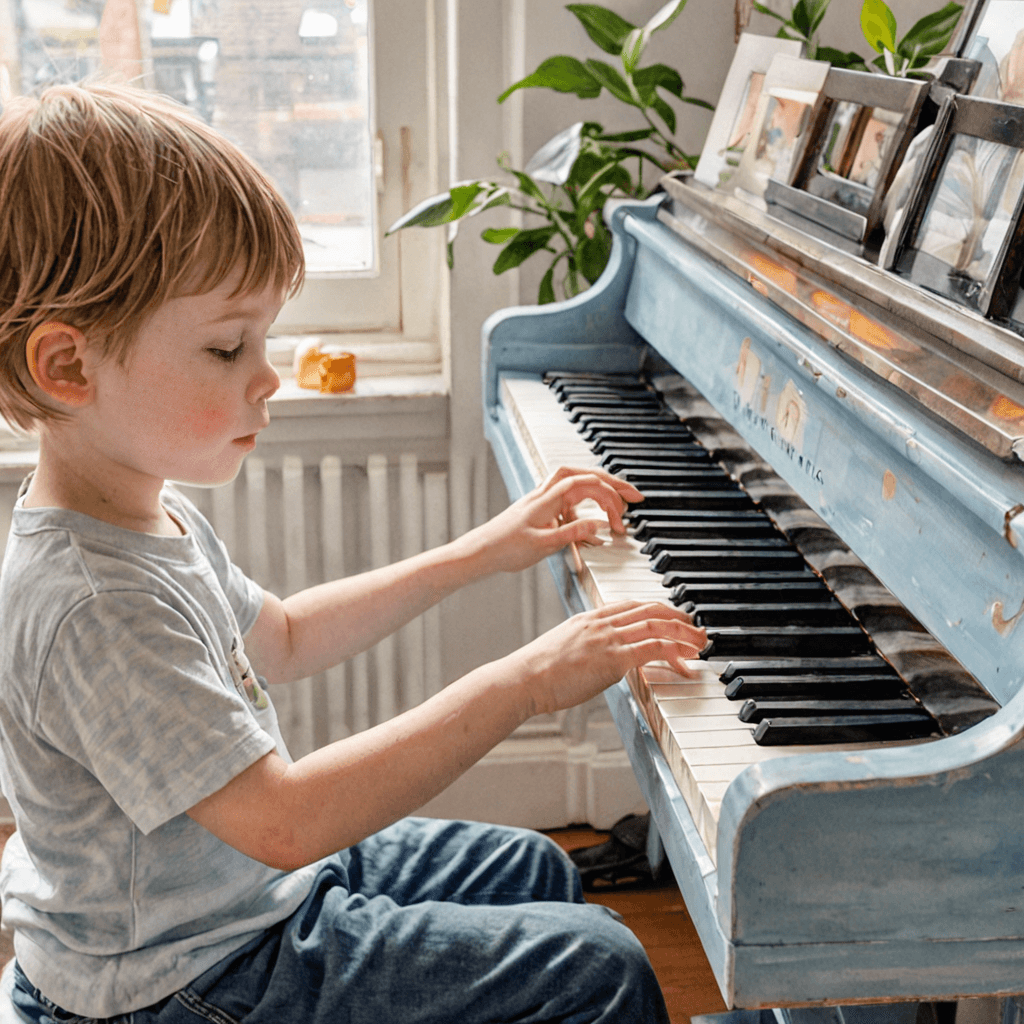
Piano Lessons for Toddlers in Etobicoke: Signs They’re Ready
Table of Contents
Most parents of a two-, three-, or four-year-old who keeps climbing onto the piano bench ask the same question: is my child old enough for real lessons, or are we jumping the gun? The honest answer is that age is one of the least reliable ways to tell — readiness shows up in behaviour long before it shows up on a birthday cake. Below, we walk through what genuine readiness actually looks like in a very young child, what a first lesson involves at this age, and how to set your family up so those early months build a love of music rather than a standoff over the keyboard.
Why age is the wrong first question
Parents often arrive with a number in mind: “I heard four is the magic age,” or “My friend’s daughter started at three.” The trouble is that two children of exactly the same age can be worlds apart in what they can actually do in a lesson. One four-year-old will sit, watch, and try to copy what a teacher shows them. Another will treat the piano as a very large, very loud toy and lose interest in ninety seconds. Neither is “behind” — they are simply at different points in a developmental window that opens at slightly different times for every child.
That is why, at Muzart Music and Art School, when a parent asks whether their very young child is ready, we’ve learned to look past age and even past physical size. The two signals that actually predict a good start are whether a child can settle into a short, structured block of activity, and whether they can follow a simple instruction and mirror something back — echo a clap, copy a hand shape, repeat a two-note pattern. When those two things are present, lessons tend to take. When they are not quite there yet, waiting a single season often turns what would have been a frustrating start into a joyful one.
Notice what is not on that list. Hand size barely matters at this stage, because early lessons are not about stretching to reach an octave. Reading music is years away. Even the child’s obvious enthusiasm, on its own, is not enough — plenty of toddlers love the sound of the piano without yet being able to engage with a lesson. The behaviours we look for are quieter and more telling than any of that.
What a first lesson actually looks like at this age
A private lesson for a toddler or preschooler bears almost no resemblance to the lessons most adults remember. There are no scales drilled for twenty minutes and no stern corrections. Instead, a good early lesson is built out of very short activities strung together: a little rhythm game, a moment of finding high and low sounds, a call-and-response where the child copies a pattern, a song they can sing while pressing one key. The pacing is deliberately quick, because a three-year-old’s attention is a renewable but short-lived resource.
Because Muzart teaches music privately — one teacher, one child, always — the lesson bends to the individual child rather than the other way around. That matters enormously at this age. A private teacher can read the room, stretch a game that is landing, and abandon one that isn’t before frustration sets in. This is also why we don’t offer group music classes: a room of toddlers moving at six different speeds is the fastest way to lose all six of them. (Our group format exists only for children’s art, where shared tables genuinely help.)
If you’d like to see whether your child is in that ready zone, the simplest path is a trial lesson. Our $35 music trial is designed partly for exactly this — it lets a teacher spend real one-on-one time with your child and give you an honest read on whether now is the moment or whether a few months would help. From there, our monthly music program runs at $155 with all materials included, so there are no surprise costbooks or supply lists to chase down.
Setting up the first few months at home
The lesson is only thirty minutes a week; the rest of the musical week happens at your kitchen table and in the car. For very young children, “practice” is the wrong word — it implies a discipline they don’t yet have. What actually helps is tiny, frequent, playful contact with the instrument. Ninety seconds at the piano after breakfast, sung along to, beats a joyless fifteen-minute block any day.
A few things make a real difference for families starting out. Keep the piano or keyboard somewhere visible and accessible, not tucked in a basement the child rarely enters — proximity drives repetition at this age. Let the child noodle without correcting every note; the goal in the early months is a warm association with the instrument, not accuracy. And follow the teacher’s lead on which one or two small things to reinforce that week, rather than inventing your own curriculum at home. Parents who try to teach ahead of the lesson usually create confusion, however well-intentioned.
If you’re still deciding between an acoustic instrument and a keyboard for a young starter, that’s a common and reasonable question — and the honest answer depends on your space, budget, and how far you expect things to go. A teacher can talk you through it during a trial. What matters far more than the instrument in the first year is the consistency of those short, happy sessions. Strong, structured piano lessons in Etobicoke give a young child a framework, but the daily magic happens at home, in small doses.
When it’s genuinely better to wait
Sometimes the most useful thing a teacher can tell a parent is “not yet.” If a child can’t yet sit for even a few minutes of a structured activity, or can’t copy back a simple pattern, formal lessons will feel like pushing a boulder uphill for everyone. That’s not a verdict on the child’s talent — it’s a timing observation, and timing changes fast at this age.
In the meantime, there is plenty a family can do to build toward readiness: singing together, clapping rhythms, listening to a wide range of music, and playing simple copy-the-pattern games away from the instrument. Many families find that a season of this, followed by a fresh trial lesson, makes all the difference. Some children who “weren’t ready” in the spring are thriving by the fall. If you’re unsure where your child sits, request more information and we can talk through the signs to watch for before you commit to anything.
Frequently asked questions
What is the youngest age you’ll teach piano?
There’s no rigid cutoff, because readiness varies so much from child to child. We’ve had wonderful starts with children as young as three and have gently recommended waiting for some fours and fives. Rather than anchor to an age, we look at whether the child can focus through a short structured activity and copy back simple patterns. A trial lesson is the clearest way to find out where your child stands.
How long are lessons for this age group?
Lessons are typically kept short and focused, because a toddler’s or preschooler’s attention span is the real limiting factor. A private format lets the teacher pace the session to the individual child — stretching what’s working and easing off before frustration sets in. This flexibility is one of the biggest advantages of one-on-one instruction at this age.
Do I need a piano at home before we start?
It helps enormously to have something to play between lessons, but it doesn’t have to be a grand piano. Many families begin on a keyboard and upgrade later as commitment grows. What matters most is that the instrument is accessible and used often in short bursts. A teacher can advise on what would suit your home and budget during a trial.
Should my child learn to read music right away?
Not at this stage. Very young beginners learn through listening, imitation, and play long before notation enters the picture. Pushing reading too early tends to stall progress and drain the fun. Formal note-reading comes naturally once the foundational listening and coordination skills are in place.
Is group class an option for toddlers?
Not for music — we teach all music privately, because young children progress at wildly different speeds and a one-on-one setting keeps every lesson on track. We do offer group classes for children’s art, where shared tables genuinely add to the experience. For piano at this age, private is the format that works.
Ready to find out if now is the time?
The only sure way to know whether your toddler or preschooler is ready is to let a teacher spend a little one-on-one time with them. Book a trial lesson and you’ll leave with an honest read on where your child stands and what the next few months could look like. Muzart Music and Art School is located in Etobicoke near Cloverdale Mall, and we’d be glad to help you get the timing right — whether that means starting now or starting stronger a little later. Explore our piano lessons in Etobicoke or, if singing is also on the table, our singing lessons in Etobicoke for young children.