
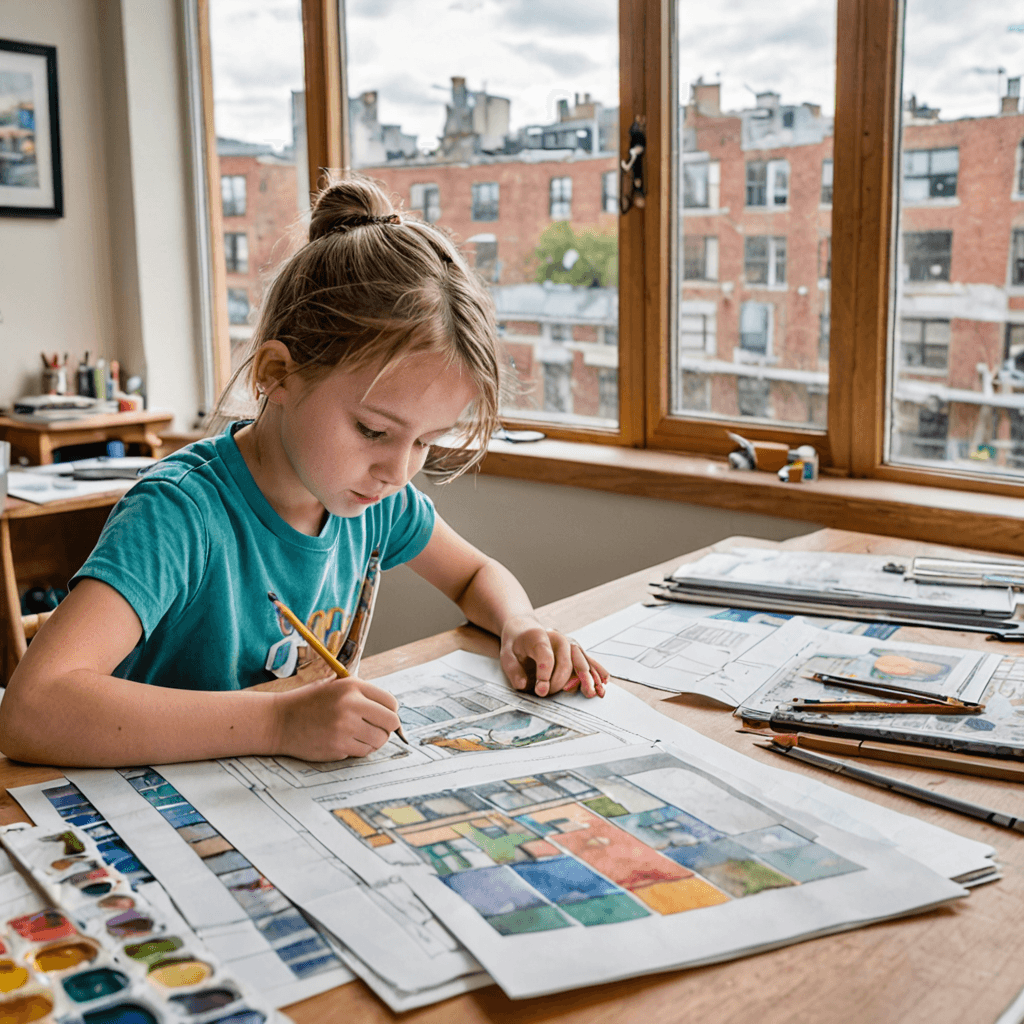
Perspective Drawing for Children in Etobicoke: Understanding Space and Depth
Table of Contents
Teaching children perspective drawing opens a new dimension in their artistic development—literally. The ability to represent three-dimensional space on a two-dimensional surface marks a significant leap in artistic sophistication, transforming flat drawings into images with depth, realism, and visual impact. At Muzart Music and Art School, located in Etobicoke near Cloverdale Mall, we introduce young artists to perspective drawing concepts in age-appropriate stages that build understanding gradually while maintaining creativity and confidence.
For families in Toronto, Etobicoke, and Mississauga seeking comprehensive art education for their children, understanding how perspective drawing fits into broader artistic development helps set realistic expectations and appreciate the cognitive growth these skills represent. Perspective drawing isn’t just an artistic technique—it’s a way of seeing and understanding the world that enhances spatial reasoning, observational skills, and visual problem-solving abilities that extend far beyond the art studio.
This comprehensive guide explores how children develop perspective understanding at different ages, the foundational concepts that make perspective accessible, effective teaching strategies that prevent frustration, and how perspective skills integrate with overall artistic development. Whether your child has just begun showing interest in realistic drawing or has been creating art for years, understanding perspective instruction helps support their journey toward more sophisticated artistic expression.
The Developmental Stages of Spatial Understanding in Young Artists
Children’s ability to understand and represent perspective develops in predictable stages aligned with cognitive development. Young children ages 4-6 typically create drawings without perspective, placing objects on a baseline or floating in space, using size to indicate importance rather than distance, and showing multiple viewpoints simultaneously in a single drawing. These characteristics reflect how young children process visual information—focusing on what they know about objects rather than how those objects appear from a specific viewpoint.
Around ages 7-9, children begin demonstrating emerging spatial awareness. Their drawings show objects placed higher on the page to indicate distance, size relationships that reflect distance (farther objects smaller), rudimentary understanding of overlap and occlusion, and attempts to show depth through intuitive methods. This stage represents a transitional period where children become aware that their drawings don’t match the three-dimensional reality they observe but may not yet understand the principles that would help them achieve greater realism.
Ages 10-12 mark the period when formal perspective instruction becomes most effective. At this stage, children possess the cognitive capacity to understand abstract concepts like vanishing points, the ability to follow multi-step drawing procedures, patience for the somewhat technical nature of perspective construction, and enough observational experience to recognize perspective in the environment around them. This doesn’t mean younger children cannot learn perspective concepts, but rather that instruction should be simplified and adapted to their developmental level.
Our group art classes in Etobicoke introduce perspective concepts at age-appropriate levels, ensuring children build understanding at a pace that matches their cognitive development while avoiding frustration or discouragement.
One-Point Perspective: The Foundation of Spatial Drawing
One-point perspective serves as the ideal introduction to perspective drawing for young artists because it demonstrates depth principles through a single vanishing point, applies to familiar subjects like roads, hallways, and railroad tracks, uses straightforward construction methods, and produces dramatic, satisfying results relatively quickly. This perspective system assumes the viewer faces the subject straight on, with one surface parallel to the picture plane and all receding lines converging to a single point on the horizon.
Teaching one-point perspective begins with establishing the horizon line—the eye-level line where sky meets ground. This line represents the viewer’s eye level and contains the vanishing point. Understanding that the horizon line changes based on the viewer’s position (lower when sitting, higher when standing on a hill) helps children grasp the relationship between viewpoint and perspective. The concept that “everything at my eye level appears on the horizon line” provides an accessible way to think about this element.
The vanishing point—the spot on the horizon where parallel lines appear to converge—represents the next key concept. Young artists learn that parallel lines going away from them (like railroad tracks or hallway walls) appear to meet at the vanishing point, creating the illusion of distance. Simple exercises like drawing a road disappearing into the distance or a tunnel viewed straight on allow children to practice this principle with satisfying results.
Three-dimensional forms in one-point perspective follow predictable construction patterns. A box viewed from the front shows its front face as a square or rectangle parallel to the picture plane, with edges extending back to the vanishing point. Teaching children to draw boxes, buildings, and rooms using these principles builds their understanding systematically. Our private art lessons provide individualized instruction that adapts perspective teaching to each student’s learning pace and prior experience.
Two-Point Perspective: Advancing Spatial Sophistication
Once students demonstrate comfort with one-point perspective, two-point perspective introduces additional complexity and realism. This system applies when viewing objects at an angle, uses two vanishing points on the horizon line, and creates more dynamic, natural-looking compositions. Two-point perspective better represents how we typically see buildings, furniture, and objects in our environment, making it essential for realistic drawing.
The key conceptual difference between one- and two-point perspective lies in how we view the object. In one-point perspective, one face of the object sits parallel to the picture plane. In two-point perspective, the object angles away from us, with no face parallel to the picture plane. This means vertical edges remain vertical, but all horizontal lines recede to one of two vanishing points positioned on the horizon line.
Teaching two-point perspective effectively requires careful sequencing. Students first learn to establish the horizon line and place two vanishing points, typically at the edges of their paper or beyond. The closest corner of the object (often a building or box) appears as a vertical line, with edges extending to both vanishing points. Students learn to alternate between vanishing points as they construct the form, creating the characteristic angled appearance of two-point perspective.
Common challenges in learning two-point perspective include placing vanishing points too close together (creating distorted, exaggerated perspective), forgetting which edges connect to which vanishing point, and struggling with the increased complexity of construction. Patient instruction that breaks the process into manageable steps, provides plenty of practice with simple forms before moving to complex subjects, includes visual reference materials showing two-point perspective in real environments, and celebrates successful construction, even if initial attempts appear somewhat awkward helps students master these challenges.
The investment in comprehensive art instruction—whether through group classes or private lessons—pays dividends in developing these sophisticated visual thinking skills. Families can explore our program offerings by visiting our art lessons page to find the format that best suits their child’s learning style.
Atmospheric and Intuitive Perspective: Beyond Mechanical Construction
While linear perspective (one-point and two-point systems) provides the mechanical framework for creating depth, atmospheric perspective and intuitive perspective techniques add richness and realism to drawings. Atmospheric perspective refers to the optical phenomena where distant objects appear lighter in value, lower in contrast, less detailed, and cooler in color temperature compared to nearby objects. This occurs because intervening atmosphere scatters light, reducing the clarity of distant views.
Teaching children atmospheric perspective often begins with simple observational exercises. Looking at landscapes or cityscapes, students notice that distant mountains appear blue-gray rather than their actual colors, far-away trees lack individual leaf detail visible on nearby trees, buildings in the distance show less contrast between light and shadow, and foreground details appear sharp while background elements blur. These observations translate into drawing practices that enhance the illusion of depth even in drawings without strict linear perspective.
Practical application of atmospheric perspective includes using lighter pressure or lighter values for distant objects, reducing detail as elements recede in space, decreasing contrast in the background, and suggesting atmosphere through subtle value gradation. Young artists often find atmospheric perspective more intuitive than linear perspective because it connects directly to visual observation rather than abstract geometric principles.
Intuitive perspective techniques developed before formal perspective systems were codified continue to serve young artists well. These include overlapping (placing one object in front of another clearly indicates spatial relationship), size variation (making distant objects smaller feels natural even to young children), vertical positioning (placing distant objects higher on the page suggests depth), and detail variation (adding more detail to foreground elements). Children naturally employ some of these techniques, and formal art instruction refines and strengthens these intuitive approaches.
Perspective in Different Subject Matter and Artistic Styles
Architectural subjects provide ideal vehicles for practicing perspective because buildings feature clear geometric forms, parallel lines that converge predictably, and right angles that make perspective construction straightforward. Students learning perspective often begin with simple buildings viewed from various angles, progressing to more complex structures as skills develop. Drawing interior spaces—rooms, hallways, or staircases—offers excellent one-point perspective practice while creating dramatic, satisfying compositions.
Landscape perspective presents different challenges and opportunities. Natural forms rarely feature the straight lines and geometric precision of architecture, requiring students to apply perspective principles more flexibly. Teaching landscape perspective emphasizes understanding ground plane recession (how the ground appears to rise toward the horizon), relative size of elements at different distances, atmospheric perspective for distant mountains or trees, and how linear elements like fences, roads, or rivers follow perspective rules within organic environments.
Still life drawing incorporates perspective on a smaller, more intimate scale. Students learn that perspective principles apply whether drawing a cityscape or a tabletop arrangement of objects. Ellipses (how we see circles in perspective) become particularly important in still life, as students draw cylindrical objects like bottles, cans, or bowls from various angles. Understanding how circular forms flatten into ellipses based on viewpoint represents an important perspective skill.
Figure drawing in perspective presents advanced challenges that older or more experienced students tackle with enthusiasm. Understanding how the human body occupies three-dimensional space, with parts closer to the viewer appearing larger (foreshortening), adds complexity to figure work. While beginning students focus primarily on proportion and gesture, intermediate artists benefit from understanding how perspective affects figure representation, particularly in dynamic poses.
Our comprehensive curriculum at our Etobicoke studio addresses perspective across all these subject areas, ensuring students develop versatile skills applicable to any drawing challenge they choose to pursue.
Teaching Strategies That Make Perspective Accessible and Engaging
Successful perspective instruction for young artists balances technical accuracy with creative freedom. Overly rigid, rule-bound teaching can make perspective feel like geometry class rather than art, potentially dampening enthusiasm. Effective approaches integrate perspective concepts within engaging projects, allow room for artistic interpretation and creativity, provide clear demonstrations and step-by-step guidance, and celebrate both technical accuracy and artistic expression.
Beginning with observation rather than construction helps children understand why perspective matters before tackling the mechanics of creating it. Taking students outside to observe how roads narrow in the distance, how building edges angle toward vanishing points, or how railroad tracks appear to converge helps ground abstract concepts in concrete visual experience. Photographic reference materials similarly help students see perspective principles operating in real environments.
Hands-on demonstration proves essential for teaching perspective construction. Students benefit from watching their instructor draw step-by-step while explaining each decision, seeing common mistakes demonstrated and corrected, having access to visual examples at various stages of completion, and receiving individual feedback on their own work. The personalized attention available in our private art lessons ensures students receive the detailed demonstration and feedback that makes perspective concepts clear and achievable.
Project-based learning makes perspective instruction more engaging than isolated exercises. Rather than simply drawing vanishing point diagrams, students create finished artworks that happen to employ perspective—imaginative cityscapes in one-point perspective, architectural fantasy drawings using two-point perspective, or narrative illustrations where perspective enhances the storytelling. This approach keeps the focus on creative expression while building technical skills.
Integrating Perspective Skills with Overall Artistic Development
Perspective drawing represents one component of comprehensive art education, not an isolated skill practiced in isolation. At Muzart Music and Art School, we integrate perspective instruction within a broader curriculum that includes color theory and color mixing, composition and design principles, drawing techniques and media exploration, observational drawing skills, and creative expression and personal style development. This holistic approach ensures students become well-rounded artists rather than technicians who can construct perfect perspective but lack creative vision.
The cognitive benefits of learning perspective extend beyond improved drawing ability. Perspective instruction develops spatial reasoning and visualization skills, understanding of mathematical concepts like proportions and geometry, problem-solving abilities and systematic thinking, and observational skills and visual analysis. These capabilities support success in STEM fields, architecture and design, and general academic achievement, making perspective instruction valuable even for students who may not pursue art professionally.
For students preparing portfolios for art school applications, perspective drawing often appears as a required or highly valued component. Admissions committees look for understanding of fundamental perspective principles, ability to apply perspective in various subjects and styles, integration of perspective with other drawing skills, and creative rather than merely mechanical use of perspective. Our portfolio preparation program includes comprehensive perspective instruction tailored to meet specific art school requirements and expectations, with trial lessons available for $70.
FAQ Section
At what age should children begin learning perspective drawing?
While some perspective concepts can be introduced to children as young as 7-8, formal perspective instruction typically proves most effective for students ages 10 and older who possess the cognitive development to understand abstract concepts like vanishing points and the patience for the somewhat technical construction process. However, this doesn’t mean younger children cannot benefit from perspective-related activities. Elementary-age students can learn intuitive perspective techniques like making distant objects smaller, placing farther objects higher on the page, and using overlap to show spatial relationships. These intuitive approaches build foundational understanding that supports later formal instruction. The key is matching instruction to developmental level—simplified, playful exploration for younger children progressing to more systematic technical instruction as cognitive abilities mature. Our experienced instructors assess each student’s readiness and adapt instruction accordingly, ensuring perspective concepts enhance rather than frustrate artistic development.
Does my child need to be good at math to learn perspective drawing?
While perspective drawing does involve some geometric and mathematical concepts, strong math skills aren’t prerequisites for success. The geometry involved in basic perspective (identifying horizon lines, vanishing points, and parallel lines) operates at an intuitive, visual level rather than requiring calculation or proof. Many students who struggle with abstract math in the classroom excel at perspective drawing because they can see and manipulate the concepts visually rather than working with pure numbers. That said, perspective instruction can actually strengthen mathematical understanding by making geometric concepts tangible and visible. Students often develop better intuition about parallel lines, angles, and proportional relationships through perspective drawing. The practical application helps mathematics feel relevant and accessible. At our Etobicoke studio, we present perspective concepts in visual, hands-on ways that work for various learning styles, including students who don’t consider themselves mathematically inclined. The artistic context makes geometric principles engaging rather than intimidating.
How long does it take for children to become comfortable with perspective drawing?
The timeline for developing perspective comfort varies considerably based on age, prior drawing experience, frequency of practice, and individual spatial reasoning abilities. Most students can grasp basic one-point perspective concepts within 3-5 weeks of regular instruction and practice, creating simple convincing drawings of roads, tunnels, or basic buildings. Achieving comfort with two-point perspective typically requires 2-3 months of consistent work, as the added complexity demands more practice to internalize. True fluency—where students apply perspective intuitively rather than consciously constructing each element—may take 6-12 months of regular practice and application. However, progress isn’t linear. Students often experience breakthrough moments where concepts suddenly click, followed by periods of consolidation and refinement. The key is consistent practice within engaging projects rather than repetitive drills. Students who apply perspective in varied, creative contexts learn faster and retain skills better than those who simply complete technical exercises. Our comprehensive art programs provide regular opportunities to practice and apply perspective skills in diverse, interesting projects that maintain enthusiasm while building competence.
Can children learn perspective drawing through online tutorials, or is in-person instruction necessary?
While online tutorials can introduce perspective concepts, in-person instruction offers significant advantages for most young learners. Perspective construction involves precise spatial relationships that can be difficult to grasp from video alone. In-person instruction provides immediate feedback on common errors like incorrect vanishing point placement or lines that don’t converge properly, demonstration from multiple angles and viewpoints, hands-on guidance adjusting the student’s work, and answers to specific questions as they arise. Young artists benefit particularly from watching an instructor demonstrate in real-time, seeing the decision-making process as it unfolds, having their specific misconceptions identified and corrected, and receiving encouragement during the inevitable frustration that accompanies learning challenging new skills. Our in-person instruction at our Etobicoke location allows for this responsive, personalized teaching that adapts to each student’s learning pace and style. Students throughout Toronto, Etobicoke, and Mississauga can book a trial lesson to experience how personalized instruction accelerates perspective learning and makes challenging concepts accessible and achievable.
Building Spatial Understanding Through Expert Perspective Instruction
Perspective drawing represents a significant milestone in artistic development, marking the transition from intuitive mark-making to sophisticated visual problem-solving. The ability to represent three-dimensional space convincingly on a two-dimensional surface opens vast creative possibilities while developing cognitive skills with applications far beyond the art studio. At Muzart Music and Art School, we approach perspective instruction as both technical skill-building and cognitive development, ensuring students gain abilities that serve their artistic goals while strengthening broader spatial reasoning capacities.
Our experienced instructors understand that effective perspective teaching requires adapting instruction to developmental stages, balancing technical accuracy with creative freedom, providing clear demonstrations and patient guidance, and celebrating progress while maintaining appropriately high standards. This approach builds confident, capable artists who use perspective as a tool for creative expression rather than viewing it as a restrictive set of rules.
Located conveniently in Etobicoke near Cloverdale Mall, our studio serves families throughout Toronto, Etobicoke, and Mississauga with comprehensive art instruction that includes perspective drawing as part of a well-rounded curriculum. Whether your child is just beginning to show interest in realistic drawing or seeking to advance their existing skills through more sophisticated techniques, now is the perfect time to explore what expert instruction can offer.
Our group art classes provide collaborative learning environments where students benefit from peer observation and shared exploration, while our private lessons offer individualized attention tailored to specific goals and learning needs. Both formats include comprehensive perspective instruction delivered at appropriate developmental levels with patience, expertise, and enthusiasm. Request more information about our programs to find the perfect fit for your young artist.
The spatial understanding and visual problem-solving skills developed through perspective drawing create foundations for lifelong artistic satisfaction and achievement. Whether your child dreams of becoming a professional artist, architect, or designer, or simply wants to draw more realistically and confidently, mastering perspective transforms their artistic capabilities. Visit our website to book your trial lesson and discover how expert perspective instruction combined with comprehensive art education helps young artists see, understand, and represent the three-dimensional world with confidence and creativity.