
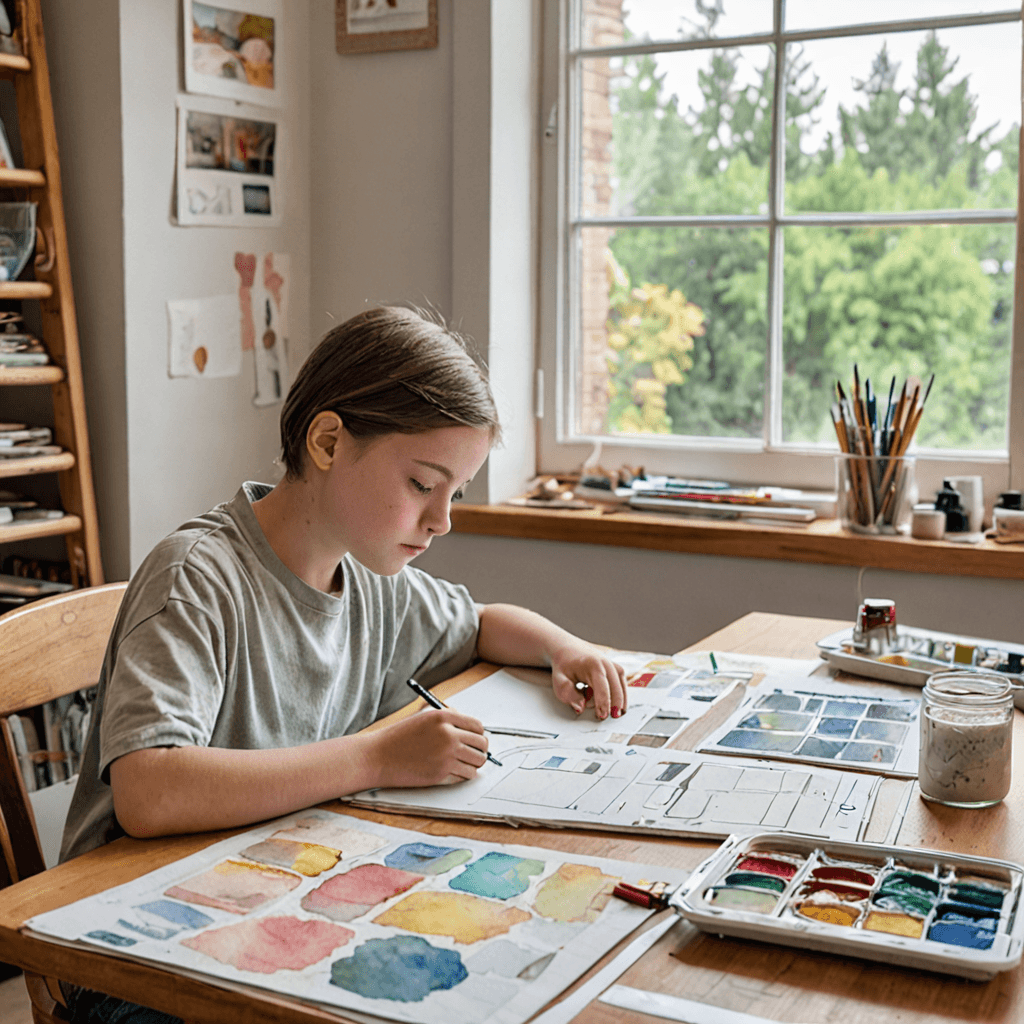
Composition and Design in Children’s Art: Toronto Studio Approach
Table of Contents
Composition and design principles represent the invisible architecture underlying visually successful artwork—the organizational structures that guide viewers’ eyes, create visual interest, establish balance and harmony, and communicate meaning effectively. At Muzart Music and Art School, located in Etobicoke near Cloverdale Mall, we introduce young artists to composition and design concepts through age-appropriate instruction that develops visual problem-solving abilities without constraining natural creativity. Understanding how elements work together to create compelling artwork transforms random mark-making into intentional, sophisticated visual communication.
For families in Toronto, Etobicoke, and Mississauga seeking comprehensive art education for their children, understanding how composition and design instruction enhances artistic development helps appreciate these somewhat abstract concepts’ practical value. Students who grasp compositional principles create more visually engaging artwork, develop stronger critical thinking about visual relationships, understand why some artworks feel balanced while others feel chaotic, and build analytical skills that transfer to media literacy and visual culture navigation. These capabilities extend far beyond art-making to support success in design fields, STEM disciplines requiring spatial reasoning, and general visual communication in our increasingly image-based culture.
This comprehensive guide explores fundamental design principles and how they apply to children’s art, age-appropriate approaches to teaching composition, practical strategies for developing compositional awareness, and how composition study integrates with technical skill development and creative expression. Whether your child creates instinctively without formal training or has been learning art systematically, understanding composition instruction supports their journey toward more sophisticated, intentional artistic expression.
Understanding Fundamental Design Principles for Young Artists
Balance represents one of the most foundational compositional concepts, referring to how visual weight distributes across an artwork. Symmetrical balance places equal weight on both sides of a central axis, creating formal, stable compositions that feel calm and orderly. Young children naturally create symmetrical compositions—drawing faces with eyes equidistant from center, creating mirror-image butterfly wings, or arranging flowers symmetrically in vases. This intuitive symmetry provides comfortable starting point for discussing balance consciously.
Asymmetrical balance creates equilibrium without mirror symmetry by balancing larger elements on one side with multiple smaller elements on the other, or by positioning elements at different distances from the composition’s center. Asymmetrical balance feels more dynamic and interesting than strict symmetry while still maintaining visual stability. Teaching children asymmetrical balance often begins with simple exercises like balancing one large shape with several small ones on a see-saw, then translating that physical balance understanding to visual composition.
Contrast creates visual interest through difference—light versus dark values, large versus small shapes, rough versus smooth textures, warm versus cool colors, or geometric versus organic forms. Without contrast, artworks become visually monotonous and fail to engage viewers. Even young children can understand contrast intuitively: “If everything is the same color, nothing stands out” makes immediate sense. Exercises emphasizing contrast include creating artworks using only black and white (value contrast), arranging very large and very small shapes together (size contrast), and combining angular geometric shapes with flowing organic forms (shape contrast).
Unity and variety work together to create cohesive yet interesting compositions. Unity comes from repeated elements, consistent color palettes, related shapes and patterns, and overall coherent feeling that holds the artwork together. Variety provides visual interest through changed elements, unexpected details, and diverse components that prevent monotony. Successful compositions balance these complementary principles—enough unity to feel coherent, enough variety to remain engaging. Our group art classes in Etobicoke teach these principles through hands-on exploration that makes abstract concepts tangible and applicable.
Creating Visual Hierarchy and Focal Points
Every successful composition needs a focal point—the area that first captures viewers’ attention and provides entry into the artwork. Without clear focal points, viewers’ eyes wander aimlessly across the image without finding visual anchors. Teaching children to create deliberate focal points transforms their artwork from collections of elements into organized visual statements. Techniques for establishing focal points include placing the most important element at the composition’s center or along visual “hot spots”, making the focal element largest, brightest, or most detailed, surrounding the focal point with empty space that draws attention, and using lines or shapes that point toward the focal area.
The rule of thirds provides a simple guideline for positioning focal points effectively. Dividing the composition into thirds both horizontally and vertically creates a grid with four intersection points where focal elements placed create more dynamic, interesting compositions than strict centering. While this “rule” can be broken intentionally, it offers useful starting point for students learning to position elements thoughtfully. Simple exercises have students photograph or draw the same subject with focal points at different grid intersections, then compare which placements feel most effective.
Visual hierarchy extends beyond single focal points to create paths guiding viewers through the entire composition. Primary elements capture initial attention, secondary elements provide supporting interest, and tertiary elements offer detail without competing for primary attention. Teaching visual hierarchy helps students organize complex compositions with multiple elements. A student creating a park scene might make a child on a swing the primary focal point, nearby playing children secondary elements, and background trees and sky tertiary elements. This hierarchical thinking prevents compositional chaos where every element demands equal attention.
Negative space—the empty areas surrounding and between positive elements—plays crucial roles in composition by providing visual rest that prevents overcrowding, creating shapes as interesting as the positive elements, allowing focal points to stand out clearly, and contributing to overall balance and harmony. Many beginning artists fear empty space, feeling compelled to fill every inch of their paper. Teaching students to value and use negative space deliberately elevates their compositional sophistication significantly. Exercises focusing specifically on negative space—drawing the spaces between objects rather than the objects themselves—develop awareness of composition’s spatial relationships.
Age-Appropriate Composition Instruction for Different Development Stages
Children ages 5-8 naturally organize their artwork according to developmental schemas—baseline compositions where elements sit along the bottom edge, symbolic representations where houses, people, and trees appear in standardized forms, and size relationships based on importance rather than visual perspective. While these approaches don’t match adult concepts of sophisticated composition, they represent appropriate developmental stages that shouldn’t be rushed. Effective composition instruction at this age focuses on observing and discussing composition in storybooks, other artworks, and the environment, exploring basic concepts like big/small, light/dark, and crowded/spacious through hands-on activities, and encouraging experimentation with different arrangements before finalizing compositions.
Students ages 9-12 can engage more consciously with compositional principles while still working primarily through experimentation rather than theoretical study. Instruction emphasizes thumbnail sketches trying multiple compositions before starting final artwork, analyzing what makes favorite artworks or photographs compositionally effective, applying specific compositional concepts to projects (this week we focus on contrast, next week on balance), and developing habit of stepping back to evaluate work-in-progress from viewing distance. This age group benefits from seeing composition as problem-solving—how to arrange elements for maximum visual impact—rather than as rules constraining creativity.
Teenagers possess cognitive capacity for sophisticated compositional analysis and intentional application of design principles. Instruction can include studying master artworks’ compositional structures in detail, applying mathematical proportions like golden ratio or Fibonacci sequences, experimenting with unconventional compositions that break traditional rules intentionally, and developing personal compositional preferences and style. However, even advanced students need balance between analytical understanding and intuitive creation. Over-intellectualizing composition can inhibit the spontaneous, expressive qualities that give artwork vitality. Our private art lessons tailor compositional instruction to each student’s developmental level and learning style, ensuring concepts enhance rather than constrain their creative development.
Practical Strategies for Developing Compositional Awareness
Viewfinder exercises help students isolate and analyze compositional relationships by creating simple cardboard viewfinders (rectangular frames), using them to “crop” different portions of scenes or artworks, comparing how different crops create different compositional effects, and selecting most effective compositions before beginning to draw or paint. This hands-on tool makes the abstract concept of composition concrete and manipulable, particularly valuable for visual learners who struggle with purely verbal instruction.
Thumbnail sketches—small, quick compositional studies—encourage experimentation without the commitment of finished artwork. Students create multiple 2″x3″ sketches exploring different compositional options, evaluating which arrangements feel most effective, and using the strongest thumbnail as blueprint for final artwork. This practice separates compositional problem-solving from technical execution, allowing students to focus specifically on arrangement without simultaneously worrying about rendering quality. Many professional artists use thumbnail sketching extensively, making it an authentic professional practice rather than merely a teaching exercise.
Compositional analysis of existing artworks develops students’ ability to see and understand organizational structures. Activities include tracing compositional lines and shapes over artwork reproductions, identifying focal points and visual pathways through compositions, comparing successful versus weak compositions to understand differences, and discussing how compositional choices support the artwork’s meaning or emotional impact. This analytical work trains eyes and minds to recognize compositional elements automatically, knowledge that informs students’ own composition creation even when they’re not consciously applying learned principles.
Deliberate limitation exercises force compositional problem-solving by restricting available options. Students might create compositions using only three shapes, design with restricted color palettes of two or three colors, work within unusual formats like very narrow vertical or extremely wide horizontal compositions, or arrange compositions where elements cannot touch the edges. These constraints require thoughtful arrangement rather than intuitive placement, developing compositional awareness through focused challenges. Our instructors design these exercises to build specific compositional skills while maintaining creative engagement that makes learning feel like play rather than work.
Integrating Composition with Color Theory and Technical Skill
Color relationships fundamentally affect compositional success. Complementary colors (opposites on the color wheel) create strong contrast that draws attention, analogous colors (neighbors on the color wheel) provide harmonious unity, warm colors appear to advance while cool colors recede, and high-contrast value relationships create stronger focal points than subtle value differences. Teaching students to consider color compositionally rather than just decoratively elevates their work significantly. A student might learn to place a warm, bright focal element against cool, dark surroundings, using color relationships to reinforce compositional hierarchy.
Color temperature affects spatial composition by warm colors advancing visually toward viewers and cool colors receding into depth. This principle allows students to create depth through color choices alone, even in otherwise flat compositions. Understanding this relationship helps students make intentional color decisions supporting their compositional goals rather than selecting colors randomly based purely on preference. A landscape student might learn to use warm yellows and oranges for foreground elements, shifting to cooler blues and greens for background areas, creating depth through color temperature progression.
Value (lightness and darkness) often matters more compositionally than hue (actual color). Strong value contrast creates clear focal points and visual interest regardless of color choices, while subtle value variations throughout creates unity and cohesion. Many successful paintings “work” in black-and-white because their value composition remains strong even without color. Teaching students to evaluate their composition’s value structure—sometimes by photographing artwork in black-and-white or squinting to blur color and see only values—develops sophisticated understanding of tonal composition. Our comprehensive art program integrates color theory with compositional instruction, ensuring students understand how these elements work together. All art materials are included in our program tuition, allowing students to explore compositional and color concepts without additional supply costs.
Line, Shape, and Texture in Compositional Design
Linear composition uses actual and implied lines to direct viewers’ eyes through artworks. Actual lines like horizon lines, edges, or drawn marks guide attention explicitly, while implied lines created by aligned elements, directional gazes, or pointing gestures guide more subtly. Understanding how lines function compositionally helps students create visual pathways that lead viewers through their artwork in intended sequences. A student composing a portrait might use the subject’s gaze direction to imply a line leading to a secondary element, creating narrative connection between composition elements.
Diagonal lines create dynamic energy and movement compared to horizontal and vertical lines’ stability. Teaching students to incorporate diagonal elements strategically adds visual excitement to compositions. Many successful action scenes, sports paintings, or dramatic narratives emphasize diagonal composition, using angled elements to convey motion, tension, or instability. Students can experiment with tilting their drawing surface to change verticals into diagonals, immediately energizing static compositions.
Shape relationships and repetition create rhythm and unity in composition. Repeated circular shapes throughout a composition create visual rhythm connecting disparate elements, varied sizes of similar shapes provide unity with variety, and contrasting geometric and organic shapes create visual interest. Teaching students to think in terms of abstract shapes underlying their subjects rather than only the subjects themselves develops stronger compositional sense. A student drawing a figure might notice the negative spaces around the body create interesting triangular shapes worth considering compositionally.
Texture affects composition by attracting visual attention (rough textures draw more notice than smooth ones), creating areas of rest versus activity, adding detail that can serve as focal points or supporting elements, and contributing to overall visual interest and variety. While beginning students often think of texture as decorative surface quality, advanced students understand texture’s compositional functions. A mixed-media composition might use rough, heavily textured areas as focal points against smoother, quieter surroundings, or reverse this relationship for different effects.
Compositional Concepts in Different Art Forms and Media
Drawing composition emphasizes line quality and mark-making, value relationships and tonal structure, positive and negative space relationships, and focal point creation through detail and emphasis. Pencil, charcoal, ink, and other drawing media each offer unique compositional possibilities—fine pen lines create different compositional effects than broad charcoal strokes. Students learn to match media choices to compositional intentions, selecting tools that support their desired visual outcomes.
Painting composition includes all drawing compositional elements plus color relationships and temperature, brushstroke direction and texture, transparency versus opacity effects, and edge quality (hard versus soft transitions). The additional variables painting introduces create both opportunities and challenges. Students develop systematic approaches to color composition, often starting with value studies before adding color, ensuring strong underlying tonal composition supports color choices. Our art lessons in Etobicoke provide comprehensive instruction across multiple media, ensuring students understand how composition adapts to different materials and techniques.
Collage and mixed media composition requires considering layering and depth relationships, material contrasts and combinations, transparency and overlapping effects, and three-dimensional elements’ compositional impact. The physical construction process allows students to try multiple arrangements before final gluing, making collage excellent medium for developing compositional awareness through hands-on manipulation. Students can experiment freely, rearranging elements until achieving satisfying composition.
Digital art composition includes traditional principles plus layer organization and compositing, selection and cropping tools for compositional refinement, resolution and format considerations, and text integration when applicable. Digital tools allow easy experimentation—duplicating compositions and trying variations, testing different color schemes on the same composition, or flipping and rotating elements to evaluate alternative arrangements. This flexibility makes digital media particularly valuable for developing compositional awareness through extensive experimentation.
FAQ Section
At what age should formal composition instruction begin?
While explicit “composition lessons” suit students around ages 9-10, compositional thinking can be nurtured much earlier through age-appropriate approaches. Preschool and early elementary children benefit from discussing what they notice in artworks (“Where does your eye go first?” “What’s the biggest thing?”), experimenting with different arrangements of cut shapes before gluing, and viewing artbooks together with simple compositional observations. These informal exposures plant seeds for later formal understanding. Around ages 9-12, students can engage with composition more systematically through thumbnail sketching, analyzing master artworks’ compositional structures, and applying specific principles to projects. However, even at this age, instruction works best through hands-on exploration rather than lecture. Teenagers can handle sophisticated compositional analysis and intentional application of complex principles. The key is matching instructional approach to developmental readiness—early informal exploration, systematic experimentation in middle years, and analytical sophistication for advanced students. Our instructors assess individual students’ readiness and introduce compositional concepts when they’ll enhance rather than confuse or constrain creative development.
Will teaching composition make my child’s art less spontaneous and creative?
This understandable concern rests on a false dichotomy between technical knowledge and creative expression. In practice, compositional understanding expands rather than limits creative possibilities by providing tools for achieving intended effects, preventing frustration when instinct alone doesn’t produce satisfying results, offering frameworks for organizing complex ideas, and allowing more sophisticated visual communication. Professional artists don’t choose between knowledge and creativity—they use technical understanding in service of creative vision. A student who understands focal points can deliberately decide where to draw viewers’ attention, achieving intended emphasis that random placement might not accomplish. Understanding composition allows choosing to break rules intentionally for specific effects rather than breaking them through ignorance. The most creatively successful students combine technical knowledge with personal vision, using each to enhance the other. Our instruction emphasizes composition as a tool serving expression, not as rules constraining it. We teach principles through experimentation and exploration, maintaining the playful creativity that makes art-making joyful while building sophistication that allows students to realize their creative visions more fully.
How can we reinforce compositional learning at home?
Numerous simple activities support compositional development outside formal lessons. Looking at artwork together (in museums, books, or online) and discussing what you notice compositionally builds awareness. Simple questions like “Where does your eye go first?” or “How did the artist create balance?” encourage analytical looking without requiring art expertise from parents. Photographing family outings provides excellent compositional practice—helping children frame shots thoughtfully, trying multiple compositions of the same subject, and reviewing photos together to identify most successful compositions develops visual awareness. Simple crafts like collage, where elements can be rearranged before gluing, allow compositional experimentation. Even observing composition in everyday life—how store displays are arranged, how advertising uses focal points, how rooms are organized—reinforces compositional thinking. Digital tools make experimentation easy—taking a photo and trying different crops, or using basic editing software to test compositional variations. These activities require minimal materials or expertise while building valuable visual literacy. Our instructors can suggest specific home activities that reinforce current classroom focus, ensuring home and studio learning work together synergistically.
Do composition principles work the same across all art styles?
While fundamental compositional principles (balance, contrast, focal points, etc.) operate across all artistic styles, their application varies considerably. Realistic artwork often employs traditional compositional guidelines quite directly—placing focal points at thirds intersections, using atmospheric perspective for depth, creating clear value structures. Abstract art applies the same principles to non-representational elements—balancing shapes, colors, and values; creating focal points through contrast; establishing visual pathways through the composition. Even when abstract artists deliberately break traditional compositional rules, they do so with awareness and intention, understanding the effects their choices create. Different cultural traditions emphasize different compositional values—Western art often uses central perspective and focal point hierarchy, while Asian art traditions might employ multiple perspectives and more evenly distributed visual interest. Exposure to diverse compositional approaches from various cultures and periods enriches students’ understanding and expands their compositional vocabulary. Our curriculum includes diverse artistic traditions, ensuring students understand composition as a set of flexible principles rather than rigid rules, adaptable to any artistic vision or style they choose to pursue.
Building Sophisticated Visual Communication Through Compositional Understanding
Composition represents the difference between artwork that successfully communicates intended messages, emotions, or aesthetics and artwork that fails to engage viewers despite technical proficiency. Students who understand compositional principles create visually organized, emotionally effective, conceptually clear, and aesthetically satisfying artwork that demonstrates sophistication beyond mere technical skill. These capabilities serve not only artistic pursuits but broader visual literacy in our increasingly image-driven culture.
At Muzart Music and Art School, we integrate compositional instruction throughout our curriculum rather than treating it as separate, abstract theory. Students learn composition through hands-on exploration, practical application to projects, analysis of successful artworks, and guided experimentation. Our experienced instructors understand that effective composition teaching requires balancing systematic instruction with creative freedom, adapting concepts to developmental readiness, connecting abstract principles to concrete applications, and maintaining enthusiasm through engaging, relevant projects.
Located conveniently in Etobicoke near Cloverdale Mall and serving families throughout Toronto, Etobicoke, and Mississauga, our comprehensive art program develops young artists who understand not just how to make marks but how to organize those marks for maximum visual and emotional impact. Whether your child creates instinctively or approaches art analytically, compositional understanding enhances their capabilities and satisfaction.
Our art instruction includes systematic composition development across all age groups, integration of compositional concepts with technical skill building, exposure to diverse compositional approaches and cultural traditions, and project-based learning that makes abstract principles tangible and applicable. This comprehensive approach builds visually literate young artists prepared for art school study, professional creative careers, or simply more satisfying personal artistic expression.
The visual problem-solving skills developed through composition study transfer to countless applications beyond fine art—graphic design, photography, architecture, interior design, user interface design, and general visual communication all rely on compositional understanding. Students who grasp these principles gain advantages in increasingly visual professional environments where clear visual communication often determines success or failure.
Trial lessons provide opportunity to experience our teaching approach firsthand. Request more information about our group classes and private lessons to find the format that best suits your child’s learning style and goals, or book now to begin your child’s journey toward sophisticated, intentional visual expression. Discover how compositional understanding combined with technical skill and creative freedom develops young artists capable of creating truly compelling, effective, satisfying artwork that successfully communicates their unique visions to the world.