
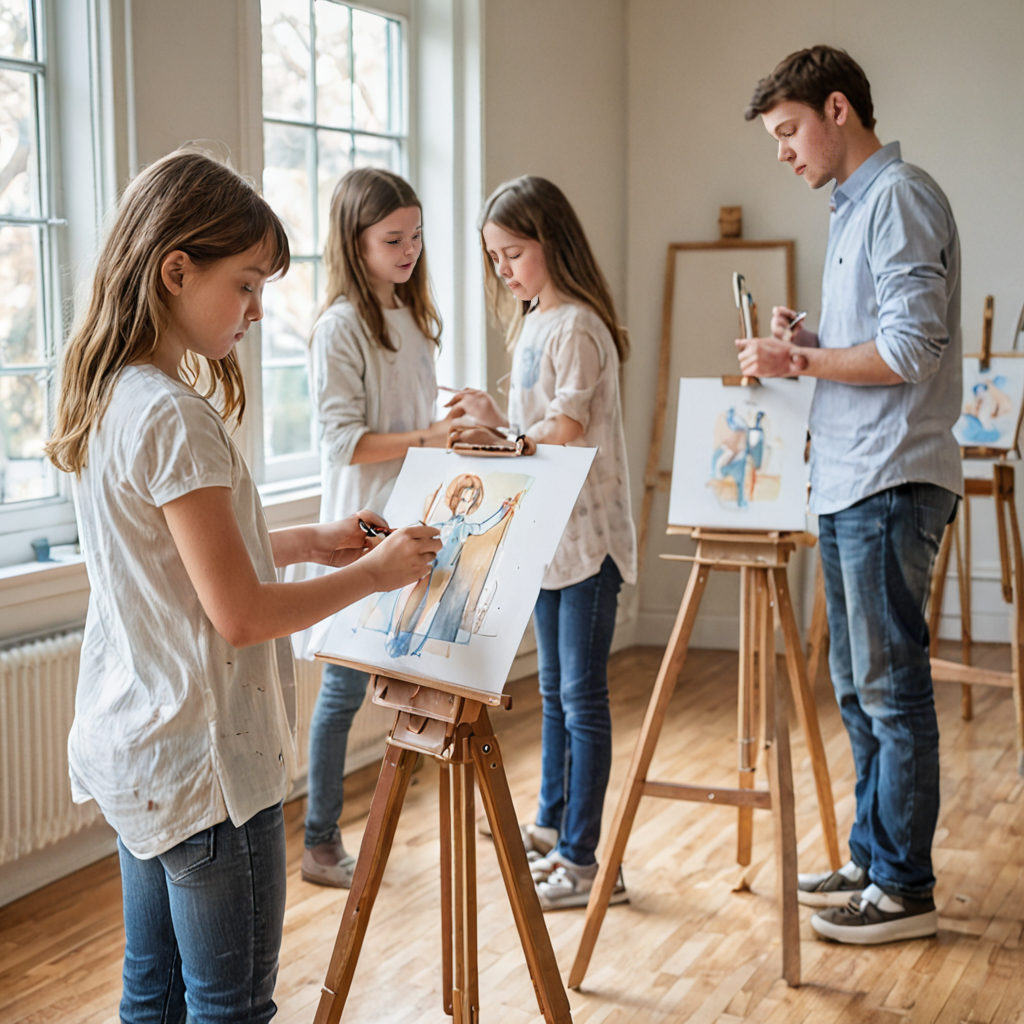
Figure Drawing for Young Artists in Etobicoke: Understanding Proportions
Table of Contents
Figure drawing represents one of the most rewarding yet challenging areas of artistic study for young artists. At Muzart Music & Art School, located in Etobicoke near Cloverdale Mall, we introduce students to figure drawing through age-appropriate methods that build understanding of human proportions, develop observational skills, and create confidence in depicting one of art’s most enduring subjects: the human form.
Understanding how to draw figures opens countless creative possibilities. From comic book characters to portrait commissions, from fashion design to fine art, the ability to render the human figure with reasonable accuracy and appealing proportion proves invaluable across nearly every artistic pursuit. Young artists who develop solid foundational knowledge of figure structure and proportion gain skills that serve them throughout their creative lives.
Whether your child participates in our group art classes or receives personalized instruction through private art lessons, we approach figure drawing as an accessible, developmentally appropriate skill that builds progressively from simple concepts to more sophisticated understanding. Our age-conscious teaching methods ensure young artists gain confidence and competence without frustration or discouragement.
Age-Appropriate Approaches to Figure Drawing
Figure drawing instruction must adapt to children’s developmental stages, ensuring concepts match cognitive capabilities and fine motor skill levels.
Early Elementary (Ages 5-8)
Young children naturally create symbolic figures—stick figures or simple shapes representing people. Rather than discouraging these developmentally appropriate representations, we build on them. Students learn that circles can become heads, rectangles can represent bodies, and lines can show arms and legs. We introduce basic concepts like “the body is longer than the head” or “arms reach down to about where legs begin.”
Simple observation exercises help young artists notice more details. They observe and discuss how people actually look—elbows bend in the middle of arms, knees bend in the middle of legs, hands have fingers. These observations gradually enrich their symbolic figures without demanding realistic rendering beyond their developmental capacity.
Action and movement interest young children more than static proportional accuracy. We encourage drawings of people doing things—jumping, dancing, playing sports. This narrative approach maintains engagement while naturally introducing concepts like gesture and movement.
Upper Elementary (Ages 9-12)
Older elementary students develop capacity for more systematic proportion understanding. We introduce simplified proportion systems—perhaps that an adult figure measures about seven to eight heads tall, or that the halfway point of a standing figure falls approximately at the hips. These concrete guidelines provide structure without overwhelming students with complexity.
Simplified geometric construction helps students organize figures logically. They learn to block in figures using basic shapes—ovals for heads, rectangles for torsos, cylinders for limbs. This approach demystifies figure drawing, transforming it from an overwhelming task into a manageable step-by-step process.
Comparative measurements develop observational accuracy. Students learn to use their pencil as a measuring tool, comparing the relationship between different body parts. Is the upper arm longer or shorter than the forearm? How wide are shoulders compared to hip width? This analytical approach builds skills applicable far beyond figure drawing.
Middle School and Teens (Ages 13+)
Advanced students can handle more sophisticated proportion systems and anatomical understanding. Classical proportion canons, skeletal structure basics, and muscle group awareness all enrich their figure drawing capabilities. However, we continue emphasizing observation over memorization—developing the ability to see and record what’s actually before them rather than drawing from preconceived notions.
Gesture drawing introduces capturing movement and energy in quick sketches. These timed exercises develop the ability to perceive and record the essential character of a pose, building skills that inform all figure work even when creating more finished, detailed drawings.
Individual style development becomes possible once students have solid foundational understanding. They can make conscious choices about stylization—perhaps elongating figures for elegance, or emphasizing certain features for expressive effect—but these choices come from understanding rather than inability.
At our Etobicoke art lessons, instructors tailor figure drawing instruction to each student’s age and developmental stage, ensuring appropriate challenge and support at every level.
Understanding Basic Human Proportions
While individual variations abound, understanding general proportional relationships provides young artists with helpful frameworks for figure drawing.
The head serves as a basic unit of measurement in many proportion systems. Classical canons suggest adult figures measure seven and a half to eight heads tall, though this varies by body type and artistic tradition. Teaching children this system provides a concrete, memorable framework for thinking about figure proportions.
Major divisions help organize figures logically. The halfway point of a standing adult figure falls approximately at the pubic bone or top of the thighs—not at the waist as many beginners assume. The elbows align roughly with the bottom of the ribcage. Wrists fall approximately at hip level when arms hang naturally. These landmarks help students place body parts in reasonable relationships to each other.
Width relationships matter as much as height. Shoulder width in adult males typically measures about two to two and a half heads wide, while females generally measure slightly narrower. Hip width varies significantly but provides another useful comparison point for building figures with believable proportions.
Children’s proportions differ significantly from adults. Young children have relatively larger heads compared to their bodies—toddlers might measure only four to five heads tall, with the halfway point of their height falling at the navel rather than the hips. As children grow, their proportions gradually shift toward adult ratios. Understanding these developmental differences helps young artists draw children convincingly.
Individual variation means proportion “rules” serve as guidelines rather than absolute requirements. Real people come in infinite variety—tall and short, slender and stocky, with countless unique characteristics. We teach students to use proportion systems as starting frameworks that can and should be adjusted based on observation of actual subjects.
Our comprehensive art instruction, included in programs with all materials provided, systematically introduces these concepts at appropriate developmental stages, building sophisticated understanding over time.
Simplified Construction Methods for Young Artists
Breaking down figure drawing into manageable steps makes this challenging subject accessible for young artists at various skill levels.
Basic Shape Construction
The mannequin approach uses simple geometric shapes to block in figures before adding details. Students learn to see the head as an oval or egg shape, the torso as a simplified rectangular or trapezoidal form, and limbs as cylinders or elongated rectangles. This geometric foundation provides structure that guides subsequent refinement.
Connecting shapes with lines that indicate joints—shoulders, elbows, wrists, hips, knees, ankles—creates an articulated framework. This stick-figure-like skeleton within the geometric shapes helps students understand how figures bend and move while maintaining reasonable proportions.
Symmetry guidelines, like the centerline running from head through torso, help students balance features and body parts. Even when figures turn or twist, this centerline concept helps young artists maintain structural coherence.
The Gesture Foundation
Quick gesture sketches capture the essential movement and energy of a pose without concern for detail or finish. Young artists practice capturing the overall thrust of a figure—the curve of a spine, the angle of shoulders, the weight distribution between feet—in just a few flowing lines.
These rapid exercises, often done in one to three minutes, develop the ability to perceive and record the “big picture” before getting lost in details. Over time, gesture understanding informs all figure work, helping students create dynamic, believable figures even when working toward finished, detailed drawings.
Gesture line exercises where students try to capture an entire figure in a single, flowing line develop hand-eye coordination and help young artists see figures as unified forms rather than collections of separate parts.
Proportion Templates and Reference
Simplified proportion templates provide young artists with reliable frameworks while they develop observational skills. A basic template showing a seven-and-a-half-head-tall figure with major landmarks marked gives students a reference point they can modify based on actual observation.
Reference images and poseable figure mannequins help students understand three-dimensional form and how proportions appear from different viewpoints. Wooden artist mannequins, though simplified, demonstrate how joints work and how the body’s structure creates different silhouettes when viewed from various angles.
Tracing exercises for beginners help students internalize proportional relationships through repetition. While tracing alone doesn’t develop drawing skill, strategic tracing of well-proportioned figures can help young artists develop feel for correct relationships before they can construct figures independently.
These methods, taught progressively in our Etobicoke studio, transform figure drawing from an intimidating challenge into an approachable, enjoyable aspect of artistic development.
Observational Skills for Figure Drawing
Accurate figure drawing depends more on learning to truly see than on memorizing proportion rules. Developing observational capabilities serves young artists across all subject matter.
Comparative seeing asks students to notice relationships: Is this part longer than that part? Is this angle sharper or gentler than that one? How much space exists between these elements? This analytical observation bypasses preconceptions about how things “should” look, helping students record what actually appears before them.
Negative space observation—noticing the shapes created by spaces around and between forms rather than the forms themselves—reveals proportional relationships that might be overlooked when focusing only on positive forms. The triangular space between a bent arm and torso, for instance, provides as much information about proportion as the arm itself.
Sighting techniques teach students to use simple tools like pencils held at arm’s length to compare angles and relative measurements. These concrete methods give young artists strategies for analyzing complex visual information systematically.
Breaking complex forms into simpler components makes observation manageable. Rather than trying to draw “a whole person” at once, students learn to observe and record one section at a time—perhaps starting with the head, then the neck and shoulders, working methodically down the figure. This sequential approach prevents overwhelm while building accurate overall proportions.
Regular practice with varied poses and viewpoints develops flexible observational skills. Drawing seated figures, action poses, foreshortened views, and figures from different angles all challenge students to truly observe rather than rely on formulaic approaches.
Light and shadow observation adds dimensional understanding to proportional drawing. Noticing where forms catch light and where shadows fall helps students understand the three-dimensional reality underneath the two-dimensional image they’re creating.
The systematic skill development in our art programs ensures observational capabilities grow alongside technical drawing skills, creating well-rounded young artists prepared for diverse creative challenges.
Common Proportion Challenges and Solutions
Certain proportional mistakes appear frequently in young artists’ work. Understanding these common challenges helps students overcome them more quickly.
Head Too Large
Beginning figure drawers commonly make heads disproportionately large compared to bodies. This tendency may stem from the psychological importance we place on faces and heads. The solution involves teaching students to actively compare head size to total figure height, using the head-height measurement system to build appropriately proportioned figures.
Practicing figure construction that begins with mapping total height before placing the head helps students avoid this trap. When they establish how tall the figure will be overall, then divide that height into appropriate units, heads naturally end up correctly proportioned to bodies.
Limbs Too Short or Too Long
Arms that don’t reach far enough down the body, or legs that seem too short for the torso, plague many student drawings. These errors typically result from not observing actual proportional relationships. Teaching specific landmarks—like wrists aligning with hip level, or knees falling at approximately three-and-a-half heads down from the top of the figure—provides concrete checkpoints students can verify.
Having students compare their drawing to reference images or live observation helps them catch these errors. “Where do the wrists fall on the actual figure? Where do they fall in your drawing?” This comparison-based error checking builds self-correction skills.
Features Too Close Together or Too Spread Out
Facial features frequently appear too close together or too widely spaced in student work. The common guideline that eyes fall halfway down the head (not higher up as many intuitively place them) surprises most beginners. Nose and mouth placement, distance between eyes, and ear positions all benefit from specific proportion guidelines combined with observational verification.
Teaching students to lightly map facial feature placement before drawing features in detail helps prevent these errors. Simple guidelines showing center vertical line, horizontal eye line, and other placement guides provide structure for accurate feature positioning.
Stiff or Unnatural Poses
Figures that look rigid or mechanical often result from over-reliance on proportion systems without attention to gesture and natural movement. The solution involves balancing geometric construction methods with gesture-based approaches that capture the flowing, organic quality of real bodies.
Having students start with gesture sketches before constructing detailed figures helps maintain natural flow. Even when building figures systematically, maintaining awareness of the initial gesture keeps results looking alive rather than stiff.
Our instructors work with students individually to identify their specific challenges and provide targeted guidance that overcomes obstacles efficiently.
Progressive Figure Drawing Projects
Well-designed projects introduce figure drawing concepts systematically, building skills through engaging assignments appropriate for different developmental stages.
Beginning Level Projects
Simplified character design projects let young artists create people with exaggerated features or stylized proportions while still applying basic understanding of where body parts attach and how they relate proportionally. Creating cartoon characters or simplified people provides low-pressure practice with figure concepts.
Action figure drawings where students sketch their favorite toys from observation combine figure study with subjects that interest them. Simplified toy anatomy makes observation more manageable while still teaching proportion and construction principles.
Family portraits using simplified figure construction allow students to practice creating different ages and body types—tall parents, shorter children, etc. This practical application motivates careful observation while producing meaningful artwork.
Intermediate Level Projects
Fashion figure design introduces stylized proportions intentionally—fashion figures typically measure nine or more heads tall. Students learn that understanding standard proportions enables effective stylization through conscious choice rather than error.
Comic or graphic novel page composition requires drawing multiple figures in various poses and scales. This complex challenge applies figure drawing skills in narrative context, showing students how foundational proportion knowledge serves practical creative goals.
Figure painting projects where students work in color require understanding not just proportion but also how light affects form. Adding color and value to proportionally sound figure drawings develops more sophisticated representational capabilities.
Advanced Level Projects
Portfolio-quality figure studies for students in portfolio preparation programs demonstrate mastery of proportion, anatomy, and rendering. These polished pieces showcase skills developed through years of progressive study.
Life drawing sessions where students work from live models or high-quality photographic reference develop observational accuracy and rendering sophistication. Regular practice with diverse poses and viewpoints builds versatile figure drawing capabilities.
Narrative artwork combining figures with environments applies figure drawing skills in complete compositional contexts. Creating scenes where properly proportioned figures interact with each other and their surroundings demonstrates comprehensive artistic capability.
These progressive projects, offered through both group and private art instruction at our Etobicoke studio, ensure students build figure drawing skills systematically while maintaining engagement and enjoyment.
Frequently Asked Questions About Figure Drawing for Young Artists
At what age should children start learning formal figure drawing proportions?
The answer depends less on specific age than on developmental readiness and interest level. Most children ages 5-8 work best with simple observational exercises and symbolic figure representations appropriate to their development—noting basic relationships like “heads are smaller than bodies” or “arms reach down to about here on the legs.” Formal proportion systems typically become appropriate around ages 9-12 when children develop capacity for more abstract comparative thinking. At this stage, simplified proportion frameworks like the head-height measurement system make sense and provide helpful structure. However, individual readiness varies significantly; some children show interest and capability earlier while others benefit from waiting until middle school years. The key is following the child’s interest and frustration level. If proportion study creates excessive frustration or kills enthusiasm, it’s too early—better to focus on observational drawing and creative expression. If the child is asking questions about why their figures don’t look quite right and seems ready for systematic frameworks, they’re probably ready for age-appropriate proportion instruction. At Muzart Music & Art School in Etobicoke, instructors assess each student individually, introducing concepts when they’ll be most beneficial rather than following rigid age-based curricula.
How can I help my child practice figure drawing at home?
Several accessible approaches support figure drawing development outside formal lessons. First, encourage regular observational sketching from life—family members reading, playing, or doing household activities make excellent subjects. Quick gesture sketches capture movement and overall impression rather than perfect detail, making practice feel achievable rather than overwhelming. Second, provide quality reference materials like children’s anatomy books designed for artists, or access to online resources with various figure poses. Photography books showing people in action offer diverse reference without requiring live models. Third, use simple geometric shapes to practice construction—having your child draw stick figures, then flesh them out with circles for heads and simple shapes for bodies builds understanding of underlying structure. Fourth, make observation games part of daily life: “Notice how Dad’s elbow is about halfway down his arm” or “See how the baby’s head is bigger compared to her body than yours is?” These casual observations build the noticing skills essential for accurate drawing. Fifth, celebrate progress and effort rather than perfection. Figure drawing is genuinely challenging; acknowledging that difficulty while praising attempts encourages persistence. Remember that home practice complements but doesn’t replace professional instruction, where students receive expert guidance on common challenges and systematic skill progression.
Should my child use references or learn to draw figures from imagination?
Both approaches serve important purposes, and the most effective figure drawing education incorporates both systematically. Working from references—whether photographs, art books, or life observation—teaches students how human bodies actually look and how proportions actually work. This observational foundation prevents the reinforcement of errors that comes from repeatedly drawing poorly proportioned figures from imagination alone. Students need reference-based practice to internalize accurate proportional relationships and understand three-dimensional form. However, the goal of reference work is ultimately to build internal understanding that enables drawing from imagination. As students observe and draw many referenced figures, they gradually internalize proportional relationships, common poses, and how bodies work in three-dimensional space. This internalized knowledge allows increasingly confident imagination-based drawing. The progression typically moves from copying reference closely, to using reference for specific parts while creating others from growing understanding, to eventually drawing entire figures from imagination while using reference only for unusual poses or details. Young artists benefit from explicit permission to use reference—many feel using reference is “cheating” and struggle unnecessarily. In professional art, reference use is standard practice; teaching students effective reference use serves them throughout their creative careers.
My child gets frustrated when their figure drawings don’t look realistic. How can I help?
Frustration with figure drawing is completely normal—it’s genuinely one of the most challenging subjects in all of visual art. Several strategies help manage this frustration productively. First, validate that figure drawing IS hard, even for experienced artists. Acknowledging the real challenge helps children understand that difficulty reflects the subject’s complexity, not personal inadequacy. Second, help them focus on specific, achievable improvements rather than overall “realistic” results. Perhaps this week’s drawing has better proportioned arms than last week’s, even if the whole figure isn’t perfect yet. Celebrating incremental progress builds confidence and persistence. Third, remind them that ALL artists work from a foundation of less-skilled earlier work. Showing them progressions of professional artists’ work—early student drawings compared to later mastery—demonstrates that skill develops through practice over time. Fourth, ensure they’re working with age-appropriate methods and expectations. If a nine-year-old is comparing their work to professional comic book art, frustration is inevitable; helping them find inspiring work by artists closer to their own age and stage provides more realistic aspiration. Fifth, balance challenging figure work with subjects they can depict more confidently. If every drawing session focuses on their hardest subject, burnout follows; ensuring they also create art they feel successful with maintains overall enthusiasm. At our Etobicoke studio, instructors recognize frustration signs and adjust challenges accordingly while providing the encouragement and structured skill-building that transforms frustration into accomplishment.
Are digital tools helpful for learning figure drawing, or should children stick to traditional media?
Both digital and traditional media offer valuable benefits for learning figure drawing, and the ideal approach often incorporates both. Traditional media like pencil and paper provide direct, immediate connection between hand and mark without technology mediating the experience. The simplicity of pencil drawing allows students to focus completely on observation and proportion without navigating software interfaces. Additionally, traditional drawings don’t require batteries, software updates, or technical troubleshooting—valuable attributes for consistent practice. However, digital tools offer unique advantages for figure study. Unlimited undo functions reduce fear of mistakes, encouraging experimental approaches and risk-taking. Layers allow students to sketch underlying structure on one layer then refine on another, making the construction process more visible and adjustable. Easy mirroring and flipping reveals proportion errors students might miss when viewing work from a single orientation. Access to vast online reference libraries through the same device used for drawing streamlines the reference-study process. The verdict? Beginning students often benefit from traditional media’s simplicity and directness. As skills develop, adding digital tools expands capabilities without replacing traditional foundation. Many students enjoy both, using traditional media for gesture sketching and quick studies while employing digital tools for more finished work or experimental approaches. At Muzart, we primarily teach using traditional media that all students can access, while acknowledging and supporting students who practice digitally at home. The core skills—observation, proportion understanding, and form rendering—transfer seamlessly between traditional and digital approaches.
Build Figure Drawing Confidence Through Expert Instruction
Figure drawing represents a milestone in every young artist’s development. Understanding human proportions and being able to render the figure convincingly opens countless creative possibilities while building observational skills and technical capabilities that serve all artistic endeavors.
At Muzart Music & Art School in Etobicoke, we introduce figure drawing through age-appropriate, progressive methods that build confidence alongside competence. Our experienced art instructors understand how to make this challenging subject accessible for young artists at every developmental stage, from simplified symbol-based approaches for younger children through sophisticated proportion systems for advanced students.
Located near Cloverdale Mall and serving families throughout Toronto, Etobicoke, and Mississauga, we offer both group art classes where students learn from peers and share creative exploration, and private art lessons providing individualized attention customized to each student’s interests and developmental stage. All art materials are included in our programs, ensuring students can explore figure drawing techniques without families worrying about specialized supply costs.
Our systematic curriculum introduces figure concepts progressively—simple observational exercises for beginners, geometric construction methods for intermediate students, and sophisticated proportion systems combined with anatomical understanding for advanced young artists. This careful progression ensures students build solid foundations before attempting more complex challenges.
Spring represents an ideal time to enhance your child’s artistic capabilities through quality instruction in fundamental skills like figure drawing. Whether preparing for art school applications through our portfolio preparation program, exploring art for enjoyment and self-expression, or developing skills for creative career interests, expert guidance in figure drawing serves students at every level.
Book a trial art lesson to experience our approach to teaching this essential artistic skill. Your trial provides an opportunity to meet our art instructors, see our curriculum in action, and understand how we develop young artists’ figure drawing capabilities through engaging, age-appropriate instruction.
Don’t let your child struggle with figure drawing through trial and error alone. Request more information about our comprehensive art programs, or schedule your trial lesson today. The figure drawing skills and observational capabilities your child develops will serve their artistic growth for years to come.