
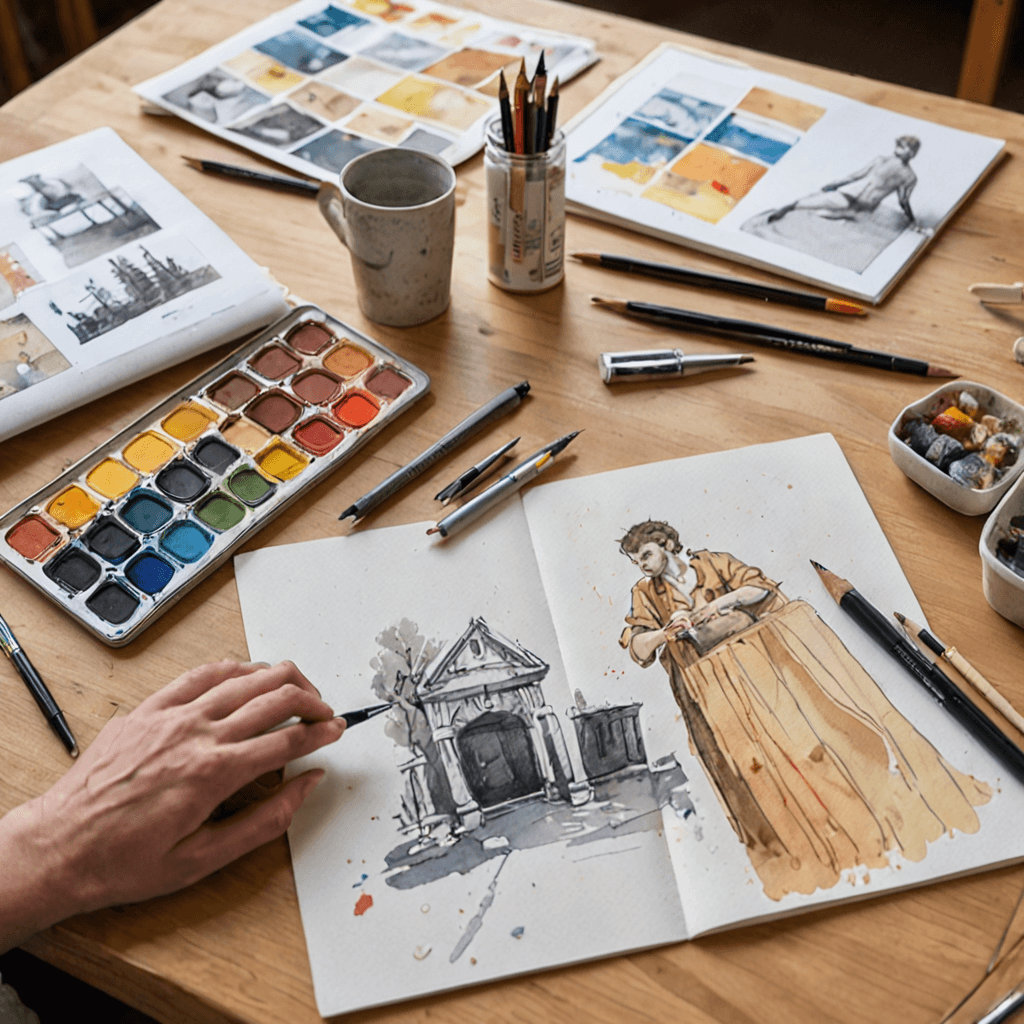
OCAD Illustration Portfolio: What Accepted Students Submit
Table of Contents
Applying to OCAD University’s Illustration program is one of the most competitive undergraduate art tracks in Canada, and the portfolio carries more weight than grades, statements, or recommendations combined. Yet most applicants build their portfolio in isolation — without ever seeing what successful submissions actually contain. Below is what we’ve observed across OCAD-accepted illustration portfolios over years of coaching Etobicoke and GTA students through the application process, and what tends to distinguish a strong submission from a rejected one.
What OCAD’s Illustration Program Actually Looks For
OCAD’s Illustration program is one of the few in Canada that treats illustration as a serious commercial, editorial, and narrative discipline — not as a softer cousin to fine art. The faculty are looking for evidence that an applicant can already think like an illustrator, even at the high school level. That means three things, in priority order: observational drawing skill, a recognisable personal voice, and the ability to communicate a story or concept through a single image.
A common assumption among applicants is that OCAD wants polished, finished illustrations in a unified style. In reality, the program tends to favour portfolios that demonstrate range and process. A submission containing eight versions of the same anime-influenced character — no matter how technically clean — usually underperforms a portfolio that shows a student drawing from life, experimenting with different media, and pushing into uncomfortable territory.
For families just starting to think about portfolio preparation for OCAD, the most useful early step is to stop asking “what should my final pieces look like?” and start asking “what range of skills should this portfolio demonstrate?”
The Required Pieces: A Typical Breakdown
OCAD’s portfolio requirements shift slightly year to year, and applicants should always verify the current year’s specifications directly through OCAD’s admissions website. That said, the structural pattern has been consistent for many cycles. A typical accepted illustration portfolio contains 10 to 12 pieces, and tends to break down approximately as follows:
Observational drawing work (3–4 pieces). Drawings from life — a still life arrangement, a figure study, an interior space, a portrait drawn from observation. These show the reviewer that the applicant has actually trained their hand and eye, rather than copying from photographs or other artists’ work. Strong observational work is the single most undervalued category by applicants and the single most valued by faculty.
Narrative or conceptual illustration (3–4 pieces). Pieces that tell a story or communicate an idea through a single image. These can be editorial-style illustrations responding to a written brief, character designs that imply a backstory, or environmental illustrations that establish mood and place. The pieces don’t need to be in colour, but they do need to demonstrate that the applicant can think visually about story.
Personal or experimental work (2–3 pieces). Pieces that show curiosity, range, and voice. This is where applicants demonstrate that they aren’t just executing assignments — they’re making art that comes from somewhere specific. A sketchbook spread, a series of small studies, a mixed-media piece, or an unexpected subject choice fits here.
Sketchbook documentation (1–2 spreads). OCAD looks closely at process. Including sketchbook pages — even messy ones — signals that the applicant works through ideas before arriving at finished pieces. Polished portfolios without any visible process tend to read as suspicious to experienced reviewers.
Common Mistakes That Lead to Rejection
Across years of working with portfolio applicants, the same handful of mistakes appear in nearly every rejected submission.
Over-reliance on reference photos. Portfolios that lean heavily on rendered drawings from photos — particularly internet-sourced reference — almost always underperform. Reviewers can identify photo-traced work quickly, and even when the result is technically clean, it signals a lack of independent observation skill.
Too much manga, anime, or single-style work. A portfolio that lives inside one aesthetic — particularly an internet-inherited one — fails to show range. Even applicants who genuinely want to pursue stylised illustration as a career need to demonstrate they can work outside their preferred style before specialising.
Missing the storytelling test. Many strong technical drawers submit portfolios full of beautiful single objects — a hand, a face, a flower — without ever showing they can build a scene, communicate a mood, or imply a narrative. OCAD Illustration is a storytelling program. A portfolio that doesn’t tell stories is, by definition, not aligned with the program.
Inconsistent finishing quality. Pieces that are clearly stronger and weaker side by side hurt the overall impression. Better to submit ten consistent pieces than twelve where two are dragging the average down.
No evidence of process. Submissions made of only polished finished pieces, with no sketchbook spreads or process documentation, can trigger skepticism. Reviewers want to see how the applicant thinks, not just what they produce when they’re trying their hardest.
What Strong Illustration Portfolios Have in Common
Patterns we’ve observed in successful submissions are surprisingly consistent.
The pieces are arranged with intention — usually opening on the applicant’s strongest observational drawing, ending on a piece that shows personality or voice, and pacing the middle to demonstrate range. The subjects feel chosen rather than assigned. The applicant clearly has interests — a recurring fascination with hands, with light through windows, with public transit, with the human face under stress — and those interests show up across multiple pieces in different forms.
The work shows ambition without overreach. A successful applicant doesn’t try to disguise a weakness by avoiding it; they include a piece that addresses it head-on. A student who struggles with hands includes a careful study of hands. A student who’s uncomfortable with colour includes one strong colour piece. Reviewers reward this kind of visible courage.
How to Prepare in Etobicoke: A Realistic 12-Month Timeline
The single most common reason for a weak OCAD illustration portfolio isn’t lack of talent — it’s lack of runway. Students who decide in grade 12 to apply often have only four to six months before the portfolio is due, which is rarely enough to build the range OCAD is looking for. The students with the strongest portfolios typically start serious portfolio preparation in grade 11 or earlier.
A 12-month preparation arc usually looks something like this: months one through three focus on observational fundamentals — figure drawing, still life, perspective. Months four through six push into narrative and conceptual work — assignments that require the student to communicate an idea visually. Months seven through nine develop personal direction — what does this applicant care about, and how does it show up in their work? Months ten through twelve are devoted to portfolio curation, refinement, and producing final versions of the strongest pieces.
Portfolio preparation classes in Etobicoke at Muzart Music and Art School are structured around this kind of long-arc preparation. A typical portfolio prep program runs one hour per week at $310 per month, with all materials included, and a $70 trial allows families to see whether the teacher and structure fit before committing.
Why Portfolio Preparation Coaching Matters
Self-directed portfolio preparation works for some applicants — usually those with extensive prior training, a clear personal direction, and the discipline to seek out their own weaknesses honestly. For most high school applicants, an outside coach offers what self-directed work cannot: honest feedback on what’s working and what isn’t, exposure to the kinds of assignments OCAD reviewers respond to, and structured weekly progress over months rather than panicked sprints in the final term.
In our experience at Muzart, the difference between a student who works alone and one who works with a portfolio coach is often the difference between an interesting portfolio and an admissible one.
Cross-discipline applicants — students considering both illustration and adjacent OCAD programs like animation, drawing and painting, or environmental design — particularly benefit from coached preparation. A student who initially applies to illustration may find that animation or drawing and painting is a better fit, and a coach with experience across multiple OCAD programs can guide that decision earlier rather than later.
For a useful baseline reference, our blog post on OCAD portfolio examples walks through the kinds of finished pieces successful applicants have submitted across multiple programs.
Frequently Asked Questions
How many pieces should be in an OCAD illustration portfolio?
OCAD typically asks for 10 to 12 pieces, though the exact number can shift year to year. Verify the current requirement on OCAD’s admissions website. The number matters less than the range — a thoughtful portfolio of 10 strong pieces will outperform 12 pieces where two or three are noticeably weaker.
Does OCAD require a sketchbook submission?
OCAD reviewers strongly value evidence of process. While a full sketchbook submission isn’t always required as a separate item, including one or two sketchbook spreads within the portfolio is widely considered best practice — and the absence of process work can hurt an otherwise strong submission.
Can I submit digital illustrations to OCAD?
Yes. OCAD does not discriminate between traditional and digital media, provided the work demonstrates strong drawing fundamentals. Portfolios composed entirely of digital work, however, often face additional scrutiny on observational drawing — reviewers want to see that the applicant has actual hand-and-eye training, not just software proficiency.
What’s the difference between OCAD illustration and animation portfolio requirements?
The illustration portfolio focuses on single-image storytelling, observational drawing, and editorial sensibility. The animation portfolio prioritises movement, sequential storytelling, character design, and an understanding of timing. Applicants often consider both programs, and well-prepared portfolios for one can be adapted to the other with some additional work.
How early should we start portfolio preparation for OCAD illustration?
Ideally during grade 11. A 12-month runway allows for foundational skill development, narrative work, personal direction, and portfolio curation. Students starting in grade 12 with four to six months can still produce admissible portfolios, but they have less room for experimentation and refinement.
What’s the most common reason for OCAD illustration rejection?
In our experience, the most common pattern in rejected portfolios is over-reliance on a single style — typically an internet-influenced aesthetic — without demonstrating observational drawing range or narrative thinking. Strong technical execution within a narrow range will not compensate for missing skills the program specifically tests for.
If you’d like to discuss what an OCAD illustration portfolio could look like for your teen, request more information about Muzart’s Etobicoke portfolio prep program, or book a $70 trial to meet a portfolio coach. The earlier the runway, the stronger the portfolio.