
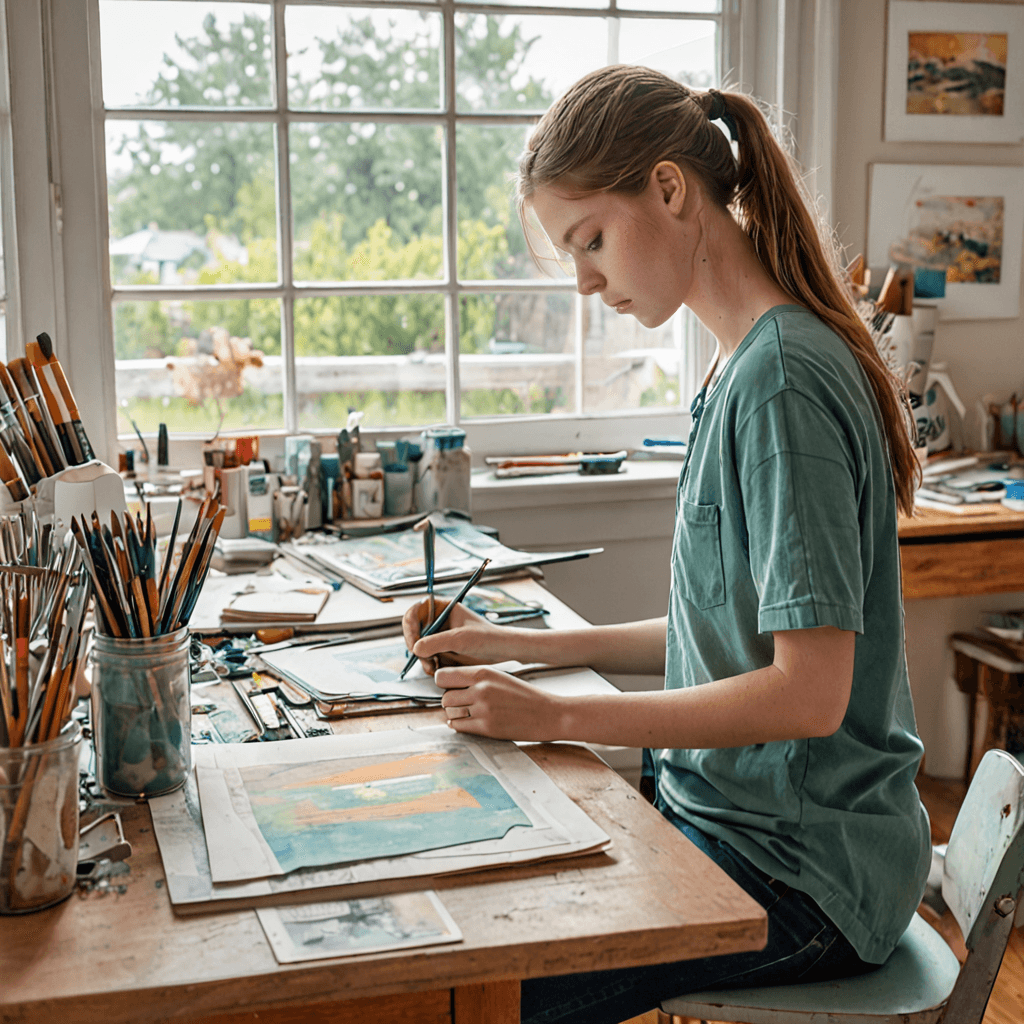
Teen Art Portfolio Summer Intensive: Making the Most of the Break
Table of Contents
For Ontario teenagers planning to apply to OCAD, ESA, an arts-focused high school, or a university visual arts program, the summer between Grade 11 and Grade 12 — or the summer leading into application year — is the most valuable window in the entire portfolio preparation process. It’s also the most commonly misused.
At Muzart Music and Art School, we work with portfolio students year-round at our Etobicoke studio, and the difference between students who use summer intentionally and students who treat it as a break is dramatic. By the time September arrives and the application timeline starts compressing, the gap between the two groups is the difference between scrambling and finishing.
This guide is for parents and teens deciding whether a summer portfolio intensive is worth the time and cost, and what to realistically expect from one. The first part of the honest answer is that a summer intensive is one of the highest-leverage moves a serious art applicant can make. The second part is that families consistently misunderstand what an intensive can and can’t accomplish — and getting that expectation right matters.
What a Summer Portfolio Intensive Can Actually Do
Here’s the realistic picture, based on our experience running portfolio prep at our Etobicoke location across multiple application cycles.
In a focused six to eight-week summer intensive, with weekly one-hour sessions and meaningful home practice, a teen can build the majority of their portfolio — typically the bulk of the finished pieces a school will eventually see. Not all of it, but most of it.
The reason this is achievable in summer specifically — and not in any other eight-week window in the year — is structural. During the school year, a portfolio student is splitting attention across homework, regular class assignments, extracurriculars, social commitments, and the constant low-grade exhaustion of high school. Even an extremely motivated student can only carve out four or five hours a week for portfolio work, and those hours are often interrupted, fatigued, or compressed.
In summer, none of that competition exists. A serious portfolio student can spend twelve to fifteen hours a week on their work without it feeling like sacrifice. Multiply that by eight weeks, and the volume of finished work that becomes possible is significantly larger than what the school year allows.
But — and this is the part families consistently underestimate — building the majority of a portfolio is not the same as having a finished portfolio. A common parent misconception we hear is that eight weeks should be enough to walk out at the end of August with a polished, application-ready portfolio. That’s not what the intensive is. It’s the bulk creation phase. The pieces still need cleaning up, refinement, sequencing, photographing, and in many cases revision based on feedback from the application target school. That polish work typically happens in September and October, sometimes into November.
Setting that expectation correctly is important, because families who expect a “done” portfolio in August are often disappointed in early September when they realize there’s still meaningful work ahead. Families who understand summer as the major creation window — followed by a polish phase in fall — finish their applications calmer and stronger.
Why Summer Specifically Beats the School Year for Portfolio Work
The advantage of summer for portfolio building isn’t just about hours available. It’s about the quality of those hours.
Sustained focus on individual pieces. A complex portfolio drawing or painting takes time — sometimes ten or fifteen hours of focused work spread across several sessions. During the school year, those sessions get fragmented across evenings, interrupted by homework, and often paused mid-piece for a week or two when school demands spike. In summer, a student can work on the same piece across three consecutive days without losing the thread.
Experimentation with media and technique. Strong portfolios usually show range — drawing, painting, mixed media, sometimes digital work, sometimes sculpture. The school year doesn’t allow time to genuinely try new techniques; everything has to be relatively safe to meet application deadlines. Summer is when a student can spend two weeks figuring out gouache, or test oil painting for the first time, or experiment with collage approaches. Some of these experiments end up in the final portfolio. Others get cut. Either way, the experimentation makes the final portfolio stronger.
Building a cohesive body of work, not just disconnected pieces. OCAD, ESA, and university art programs increasingly want to see portfolios that show conceptual thinking, not just technical skill. That requires pieces that relate to each other, develop a theme, or demonstrate an artistic point of view. This kind of cohesion is almost impossible to build during the school year, when portfolio work happens in isolated bursts. Summer gives space to think about the portfolio as a whole.
Recovery from the perfectionism trap. Talented teen artists often get stuck on a single piece, polishing it endlessly while other portfolio pieces don’t get started. Summer’s longer runway lets students move past stuck pieces, work on multiple drawings simultaneously, and gain perspective on what’s actually working versus what they’re emotionally attached to.
What a Muzart Portfolio Intensive Looks Like in Practice
Our portfolio preparation program runs as private one-hour lessons with all materials included, at a monthly rate of $310. Summer intensives follow the same structure — weekly private sessions at our Etobicoke studio — with the intensified content focus that summer allows.
The typical summer flow for a student preparing for OCAD or a similar Canadian art school application looks something like this:
Weeks 1–2: Assessment and direction. The first sessions focus on understanding where the student is starting from — what they can already do, where the technical gaps are, and what kind of artistic voice is emerging. We look at the target schools’ specific portfolio requirements (these vary significantly between OCAD, ESA, Sheridan, Ryerson and others) and start mapping which pieces will need to exist.
Weeks 3–5: Core production. This is the bulk creation phase. Students are typically working on two or three pieces simultaneously, completing one significant work per week. Home practice is heavy during this window — usually two to three additional drawing sessions per week between lessons, with materials we provide so the student has the right paper, paints, and tools at home.
Weeks 6–8: Range and experimentation. Once the foundational pieces are in motion, we shift to broadening the portfolio — trying media the student hasn’t worked in, building pieces that show conceptual range, addressing any specific requirements from target schools that haven’t yet been covered.
By the end of summer, a committed student will have roughly seven to ten finished or near-finished pieces, with clear direction on what still needs to be added and what needs refinement in fall.
The Home Practice Reality
This is the part that determines whether a summer intensive succeeds or stalls: the work that happens between lessons.
A weekly one-hour lesson is enough to direct the work, give feedback, demonstrate technique, and help the student think through composition and conceptual decisions. It is not enough to produce a portfolio. The majority of a portfolio is built at home, between lessons, by the student.
In our experience, the students who get the most out of summer intensive portfolio prep are putting in ten to fifteen hours of home practice per week — sometimes more. That sounds like a lot, but in summer it’s genuinely achievable. Without homework and school competing, a teen can spend two hours a morning drawing, take afternoons off, and still hit those numbers easily.
The students who treat the weekly lesson as the entirety of their portfolio work — coming in for one hour, going home, and not picking up a pencil again until next week — don’t make the kind of progress that summer enables. They’re not failing the program; they’re just getting school-year results from a summer schedule, which misses the entire point of the intensive.
For parents weighing whether to commit, the honest question to ask your teen is: are you willing to treat this like a part-time job for eight weeks? If yes, a summer intensive will transform the application. If no, weekly school-year sessions are probably a better use of money.
How Summer Portfolio Work Sets Up Fall
A well-used summer doesn’t end the portfolio process — it sets up the fall polish phase with the heaviest creation work already done. Students arrive in September with seven to ten substantial pieces in hand, the ability to focus on refinement rather than starting from scratch, and the perspective to make smart cuts about which pieces are actually working.
Fall lessons then shift from production to curation. We work on which pieces to include and which to leave out, how to sequence them, what supporting documentation (artist statements, process notes) the target schools require, and how to photograph or scan the work properly for application submission. This work is genuinely better with the breathing room September provides — a student who arrives in September with two finished pieces and a panic timeline can’t make these decisions calmly.
For students serious about applying to OCAD, ESA, university visual arts programs, or other arts-focused programs for September 2027 entry, summer 2026 is the right window to be in serious portfolio prep. The students who finish strongest in early winter are almost always the students who used their summer well.
To explore whether a summer portfolio intensive makes sense for your teen, book a trial portfolio prep session at $70, or request more information about our Etobicoke art lessons and summer scheduling. The trial session lets us assess where your teen is starting from and gives you a clear picture of what the program offers before committing to monthly enrollment.
Frequently Asked Questions
How many pieces will my teen have completed after an 8-week summer intensive?
A committed student doing the weekly lessons plus consistent home practice typically finishes seven to ten substantial pieces over an eight-week summer. Some pieces will be polished by end of August; others will need refinement work in September. The exact count depends on how complex the pieces are — large, layered paintings take longer than focused drawings.
Is my teen’s portfolio finished at the end of summer?
Usually not entirely. Summer is the major creation phase — typically completing the bulk of the portfolio. Fall is the polish and refinement phase: cleaning up specific pieces, adding any final required works, sequencing the portfolio, writing artist statements, and preparing the actual application submission. Families who plan for both phases finish strongest.
What’s the difference between summer portfolio intensive and regular weekly portfolio prep?
The lesson structure is the same — one weekly private hour, same instructor, same materials included. What changes is the home practice volume and the content focus. Summer allows for ten to fifteen hours of home practice weekly versus the four to five hours that’s realistic during the school year. We use that additional capacity to push harder on production and experimentation.
What if my teen is just starting their portfolio in summer? Is it too late?
Summer is actually one of the best times to start, not too late. Starting in summer with a serious intensive gives a student two solid months of focused creation before the application timeline gets tight. Students who delay starting until September often run out of time before applications are due. The students who start in summer almost always finish stronger than students who start in fall.
How does the $310 monthly portfolio prep program work for summer?
Our portfolio preparation is $310 monthly for four one-hour private lessons, with all materials included — paper, paints, drawing supplies, and any specialty media the student is working with. The pricing is the same in summer as it is the rest of the year. A trial portfolio prep session is $70 and is a good way to assess fit before committing to monthly enrollment.
What schools does Muzart prepare students for?
We prepare students for OCAD University, the Etobicoke School of the Arts (ESA) and other arts-focused high schools, Sheridan College animation and illustration programs, Toronto Metropolitan University visual arts, and other university and college visual arts programs across Ontario. Each school has different portfolio requirements, and we tailor preparation to the specific schools your teen is applying to.
If your teen is serious about applying to art school, summer is the window that separates strong applications from rushed ones. Book a trial portfolio prep session at our Etobicoke location or request more information about our summer schedule and we’ll help you figure out what the right intensive looks like for your teen’s specific application goals.