
Art History for Young Artists in Toronto: Learning from the Masters
Table of Contents
Art history education for children transforms passive museum visits into active learning experiences that deepen artistic understanding, expand creative possibilities, and connect young artists to the rich continuum of human visual expression spanning millennia. At Muzart Music and Art School, located in Etobicoke near Cloverdale Mall, we integrate age-appropriate art history into our comprehensive curriculum, ensuring students understand they’re part of an ongoing artistic conversation that began in prehistoric caves and continues in contemporary studios worldwide.
For families in Toronto, Etobicoke, and Mississauga seeking well-rounded art education for their children, understanding how art history instruction enhances rather than detracts from creative development helps appreciate its value. Learning about historical artists and movements doesn’t constrain children’s creativity—instead, it provides inspiration, expands their visual vocabulary, introduces new techniques and approaches, and contextualizes their own artistic efforts within broader human creative achievement. The masters become mentors across time, offering solutions to artistic challenges that young artists face today just as artists faced centuries ago.
This comprehensive guide explores age-appropriate approaches to art history education, how studying historical art informs contemporary practice, strategies for making art history engaging rather than academic, and the connections between art history knowledge and artistic skill development. Whether your child has just begun exploring visual art or has been creating enthusiastically for years, understanding how art history enriches their education supports their journey toward deeper artistic engagement and sophisticated creative expression.
Age-Appropriate Art History: Matching Content to Developmental Stages
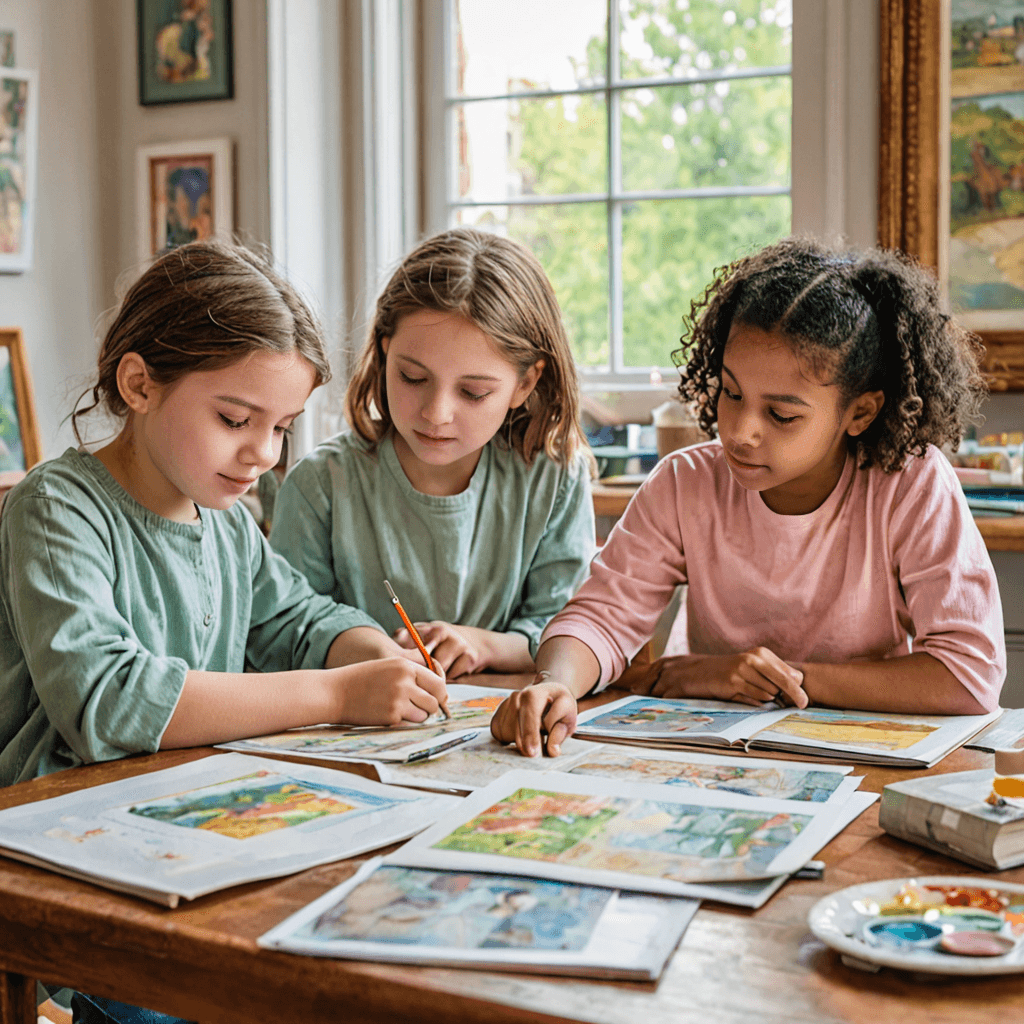
Children ages 5-8 benefit from art history introduction through stories and imagery rather than dates and analysis. At this developmental stage, narrative captures attention while abstract historical concepts feel distant and irrelevant. Effective art history for young children includes picture book biographies of famous artists (focusing on interesting life details), simple stories about how artworks were created, looking at reproductions and discussing what they see and feel, and hands-on projects inspired by historical artists’ techniques. The emphasis falls on visual experience and emotional connection rather than memorization or analysis.
Artists whose work particularly resonates with young children include Henri Rousseau (imaginative jungle scenes), Wassily Kandinsky (colorful abstract compositions), Joan Miró (playful shapes and creatures), and Vincent van Gogh (expressive colors and visible brushstrokes). These artists created visually engaging work that sparks young children’s interest while offering accessible entry points to broader art historical concepts. A child might not understand Post-Impressionism as a movement, but they can absolutely appreciate the swirling energy of Starry Night and attempt their own swirling compositions.
Students ages 9-12 possess greater capacity for historical context and analytical thinking. Art history instruction for this age group can include learning about major art movements and their characteristics, understanding how historical events influenced artistic expression, comparing and contrasting different artists’ approaches, and connecting techniques observed in historical art to their own practice. However, instruction should remain primarily visual and experiential rather than text-heavy or lecture-based. Looking at multiple examples, creating art inspired by historical works, and hands-on exploration maintain engagement while building knowledge.
Teenagers can engage with art history at an increasingly sophisticated level, including understanding social and political contexts of artistic movements, analyzing symbolism and meaning in historical artworks, tracing the evolution of techniques and materials, and developing personal aesthetic preferences informed by historical exposure. For students preparing art school portfolios, art history knowledge becomes essential, as admissions committees expect applicants to demonstrate awareness of artistic traditions and contemporary practices. Our portfolio preparation program includes comprehensive art history instruction tailored to meet art school expectations, with trial lessons available for $70.
Learning Techniques and Approaches from Historical Masters
Renaissance artists pioneered techniques that remain foundational to realistic representation today. Leonardo da Vinci’s systematic study of anatomy informs figure drawing, his investigations of perspective revolutionized spatial representation, and his use of sfumato (subtle gradations creating soft edges) demonstrates sophisticated understanding of light and atmosphere. While young students won’t replicate the Mona Lisa, they can learn simplified perspective techniques Leonardo mastered, observe how he created depth through overlapping forms, study his sketches to understand how preliminary drawing supports finished work, and appreciate how scientific observation informed his artistic practice.
Impressionist painters transformed how artists approached color, light, and outdoor painting. Monet, Renoir, and Pissarro taught that shadows contain color (not just gray or black), broken color and visible brushstrokes create visual vibration, capturing immediate visual impression matters more than photographic detail, and painting outdoors (en plein air) produces different results than studio work. Children studying Impressionism can experiment with pure color applied in dabs rather than blended smoothly, observe how colors placed next to each other mix optically at a distance, paint the same subject at different times of day to see light changes, and understand how breaking academic rules opened new artistic possibilities.
Abstract and modern artists demonstrated that art need not represent visible reality to communicate powerfully. Kandinsky, Pollock, and Rothko showed that color, line, shape, and composition create meaning independently of recognizable subjects. For children who struggle with realistic representation or feel constrained by “making things look right,” abstract art offers liberating permission to explore visual elements for their own sake. Learning that serious artists created masterpieces without depicting recognizable subjects validates children’s own abstract explorations and encourages experimentation.
Contemporary and multicultural art exposure ensures children understand art as a living, evolving practice occurring globally, not just a historical phenomenon limited to European traditions. Studying artists from diverse cultures, working in varied media including digital art, installation, and performance, addressing contemporary issues and experiences, and continuing to innovate and challenge conventions demonstrates art’s ongoing vitality and relevance. This broader exposure prepares students for contemporary art school environments and professional art worlds that value diversity and innovation. Our group art classes expose students to diverse artistic traditions and contemporary practices alongside historical masters.
Making Art History Engaging Through Active Learning
Museum and gallery visits transform art history from abstract concept to tangible experience. Toronto offers exceptional resources for art history education including the Art Gallery of Ontario (AGO) with comprehensive collections spanning centuries, the Royal Ontario Museum for ancient and world art, the Gardiner Museum for ceramics and applied arts, and numerous smaller galleries showing contemporary work. Preparing children for museum visits by discussing what they’ll see, providing focus questions or scavenger hunt activities, allowing time for unstructured looking and personal responses, and following up with discussion or related art-making makes these experiences maximally valuable.
Effective museum visits with children avoid trying to see everything in favor of deep engagement with select works. Spending quality time with 5-10 artworks produces better learning outcomes than rushing through galleries attempting to see hundreds. Questions that encourage active looking include “What do you notice about the colors in this painting?”, “How do you think the artist made this?”, “What story do you think this artwork tells?”, and “How does this artwork make you feel?” These open-ended questions value children’s observations and emotional responses while developing looking skills.
Project-based learning connects art history to hands-on creation. Rather than simply learning about Cubism abstractly, students create Cubist-inspired portraits. Instead of reading about ancient Egyptian art, they design their own hieroglyphic cartouches. This approach makes historical information immediately relevant while demonstrating techniques in accessible formats. Successful art history projects include creating work in the style of a studied artist or movement, combining techniques from multiple historical periods, responding to a historical artwork with a contemporary interpretation, and researching and presenting on an artist of personal interest.
Digital resources expand art history access beyond what physical museums and books alone provide. High-resolution images online allow close examination of artworks, virtual museum tours provide access to collections worldwide, video documentaries explore artists’ lives and processes, and interactive timelines and maps contextualize artistic movements geographically and historically. While digital resources shouldn’t replace in-person museum experiences entirely, they supplement and extend learning significantly. Our instructors incorporate both digital and traditional resources to create comprehensive, engaging art history instruction.
Connecting Art History to Contemporary Practice and Personal Growth
Understanding how historical artists solved compositional challenges provides templates for students’ own work. When a young artist struggles with creating depth in a landscape, studying how Chinese landscape painters used atmospheric perspective or how Renaissance artists employed linear perspective offers concrete solutions. When designing an abstract composition feels overwhelming, examining how Mondrian limited his palette and used geometric simplicity provides a manageable approach. Art history becomes a problem-solving resource, not just historical information.
Studying artists’ creative processes—their preliminary sketches, color studies, and multiple versions of compositions—demystifies artistic creation and normalizes struggle. Students learning that Picasso created numerous preliminary studies for Les Demoiselles d’Avignon or that Monet painted the same haystack subject dozens of times understanding that even masters worked through problems, revised repeatedly, and sometimes failed before succeeding helps them accept their own learning process. Art history reveals that great art results from dedication and persistence, not just innate talent.
Exposure to diverse artistic voices and perspectives expands students’ understanding of what art can be and do. Learning that Frida Kahlo painted personal pain and identity struggles, that Jacob Lawrence used art to document African American history, that Yayoi Kusama transformed mental health challenges into distinctive artistic vision, and that contemporary artists address social issues from climate change to social justice demonstrates art’s capacity to communicate powerful ideas and emotions. This understanding can inspire students to use their own art-making for meaningful expression beyond merely creating pretty pictures.
Art history knowledge supports critical thinking and visual literacy applicable far beyond art-making. Students who study art history develop abilities to analyze visual information carefully, understand how context influences meaning, articulate observations and interpretations clearly, and appreciate multiple perspectives and interpretations. These skills transfer to media literacy, cultural understanding, and general academic success. The $155 monthly tuition for our comprehensive art programs provides this multifaceted education that develops both artistic skill and broader intellectual capacities. Students and families can request more information about how our curriculum integrates art history with hands-on studio practice.
Building Visual Literacy and Aesthetic Appreciation
Visual literacy—the ability to read, interpret, and create visual messages—represents an increasingly crucial skill in our image-saturated world. Art history education builds visual literacy by teaching students to analyze composition and how elements are arranged, understand color relationships and their emotional impacts, recognize symbols and their cultural meanings, and distinguish between different styles and artistic approaches. These analytical skills help students navigate advertising, media, and digital imagery critically rather than passively consuming visual information.
Aesthetic appreciation develops through repeated exposure to high-quality artwork across diverse styles and periods. Students who study art history learn that beauty takes many forms—the serene balance of classical Greek sculpture, the energetic asymmetry of Japanese prints, the bold distortion of Expressionist painting, and the conceptual rigor of Minimalist sculpture all represent different but equally valid aesthetic values. This exposure prevents narrow definitions of “good art” and encourages openness to diverse visual experiences.
Understanding artistic movements as responses to historical contexts deepens appreciation. Students who learn that Romanticism emerged partly as reaction to Enlightenment rationalism, that Dada artists responded to World War I’s senseless violence with deliberately nonsensical art, or that Abstract Expressionism reflected post-World War II American cultural confidence understand art as embedded in human experience rather than isolated from it. This contextual understanding makes historical art feel relevant and meaningful rather than distant and arbitrary.
Personal taste development occurs naturally through broad exposure. As students encounter numerous artists and styles, they discover what resonates personally—some children gravitate toward bold colors and expressive brushwork, others prefer careful realism or geometric abstraction. Art history provides the vocabulary and framework for students to articulate their preferences while respecting that different viewers respond to different artistic qualities. Our instructors encourage students to develop personal aesthetic awareness while remaining open to new visual experiences.
Integrating Art History with Studio Practice
Masterwork studies—close examination and replication of historical artworks—teach technical skills while building art historical knowledge. Students who carefully copy a Vermeer painting learn about his color palette, his approach to light and shadow, the careful observation underlying apparent effortlessness, and the patience required for detailed work. This isn’t about creating forgeries but about learning through careful observation and replication how masters achieved their effects. Even simplified versions adapted to children’s skill levels provide valuable learning experiences.
Style exploration projects encourage students to work in various historical styles, creating original compositions using Pointillist techniques or Cubist fragmentation or Surrealist juxtaposition. These exercises demonstrate that style represents conscious choice rather than innate ability—students can learn to work in various modes just as professional artists do. Understanding multiple styles as available options rather than fixed categories expands creative flexibility.
Art history-inspired contemporary creation challenges students to apply historical techniques or concepts to current subjects. A student might paint a self-portrait using Rembrandt’s lighting approach, create a cityscape using Impressionist color theory, or design a poster employing Art Nouveau’s flowing organic lines. These projects demonstrate history’s ongoing relevance while encouraging creative synthesis of past and present approaches.
Our curriculum at our Etobicoke location integrates art history throughout studio instruction rather than treating it as separate academic content. Students don’t just hear about Impressionism—they mix colors on their palettes like Impressionists, apply paint in short strokes, and observe how colors interact optically. This experiential approach makes art history immediately applicable and memorable. Families can experience this integrated approach through trial lessons—visit our website to book now and discover how art history enriches studio practice.
FAQ Section
At what age should children start learning art history?
Art history exposure can begin as early as preschool age (4-5 years) through age-appropriate methods that emphasize visual experience over historical facts. Very young children benefit from looking at reproductions of famous artworks, discussing what they see and how images make them feel, hearing simple stories about artists’ lives, and creating art inspired by styles they’ve observed. Formal art history instruction with chronological understanding, movement names, and historical context becomes appropriate around ages 9-10 when children develop capacity for abstract historical thinking. However, even this “formal” instruction for children should remain primarily visual and hands-on rather than lecture-based. The key is matching complexity to developmental stage—young children need concrete, sensory experiences while older students can handle more analysis and context. Our private art lessons tailor art history integration to each student’s age and interest level, ensuring exposure feels enriching rather than overwhelming or boring.
Will learning about other artists’ work stifle my child’s own creativity?
This common concern proves unfounded in practice. Research and teaching experience consistently show that exposure to diverse artistic examples expands rather than constrains creativity. Learning how other artists solved problems provides tools and options rather than prescriptive rules. A child who learns about Monet’s approach to painting water gains one possible technique—not the only way or the required way, but an option to try, adapt, or reject based on personal preference. Art history exposure prevents the frustration that occurs when children want to create certain effects but lack technical knowledge to achieve them. Far from copying mechanically, students who study historical art typically combine influences in novel ways, creating original work informed by but not derivative of their studies. The artists most admired for originality—Picasso, for instance—studied historical art extensively. Their innovation built upon rather than ignoring artistic traditions. We encourage students to learn from masters while developing distinctive personal voices, understanding these goals as complementary rather than contradictory.
How can we make art history interesting for children who just want to make art?
The key is making art history active, hands-on, and directly connected to art-making rather than presenting it as separate academic content. Children resist passive learning (lectures, reading, memorization) but engage enthusiastically with participatory approaches including looking at an artwork and immediately creating something inspired by it, learning about an artist while practicing their technique, visiting museums with hands-on activity sheets or challenges, and choosing artists to study based on personal interest. Project-based learning where art history provides context for exciting creative work maintains engagement. A child creating Egyptian-style relief sculpture learns about ancient Egyptian art naturally and enthusiastically, whereas the same child might resist reading about Egyptian art abstractly. Starting with what excites the student—whether that’s bright colors, unusual techniques, interesting stories, or specific subjects—and finding historical artists who offer that quality creates positive associations. Our instructors excel at integrating art history seamlessly into studio practice, ensuring it enhances rather than interrupts the creative flow students love.
What art history resources work well for children at home?
Numerous excellent resources make art history accessible and engaging for home learning, supplementing formal instruction. Recommended materials include picture book biographies of famous artists (beautifully illustrated, narrative-focused), art history books designed for children (age-appropriate language and concepts), museum websites with interactive features and virtual tours, documentary videos about artists and movements (available through streaming services), and hands-on art history kits combining information with supplies for creating. The Art Gallery of Ontario offers excellent educational resources including family guides and activity sheets downloadable from their website. Many publishers produce high-quality art history series for children at various reading levels. Digital resources including Google Arts & Culture allow detailed examination of artworks from museums worldwide. However, resources work best when integrated with actual art-making—reading about Impressionism becomes more meaningful when followed by trying Impressionist techniques. Parents needn’t be art experts themselves to support children’s art history learning—simply visiting museums together, looking at art books, and encouraging discussion builds valuable exposure. Our instructors provide guidance on age-appropriate resources that complement our curriculum, ensuring home learning reinforces studio instruction effectively.
Enriching Artistic Education Through Historical and Cultural Context
Art history education transforms art from an isolated activity into participation in humanity’s ongoing visual conversation. Students who understand they’re exploring the same challenges of light, color, composition, and expression that artists have tackled for millennia feel connected to something larger than individual creation. This historical awareness doesn’t constrain creativity—it provides foundation, inspiration, and perspective that enriches artistic development at every level.
At Muzart Music and Art School, we integrate age-appropriate art history throughout our comprehensive curriculum, ensuring students develop both technical skills and cultural literacy. Our experienced instructors understand that effective art history education requires connecting historical information to hands-on practice, matching complexity to developmental readiness, emphasizing visual experience over academic memorization, and maintaining enthusiasm through engaging, relevant content. This approach builds well-rounded young artists who create with both skill and understanding.
Located conveniently in Etobicoke near Cloverdale Mall and serving families throughout Toronto, Etobicoke, and Mississauga, our art programs offer the comprehensive education that develops not just artistic ability but visual literacy, cultural awareness, and aesthetic appreciation. Whether your child is just beginning art exploration or seeking to deepen existing engagement through broader context, now is the perfect time to discover what expert, well-rounded art instruction can offer.
Our group art classes provide collaborative learning environments where students explore art history together, while our private lessons offer personalized instruction tailored to individual interests and goals. Both formats integrate art history naturally within studio practice, ensuring contextual learning enhances rather than interrupts creative flow. All art class materials are included in our program tuition, allowing students to explore various techniques inspired by historical masters without additional supply costs.
The knowledge and appreciation developed through art history study create foundations for lifelong engagement with visual culture. Whether your child pursues professional art careers or simply enjoys creating and viewing art throughout life, the understanding that art history provides deepens satisfaction and capability. Visit our art lessons page to explore our program offerings, or book a trial lesson to experience firsthand how we integrate historical learning with hands-on creation. Discover how studying the masters while developing personal artistic voice creates confident, knowledgeable, creative young artists prepared to contribute their own chapters to art’s continuing story.