
Art and Storytelling for Children in Etobicoke: Visual Narratives
Table of Contents
Long before children learn to write words, they tell stories through pictures. A child’s drawing of a family walking in the park, a dragon breathing fire at a castle, or a rocket ship blasting through a starry sky—these aren’t just images. They’re narratives, complete with characters, settings, and implied action. The deep connection between art and storytelling is one of the most natural and powerful aspects of creative development, and it’s one that skilled art educators actively nurture and build upon.
At Muzart Music & Art School, located in Etobicoke near Cloverdale Mall and serving families throughout Toronto, Etobicoke, and Mississauga, visual storytelling is woven into our art curriculum as a meaningful way to deepen both artistic skill and creative thinking. Our art lessons in Etobicoke integrate narrative concepts into practical studio work, helping young artists develop not only technical proficiency but the ability to communicate ideas, emotions, and stories through their artwork.
This guide explores how visual storytelling develops in children, what skills it builds, and how dedicated art instruction helps young artists bring their inner narratives to life on paper, canvas, and beyond.
The Natural Connection Between Art and Story
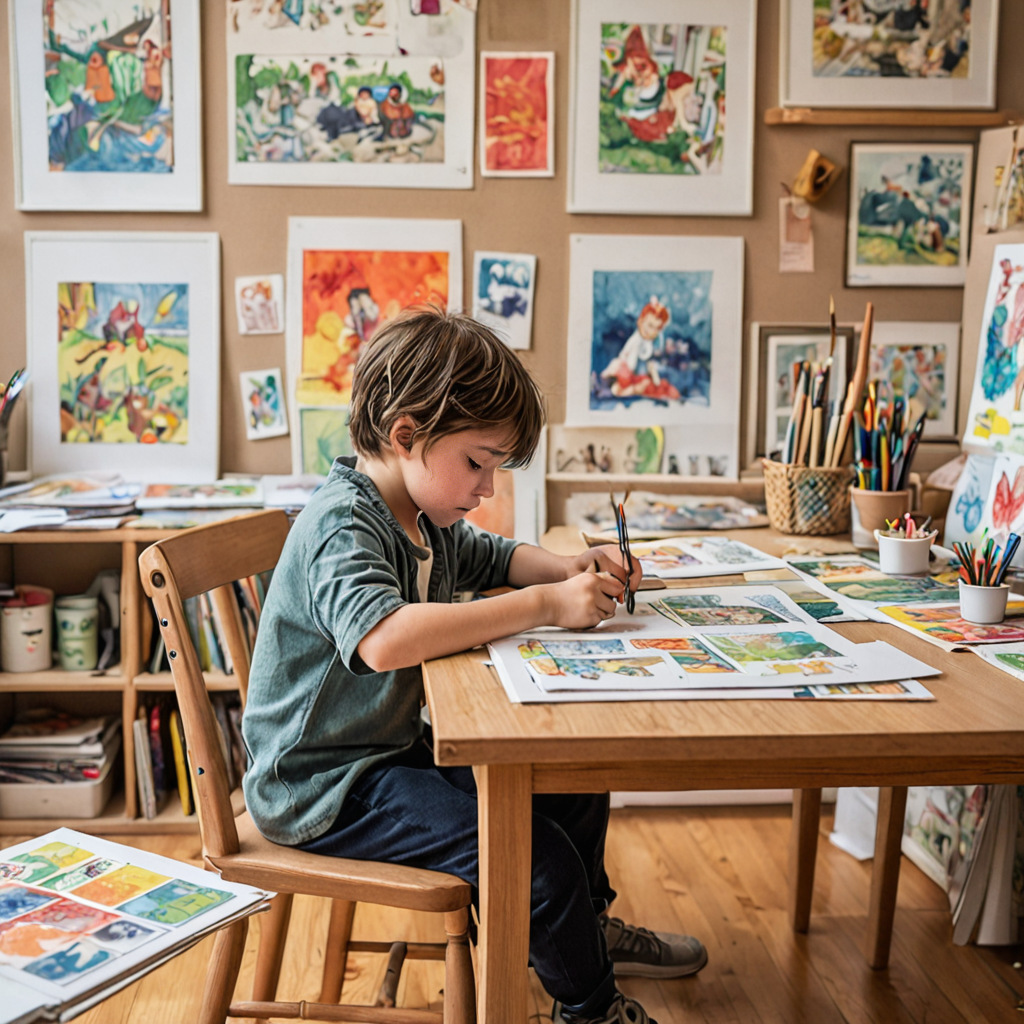
Children’s relationship with visual storytelling begins very early. Toddlers point at pictures in books and describe what’s happening. Preschoolers draw scenes and narrate them enthusiastically to anyone willing to listen. By the time children are school-aged, they’re often creating elaborate illustrated series—sequential drawings that follow characters through adventures, conflicts, and resolutions.
This natural inclination toward visual narrative is deeply rooted in how the human mind processes and communicates experience. Images carry emotional and conceptual meaning in ways that words sometimes cannot, and children intuitively understand this before they have the vocabulary to articulate it. Skilled art instruction meets children where this natural inclination lives and helps them develop the visual tools to express their stories with greater clarity, intentionality, and impact.
In our group art classes and private art lessons, instructors observe that the most engaged students are often those who have a story they’re trying to tell. When a student has a clear narrative in mind, they become highly motivated to develop the technical skills needed to communicate it. This is one of the reasons visual storytelling is such a powerful pedagogical tool—it transforms skill-building from an abstract exercise into a meaningful act of creative expression.
Sequential Art: Comics, Panels, and Visual Narratives
Sequential art—the arrangement of images in a deliberate order to tell a story—is one of the most accessible and exciting entry points into visual storytelling for young artists. Comics and graphic novels are perhaps the most familiar form of sequential art, but the underlying principles extend to picture books, storyboards, illustrated manuscripts, and countless other formats.
Working in sequential panels teaches children several important artistic and narrative skills simultaneously. First, students learn about composition within individual panels—how to frame a scene, where to position characters, and how to guide the viewer’s eye through the image. Second, they develop an understanding of visual continuity, learning how to create coherent flow from one panel to the next so that the story is clear without requiring words. Third, sequential art requires thinking about time and pacing—how long does each moment last, which details deserve a full panel and which can be suggested, and how to create a sense of action and movement within static images.
For students in our Etobicoke studio who are working toward art school applications, sequential art and storyboarding are valuable portfolio components that demonstrate narrative thinking, compositional variety, and creative range. Our portfolio preparation program helps students develop and present sequential work that showcases these skills effectively.
Picture Books: Illustration and Text Working Together
The picture book is a uniquely beautiful art form because it requires the illustration to carry significant meaning beyond what the text provides. In the best picture books, the images and words are in constant conversation—sometimes agreeing, sometimes ironically counterpointing each other, always working together to create an experience richer than either could produce alone.
Creating original picture books is a project that our art students approach with tremendous enthusiasm. The process involves developing characters whose personalities are communicated visually, creating settings that evoke mood and atmosphere, and making deliberate choices about colour palette, composition, and illustration style that serve the emotional tone of the story.
Even young students without sophisticated technique can engage meaningfully with picture book creation. A six-year-old’s simplified character drawings, consistently depicted across multiple pages with a beginning, middle, and end to their story, represent a genuine artistic and narrative achievement. Older students with more developed skills can explore more complex approaches—varied perspectives, dynamic compositions, sophisticated colour relationships—that bring their picture book visions to life with professional polish.
Working through this process in our Etobicoke studio also introduces students to practical design concepts. How does the cover invite a reader in? How do page turns create anticipation? How does the size and placement of a character within a spread communicate their importance in a scene? These questions connect artistic decision-making to narrative purpose in concrete, tangible ways.
Visual Storytelling Across Media
One of the wonderful aspects of visual storytelling as a teaching framework is its adaptability across different media and techniques. The same narrative impulse that drives sequential art also informs painted scenes, sculptural tableaux, printmaking series, and digital illustration. Our art curriculum uses visual storytelling as a thread that connects work across very different media, giving students a coherent creative framework even as the technical approaches vary significantly.
When students work in watercolor—a medium explored in depth in our Etobicoke classes—they discover that the fluid, luminous quality of the medium lends itself naturally to certain kinds of stories. Dreamlike, atmospheric narratives feel at home in watercolor. Dynamic action stories might call for bolder, more graphic media. Part of developing artistic maturity is learning to match medium to message—understanding not just how to use a material, but when it’s the right choice for the story you’re trying to tell.
Printmaking, with its inherent repeatability and graphic clarity, is excellent for sequential storytelling—each print in a series can represent a moment in a narrative while maintaining visual unity through the shared aesthetic qualities of the printmaking technique. Mixed media projects allow students to combine approaches in ways that serve complex or layered narratives.
Collage is another wonderfully accessible medium for visual storytelling, particularly with younger students. By selecting, cutting, and arranging found images and materials, children can construct scenes and characters that they might not yet have the drawing skills to create from scratch. The act of composition—deciding what goes where and why—is itself a form of narrative construction.
How Art Instructors Support Visual Storytelling
The role of an art instructor in developing visual storytelling skills is multifaceted. Technical instruction—how to construct a figure, create the illusion of depth, use colour emotionally—provides students with the visual vocabulary to express their narratives. But equally important is the cultivation of narrative thinking itself.
Our instructors at Muzart Music and Art School ask questions that support narrative development throughout the creative process. Before students begin a project, instructors might ask: Who is in this scene? What just happened before this moment? What will happen next? How does your character feel, and how can you show that through their posture or expression? These questions prompt students to think beyond surface-level image-making into the richer territory of story and meaning.
During the creative process, instructors help students make compositional choices in service of their narrative intentions. If a student wants to show a character running away from something, how does the composition communicate urgency? Where should the character be positioned in the frame? What direction should they be facing? These are simultaneously compositional and narrative questions, and working through them develops both artistic and storytelling capacity.
Critical dialogue about finished work also plays an important role. When students share their visual narratives with each other in our group art classes, they develop the ability to communicate their artistic intentions and to receive and respond to feedback. This kind of structured creative conversation is a form of critical thinking training that serves students across every area of their education and lives.
Visual Storytelling and Academic Development
The skills developed through visual storytelling in art classes have meaningful connections to academic development in several areas. Language arts and literacy connections are perhaps the most obvious—students who think carefully about how images communicate meaning become more sophisticated readers and writers, better able to analyze not just what a text says but how it says it.
Sequence and logic thinking, developed through sequential art and narrative structure, supports mathematical reasoning and problem-solving. The ability to plan, organize information into a meaningful order, and anticipate consequences—all practiced in visual storytelling—are transferable cognitive skills.
Visual storytelling also supports social-emotional development. When children create narratives through art, they often explore themes that matter deeply to them—friendship, fear, adventure, belonging, conflict. The artwork becomes a safe space to process these themes, communicate about them, and develop emotional vocabulary. Instructors at our Etobicoke studio are attentive to this dimension of art-making, treating student narratives with respect and using them as opportunities for meaningful conversation when appropriate.
FAQ: Art and Storytelling for Children
How young can children start working with visual storytelling in art classes?
Visual storytelling can be introduced very naturally from the earliest ages—children as young as four or five already create narrative drawings spontaneously, and simple sequential art projects (beginning, middle, end) are entirely accessible to young students. Our instructors adapt the complexity and approach based on each child’s developmental stage and interests, making narrative art an inclusive experience for all ages.
Do children need strong drawing skills before they can work on visual storytelling projects?
Not at all. Visual storytelling is actually a wonderful motivator for developing drawing skills, because students become invested in improving their technical abilities in service of their narrative goals. Our group art classes and private art lessons welcome students at all skill levels and use storytelling projects as a natural framework for skill development.
How does visual storytelling connect to art school portfolio preparation?
For students preparing art school portfolios, visual storytelling projects are excellent portfolio pieces because they demonstrate narrative thinking, compositional variety, and creative range. Our portfolio preparation program actively incorporates sequential and narrative work into portfolio development, helping students present a body of work that shows depth and creative intention.
Is visual storytelling focused only on drawing and illustration?
Not at all. Visual narratives can be created through painting, printmaking, collage, mixed media, sculpture, and digital tools. Our curriculum uses a variety of media to explore visual storytelling, ensuring that every student finds approaches that connect with their interests and strengths. The storytelling impulse is the common thread; the media can vary widely.
What’s the difference between group art classes and private lessons for visual storytelling?
Both formats support visual storytelling development, but in different ways. Group classes provide the energy of a shared creative community—students inspire each other with their stories and benefit from collaborative discussions about each other’s work. Private lessons allow for deeper, more individualized exploration of each student’s specific narrative interests and skill development goals. Many families choose a combination depending on their child’s needs. Trial lessons are available for $35, and our monthly programs begin at the same rate, with all materials included.
Begin Your Child’s Visual Storytelling Journey
Every child has stories to tell. The question is: do they have the visual tools and the supportive guidance to bring those stories to life? At Muzart Music and Art School in Etobicoke, our experienced art instructors provide exactly that—thoughtful, personalized instruction that develops technical skill, creative confidence, and the genuine ability to communicate through images.
Whether your child is drawn to comics, picture books, painted scenes, or any other form of visual narrative, our studio provides the space, materials, and expertise to help them develop their artistic voice. Book a $35 trial art lesson today to experience our Etobicoke studio firsthand and meet the instructors who will support your child’s creative journey. For more information about our programs, schedules, or curriculum, request more information and our team will be happy to answer your questions.