
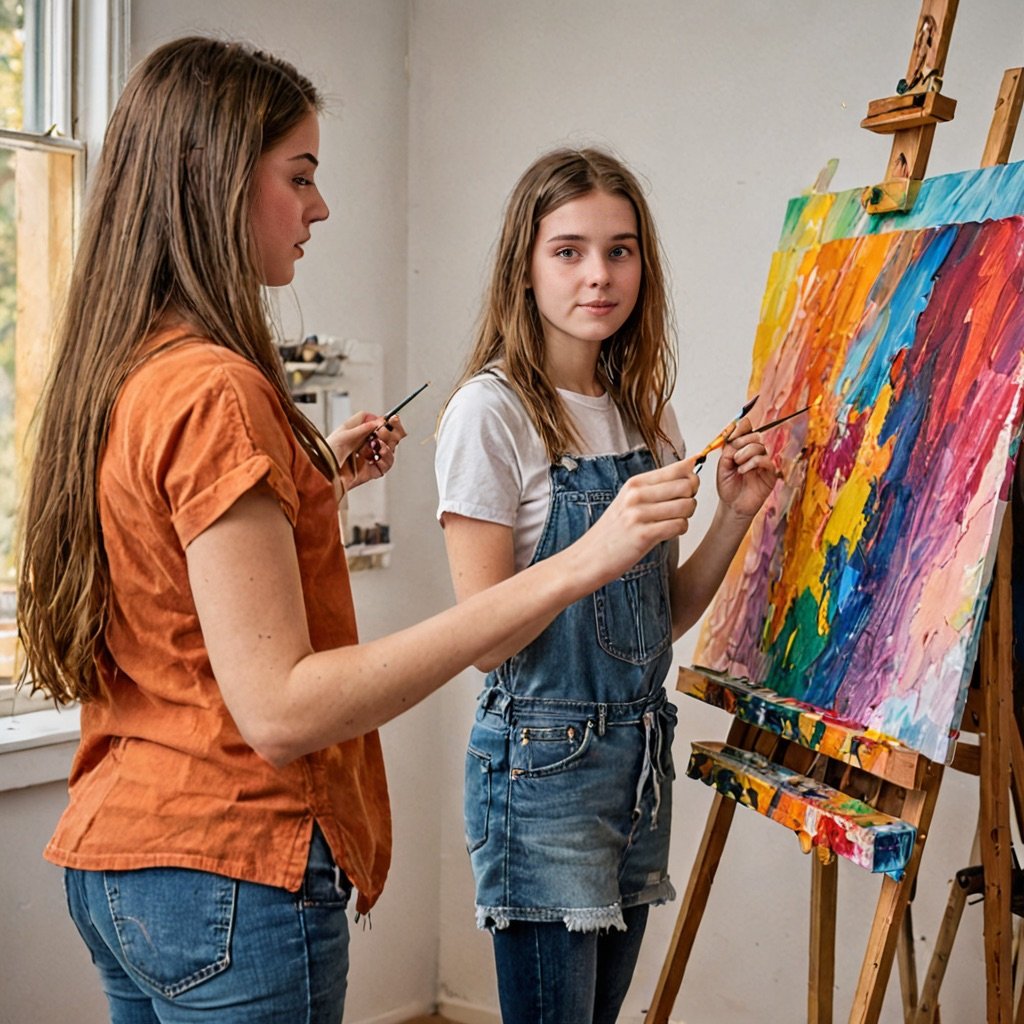
Acrylic Painting for Teens: Building Skills for Portfolio Work
Table of Contents
When teenagers start thinking seriously about art — whether for art school applications, competitions, or personal development — acrylic painting is almost always one of the first mediums they need to master. Acrylics occupy a unique position in the art world: versatile enough to mimic the effects of oil paint and watercolour, forgiving enough for developing artists to experiment freely, and respected enough by portfolio evaluators to carry weight in an application.
But there’s a gap between casual acrylic painting and the kind of acrylic work that belongs in a portfolio. The techniques teens learn in a structured art program are fundamentally different from what they pick up painting for fun in their bedroom. Building portfolio-quality acrylic skills requires understanding colour mixing at a sophisticated level, developing control over opacity and layering, learning composition principles, and — perhaps most importantly — learning to paint with intention rather than impulse.
At Muzart Music and Art School in Etobicoke near Cloverdale Mall, acrylic painting instruction is a core component of our art lessons program, particularly for teens preparing portfolios for art school applications. Here’s what the journey from casual painter to portfolio-ready acrylic artist actually looks like.
Why Acrylics Are the Starting Medium for Serious Teen Artists
Art instructors consistently recommend acrylics as the primary painting medium for teenagers, and the reasons go beyond convenience. Acrylics offer a combination of properties that make them ideal for developing artists who need to build skills quickly and produce portfolio-quality work within a defined timeline.
Fast drying time allows for rapid iteration. Unlike oil paint, which can take days or weeks to dry between layers, acrylics dry within minutes. For a teenager working toward a portfolio deadline, this speed is critical. It allows students to build up layers in a single session, make corrections without waiting, and complete finished pieces in a fraction of the time that oils would require.
Forgiveness without crutches. Acrylics can be painted over easily. A failed section doesn’t require scraping, sanding, or starting over — you simply paint on top of it once the underlying layer dries. This forgiveness encourages experimentation, which is exactly what developing artists need. However, because acrylics dry permanently and can’t be reworked the way oils can, students still learn to make deliberate decisions rather than endlessly adjusting.
Range of finish and effect. Depending on how they’re applied, acrylics can produce effects that range from watercolour-like transparency (when diluted with water or medium) to thick, textured impasto (when applied heavily with a palette knife). This versatility means teens can explore multiple approaches within a single medium, developing a broader skill set without switching materials.
Material accessibility. Quality student-grade acrylics are affordable and widely available. At Muzart, all painting materials are included in our lesson fees, so students can focus on skill development without worrying about supply costs.
The Core Acrylic Techniques Every Teen Portfolio Student Must Learn
Portfolio evaluators aren’t looking for paintings that simply look nice — they’re looking for evidence of technical understanding, creative thinking, and artistic development. These are the specific acrylic techniques that demonstrate those qualities.
Colour Mixing and Colour Theory Application
The ability to mix accurate, intentional colours is the single most telling indicator of a student’s painting skill level. Beginners squeeze paint directly from tubes and end up with garish, unnuanced colours. Skilled painters mix every colour they use, creating custom palettes that are cohesive, atmospheric, and specific to the subject being painted.
Teens at Muzart learn to work from a limited palette — typically a warm and cool version of each primary colour plus white — and mix every other colour they need. This constraint forces a deep understanding of colour relationships and produces paintings with harmonious colour schemes that evaluators immediately recognize as the work of a trained artist.
Colour temperature is another concept that separates amateur work from portfolio-quality painting. Understanding that shadows contain cool tones and highlights contain warm tones (or vice versa, depending on the light source) adds a level of sophistication that transforms flat, lifeless paintings into work with genuine visual depth.
Value Structure and Underpainting
Before colour, there is value — the range from light to dark that gives a painting its structure. Teen students learn to plan the value structure of a painting before applying any colour, often through an underpainting in a single neutral tone. This process teaches students to see the world in terms of light patterns rather than colours, which is a fundamental shift in visual perception.
A strong value structure is what makes a painting “read” from across a room. Portfolio evaluators often evaluate work at a distance first, and paintings with strong value contrast and clear light logic stand out immediately. Students who skip this step and jump straight to colour almost always produce work that feels flat and unconvincing, regardless of how well the colours themselves are mixed.
Edge Control and Brushwork
The edges in a painting — where one shape meets another — communicate as much information as the shapes themselves. Hard edges draw the eye and create a sense of sharpness and focus. Soft edges recede and suggest atmosphere, movement, or secondary importance. Controlling edges intentionally is one of the most advanced techniques a teen painter can demonstrate in a portfolio piece.
Brushwork is equally important. Every brushstroke should serve a purpose: describing form, creating texture, directing the viewer’s eye, or contributing to the overall energy of the painting. Evaluators can immediately tell whether a student has been painting mindfully or simply filling in areas with colour. At Muzart, instructors help teens develop conscious brushwork habits early, so that by the time they’re producing portfolio pieces, deliberate mark-making is instinctive.
Composition and Focal Point
A technically excellent painting with poor composition will always underwhelm. Teens learn compositional principles — the rule of thirds, leading lines, visual weight, positive and negative space, and asymmetrical balance — as practical tools rather than abstract rules. Every painting assignment at Muzart includes a compositional planning phase where the student creates thumbnail sketches before committing to a full-scale canvas.
The ability to create a clear focal point — an area of the painting that draws the viewer’s eye first and holds their attention — is a compositional skill that portfolio evaluators prioritize. Focal points are created through contrast: the area of highest value contrast, the sharpest edges, the most saturated colour, or the most detailed rendering should all converge at the focal point.
Building a Portfolio-Quality Acrylic Body of Work
For teens preparing applications to programs at OCAD, Sheridan, or other Ontario art schools, the portfolio needs to demonstrate range, growth, and technical skill across multiple pieces. Acrylic work typically forms a significant portion of a painting portfolio, and the pieces need to work together as a cohesive collection.
Subject variety matters. A portfolio with five still life paintings, no matter how well executed, suggests limited range. Students at Muzart work across subjects — still life, landscape, portraiture, and abstract composition — to demonstrate versatility. Each subject tests different skills: still life develops observational accuracy, landscape teaches atmospheric perspective, portraiture demands anatomical understanding, and abstraction shows creative risk-taking.
Show process, not just product. Many art school applications ask for process work alongside finished pieces. Teens who document their sketches, colour studies, value thumbnails, and work-in-progress photographs demonstrate a mature, thoughtful approach to art-making that evaluators value highly. Students in Muzart’s portfolio preparation program learn to document their process from the beginning, building a library of preparatory work that supports each finished piece.
Technical growth should be visible. Arranging portfolio pieces to show progression — from earlier, simpler work to more recent, sophisticated pieces — tells a story of development. Evaluators want to see that a student is on an upward trajectory, not that they’ve plateaued at a competent level. This is one reason why starting portfolio preparation early, ideally 12 to 18 months before application deadlines, gives students the best chance of demonstrating meaningful growth.
The Role of Private Instruction in Teen Acrylic Development
Group art classes introduce techniques and provide a supportive creative environment, but portfolio-level acrylic work requires individualized attention that only private art lessons can provide.
In a private lesson, an instructor can identify a student’s specific weaknesses — perhaps their colour mixing is strong but their edges are too uniform, or their compositions are dynamic but their value range is too narrow — and design exercises that target exactly those areas. This kind of personalized feedback loop accelerates development dramatically compared to generalized group instruction.
Private art instruction at Muzart is available for students of all ages, and our portfolio preparation program — at $310 per month for one-hour lessons with all materials included — is specifically designed for teens working toward art school applications. Each session balances new technique instruction with dedicated portfolio production time, ensuring that students are building skills and creating submission-ready work simultaneously.
For younger teens who are exploring art but not yet focused on portfolio work, our group art classes provide an excellent introduction to acrylic painting alongside other mediums like watercolour, drawing, and mixed media.
Frequently Asked Questions About Acrylic Painting for Teens
What age should a teenager start working on acrylic painting for portfolio purposes?
Students who begin focused acrylic instruction by age 14 or 15 are well-positioned for portfolio submissions at age 17 or 18. This timeline allows two to three years of skill development, which is enough to show significant growth in a portfolio. However, starting earlier is always beneficial — students who have been painting since childhood bring strong foundational skills to focused portfolio work. Starting later is also possible, but may require more intensive instruction to build the skill level evaluators expect.
How many acrylic paintings should a teen include in an art school portfolio?
This varies by program, but most Ontario art school applications expect to see between 10 and 20 pieces total across all mediums. Within that, three to five strong acrylic paintings is a solid contribution. The emphasis should be on quality and variety rather than quantity. One exceptional acrylic painting demonstrates more skill than three mediocre ones. Your instructor at Muzart will help curate the strongest selection for each application.
Can acrylic painting be self-taught for portfolio preparation?
Self-teaching can develop basic skills, but portfolio-quality work almost always requires structured instruction. The gap between amateur acrylic painting and portfolio-ready painting lies in details that are invisible to the untrained eye — subtle colour temperature shifts, intentional edge quality, deliberate composition. A trained instructor sees these elements and provides the feedback necessary to elevate work from competent to compelling. Request more information about how Muzart’s structured approach develops portfolio-level skills.
Do art schools prefer to see acrylics or oils in a portfolio?
Most Ontario art school programs accept and value both mediums equally at the undergraduate application level. Acrylics are a pragmatic choice for teen applicants because they’re faster to work with, easier to transport, and demonstrate the same core painting skills as oils. Some students incorporate both mediums in their portfolio to show versatility. The evaluators are assessing painting fundamentals — colour, value, composition, brushwork — not the specific paint formulation used.
How often should a teenager practice acrylic painting outside of lessons?
Two to three focused painting sessions per week, each lasting one to two hours, is a productive practice schedule for a teen building toward a portfolio. On days without full painting sessions, shorter exercises like colour mixing studies, value sketches, and compositional thumbnails keep skills developing. Consistency matters more than marathon painting sessions. Students who paint regularly in shorter bursts develop muscle memory and visual intuition faster than those who paint infrequently in long sessions.
Start Building Real Acrylic Skills at Muzart
The difference between a teenager who paints casually and one who paints with portfolio-level skill comes down to structured instruction, intentional practice, and expert feedback. The techniques described in this guide — colour mixing, value structure, edge control, brushwork, and composition — aren’t talents that some teens have and others don’t. They’re skills that any dedicated student can develop with the right guidance.
At Muzart Music and Art School in Etobicoke near Cloverdale Mall, our art instruction programs give teens the structured pathway they need to move from beginner to portfolio-ready. Whether your teenager is exploring art for the first time or preparing for an upcoming art school application, we have a program that fits.
Book a trial art lesson today — a portfolio preparation trial is $70 — and see how focused instruction transforms the way your teen approaches painting. Families across Etobicoke, Toronto, and Mississauga are welcome.