
Drum Lessons for Children with ADHD: Why Percussion Works When Nothing Else Does
Table of Contents
Most parents who book a drum trial lesson at Muzart Music and Art School for a child with ADHD have already tried something else. Piano, guitar, sometimes violin. The pattern usually looks the same: enthusiasm in the first two weeks, resistance by week four, full meltdown by week eight. The lessons get dropped, and parents are left wondering whether music is simply not going to work for their child.
It almost always does work. Just not on the instrument they tried first.
For children with ADHD or significant focus challenges, drums tend to succeed where other instruments quietly fail. This is not a marketing claim — it is something we have watched happen consistently in our Etobicoke studio, and it is grounded in how a drum lesson is structured differently from a piano or guitar lesson at the beginner level.
Why Drums Work Differently for ADHD Kids
In our experience teaching beginners across all four instruments we offer, drum lessons engage focus differently than piano or guitar lessons. The reason is structural: drumming is more physical, and at the early stages there is no traditional note-reading involved. That combination lowers the cognitive load that often overwhelms children with ADHD when they are learning music.
When a child sits at a piano for their first lesson, they are simultaneously asked to look at a page of symbols, translate those symbols into key positions, coordinate two hands moving independently, control finger pressure, and hold a steady tempo. For a neurotypical child, this is challenging. For a child with ADHD, it can be genuinely impossible without significant scaffolding — and the scaffolding itself can feel like more rules to track.
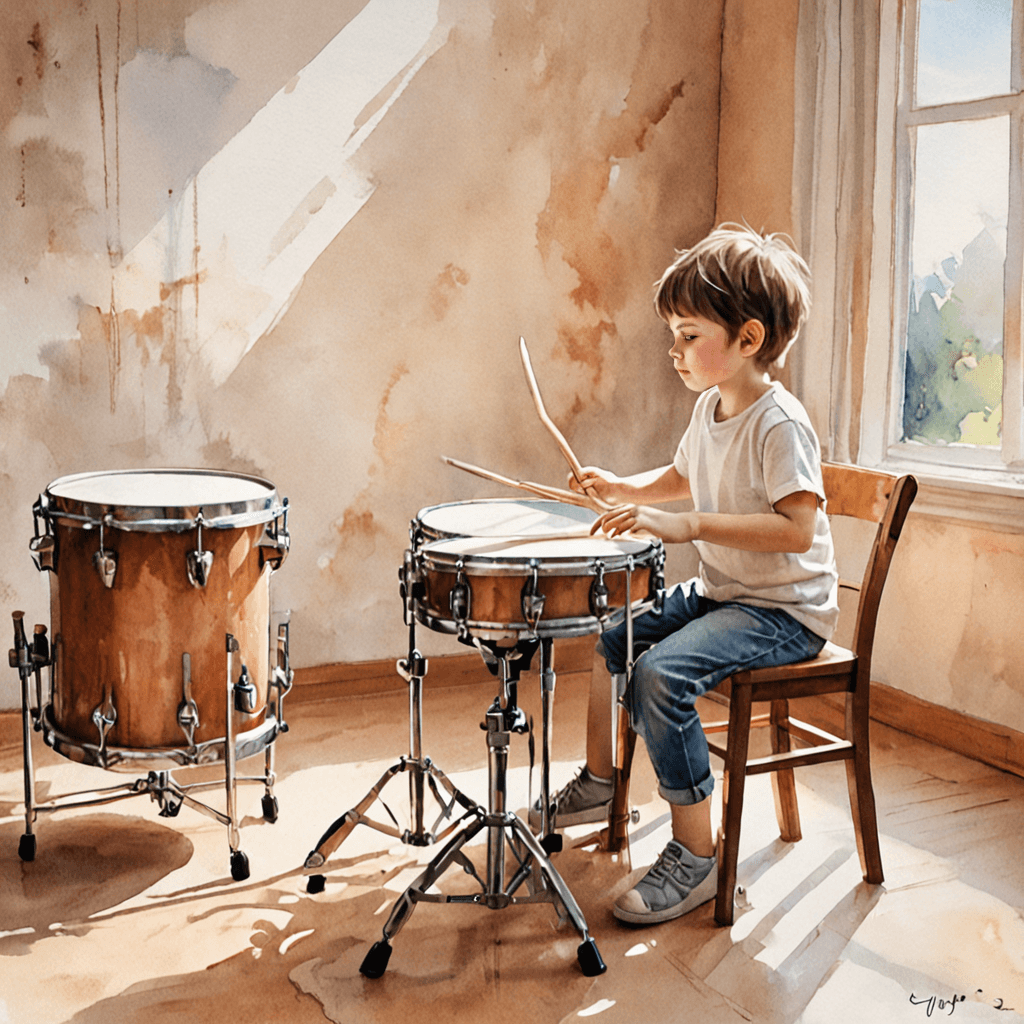
A first drum lesson looks completely different. The child sits behind the kit, watches the teacher demonstrate a basic rock beat, and starts playing along. There is no page of symbols. There is no decoding step. There is movement, sound, and feedback in the same moment. The child’s brain only has to manage one channel: what their body does makes a sound, and they hear immediately whether it matches what they intended.
That single-channel structure is exactly what many ADHD children need to lock into focus.
The Cognitive-Load Advantage of No Sheet Music (At First)
Standard music notation is one of the most cognitively demanding things a beginner can be asked to do. It requires sustained working memory, sequential processing, and the ability to translate visual symbols into motor output in real time. Children with ADHD often struggle with exactly these kinds of tasks, especially in the early weeks when nothing about the system feels intuitive yet.
Drum lessons sidestep this in the beginner phase. Rhythm gets taught through demonstration, count-along, and repetition. Students learn to feel a beat, count subdivisions out loud, and build coordination through physical practice — long before they are asked to read drum notation. By the time notation is introduced (usually well into the first year, sometimes later), the student already understands the rhythms intuitively. They are not learning notation as a foreign language; they are learning to label something they already know how to do.
For an ADHD child, this sequencing matters enormously. The reward — making music — comes immediately, not after months of struggling with prerequisites. That early reward is often what keeps a child returning to lessons week after week, which is the entire game.
Why Physical Engagement Channels ADHD Energy Productively
ADHD is not a deficit of attention. It is a difference in how attention is regulated. Children with ADHD often pay too much attention to too many things at once, which is why sitting still and focusing narrowly is so taxing. The conventional wisdom — sit quietly, focus harder, try again — frequently makes things worse.
Drums work with that wiring instead of against it. Drumming is whole-body activity. Both arms are doing something, both legs are doing something, the eyes are tracking the kit, the ears are listening for tempo. There are enough simultaneous physical channels that the child’s natural distractibility gets converted into coordination practice. Energy that would otherwise leak out as fidgeting or restlessness is the fuel for the lesson, not the obstacle to it.
Parents often tell us that their ADHD child is calmer after a drum lesson than before — not because the lesson exhausted them, but because it gave their nervous system something organized to do for thirty minutes. That is a different kind of focus than what a piano lesson asks for, and it is one many ADHD kids can sustain.
What the First Few Months Typically Look Like
A common question from parents is what realistic progress looks like. The honest answer is that it varies more for ADHD students than for neurotypical students, but there are patterns we see consistently.
In the first lesson, most students play along to a simple rhythm in the second half of the session. The rhythm is very basic — maybe just a steady kick and snare pattern over a song with a clear backbeat — but they are playing along to actual music on day one. Those small wins early in the process are essential for ADHD students, who often arrive expecting to fail at music because they have failed before.
By around the sixth to eighth lesson, most students can play through a simple full song start to finish. Not a complicated arrangement, but a real song with a recognizable structure. For a child who could not get through five minutes of piano practice without melting down, this is a transformative experience.
Beyond that, progress depends on practice, the child’s specific challenges, and how well the teacher adapts the curriculum. Which brings us to the most important factor.
Why Private Drum Lessons Matter More for ADHD Students
We offer private lessons only — no group music classes — and for ADHD students this is not a minor detail. Group classes pace to the median student. ADHD children are rarely the median student. They might be ahead on physical coordination and behind on patience, or vice versa, and a group setting cannot adapt to that.
A private lesson can. A good drum teacher working one-on-one will notice within the first ten minutes whether the child needs more visual demonstration, more verbal explanation, more breaks, more challenge, or more repetition. That responsiveness is the entire reason private drum lessons in Etobicoke work for kids who struggle in larger group environments — at school, at sports, anywhere the curriculum is fixed and the child has to fit it.
A trial lesson is the best way to see this in action. Our drum trial lesson is $35, and parents are welcome to sit in for the first lesson to watch how their child responds to the teacher and the instrument before committing to a monthly program at $155.
Finding the Right Drum Teacher for an ADHD Child
Not every drum teacher is the right fit for an ADHD student, and it is worth saying that openly. Some teachers prioritize technical polish from week one. Others teach to a strict curriculum regardless of the child’s pace. For a neurotypical, motivated student, either approach can work.
For an ADHD student, the teacher’s flexibility and patience matter more than their technical résumé. Look for teachers who:
- Explain concepts in multiple ways without becoming frustrated
- Adjust the lesson structure based on the child’s energy that day
- Celebrate small wins instead of dismissing them
- Communicate clearly with parents about what is working and what is not
If you are considering music lessons for your child in Etobicoke and ADHD or focus challenges are part of the picture, we encourage you to mention this when you book. It helps us match the student with the right teaching approach from the first lesson onward.
Frequently Asked Questions
At what age can a child with ADHD start drum lessons?
Most students start between ages six and eight, but we have had successful five-year-old beginners and we regularly see older children who have already cycled through other instruments. For ADHD students specifically, readiness has less to do with age and more to do with whether they can sit with a teacher for a focused period — even a short one — and respond to redirection. A trial lesson is the most reliable way to gauge readiness.
Does drumming actually help with focus, or is that just marketing?
We are careful not to overclaim, because every child is different. What we can say from teaching practice is that the structure of a drum lesson — physical, immediate, single-channel — is easier for many ADHD students to engage with than the structure of a piano or guitar lesson. Whether drumming generalizes to better focus outside the studio depends on many factors we cannot control, but inside the studio the focus difference is consistent enough that we have stopped being surprised by it.
Will my child need to learn to read music?
Eventually, yes — drum notation becomes important as students progress. But in the beginner phase, we focus on rhythm and physical coordination first. Notation is introduced gradually, usually once the student is comfortable with basic patterns and can count along confidently. For ADHD students, this delayed introduction of reading is one of the reasons drums work so well.
How long are drum lessons, and is that too long for an ADHD child?
Our standard music lessons are thirty minutes, which works well for most beginners including those with ADHD. The lesson is structured with enough variety — warm-ups, new material, song play-along, recap — that even students who struggle with sustained attention can stay engaged. If a thirty-minute lesson is genuinely too much, the teacher can adjust the structure within the lesson rather than shortening it.
What does a trial drum lesson cost, and what should I expect?
A drum trial lesson at Muzart is $35. The teacher will spend the session getting to know your child, introducing the kit, teaching a simple beat, and likely playing along to a song. For ADHD students, we recommend that parents stay for the trial so the teacher can ask questions about how your child learns best. After the trial, you can decide whether to enrol in our monthly program at $155, which includes weekly thirty-minute private lessons and all materials.
If your child has ADHD and music has not worked out so far, drums are worth a serious look. To book a trial lesson, visit our book now page, or request more information if you would like to talk through your child’s specific situation before committing to a session.