
Painting Classes for Children in Etobicoke: Acrylic, Watercolour, and Beyond
Table of Contents
Drawing gets all the attention in early children’s art education, and painting is often treated as a more advanced activity to be saved for later. That’s backwards. Painting introduces children to colour, texture, and the relationship between hand and material in ways drawing simply can’t, and the cognitive and creative gains from regular painting work are some of the most underrated benefits of an arts-based childhood. Below is what makes painting different from drawing for young learners, what each medium teaches, and what to look for when you’re choosing painting classes for children in Etobicoke.
Why Painting Specifically (And Not Just Drawing)
Drawing develops observation, line, and composition. Painting develops something different: the ability to think in colour, to manage a medium that doesn’t always behave, and to make decisions in real time about value, mixing, and layering. A child who only draws develops a flat visual vocabulary; a child who paints regularly develops a richer one.
There’s also a quiet cognitive benefit: painting forces children to plan ahead in a way drawing doesn’t. With pencil, you can erase. With paint, you commit. Children who paint regularly become noticeably better at decision-making — they assess the colour, the placement, the timing of when to add another layer, and then they commit. This pattern of deliberate decision-making transfers into other areas of learning.
The third advantage is more emotional: painting is messier, more sensory, and more forgiving of “mistakes.” A blob of unintended green can become a tree, a shadow, a wave. Children working in paint are constantly turning accidents into opportunities, which builds creative resilience in a way that more controlled media don’t.
Acrylic, Watercolour, Gouache, and Mixed Media: What Each Teaches
Children’s painting classes typically cycle through several different media over the course of a year. Each one teaches something distinct:
Acrylic paint is the most forgiving and the most versatile starting point for children. It dries quickly, layers well, can be applied thickly or thinly, and corrects easily — a child who paints over an area they don’t like sees the correction immediately. Acrylic introduces the foundational skills of colour mixing, brush control, and layering without the patience demands of slower-drying media.
Watercolour teaches something acrylic can’t: working with a medium that has its own behaviour. Water moves, pigment spreads, the paper itself becomes part of the composition. Children who paint regularly in watercolour develop a particular kind of patience — they learn to wait, to let the medium do what it does, and to respond to what’s happening on the paper rather than forcing what they imagined onto it. This is one of the most valuable lessons in any artistic education.
Gouache sits between acrylic and watercolour. It’s water-based like watercolour but opaque like acrylic, which makes it ideal for teaching colour values and flat-design composition. Many illustration programs at the university level still use gouache because it’s the medium that most directly teaches design thinking.
Mixed media — combining paint with collage, ink, pastels, markers, or unexpected materials — is where children’s painting work gets genuinely playful. Mixed media projects let kids treat the painting surface as a place to build something rather than just decorate. This is also where personal style first starts emerging, often around ages eight to ten.
A well-run children’s painting program rotates through these media over the course of a year, giving children real exposure to each. A program that only does acrylic — however well-taught — is leaving most of the painting education on the table.
What Children Actually Gain From Painting Classes
The benefits stack across cognitive, emotional, and practical domains:
Colour literacy. Children who paint regularly develop a vocabulary for colour that drawing alone doesn’t build. They learn what colours do next to each other, how warm and cool tones interact, why some combinations sing and others fight. This literacy carries into how they see the world.
Patience and process tolerance. Watercolour particularly teaches patience — you can’t rush a wash that needs to dry. Children who paint regularly become noticeably better at sustained attention on extended projects.
Decision-making under uncertainty. Paint forces commitment. Children who paint develop comfort with making choices they can’t fully undo, which is a transferable life skill.
Process from observation. Painting still lifes, landscapes, or scenes from observation teaches the same visual literacy that drawing teaches, but with the added challenge of translating what you see into colour. This is foundational for any child who might later pursue serious art education or portfolio preparation.
Creative resilience. Painting accidents become creative opportunities. Children who paint develop the habit of working with what’s in front of them rather than abandoning the piece when it doesn’t go as planned.
Pure enjoyment. Painting is genuinely fun for most children — more sensory, more immediate, and more visually rewarding than many other artistic activities. Children who associate art with the pleasure of paint typically continue making art voluntarily long after their structured lessons end.
Age-Appropriate Painting Work
Painting classes for children should be calibrated to age and developmental stage. A program that runs the same curriculum for five-year-olds and twelve-year-olds isn’t serving either group well.
Ages 5–7: Foundations and play. Large brushes, large paper, primary colours, mixing experiments, sensory exploration. The goal isn’t producing finished pieces — it’s building familiarity with the medium and discovering what paint does. Children this age benefit from acrylic, fingerpaints, and simple watercolour exercises. Process matters far more than product.
Ages 8–10: Skill development. Colour mixing taught more deliberately. Introduction of composition, layering, and basic value. Children this age can start producing pieces that feel intentional and complete. Watercolour technique becomes more refined; gouache enters the rotation; mixed media projects expand. This is also where personal interests start showing up — some kids gravitate toward landscapes, others toward characters, others toward abstract work.
Ages 11–13: Pre-portfolio thinking. Children at this age can begin working on more sophisticated compositions, more refined technique, and the early foundations of portfolio-quality work. This is the stage where consistent painting practice starts mattering for kids who might later audition for arts high schools like ESA or Wexford, and the work done now feeds directly into the portfolios built in grades seven and eight.
The age cohorts matter enough that a single mixed-age painting class is rarely ideal. Our group art classes program groups children by age and stage so the curriculum matches the developmental readiness of each cohort.
What to Look For in a Children’s Painting Class
A media rotation that includes more than acrylic. Children should be exposed to watercolour, gouache, and mixed media over the course of a year. Programs that default to acrylic for every class are limiting what kids learn.
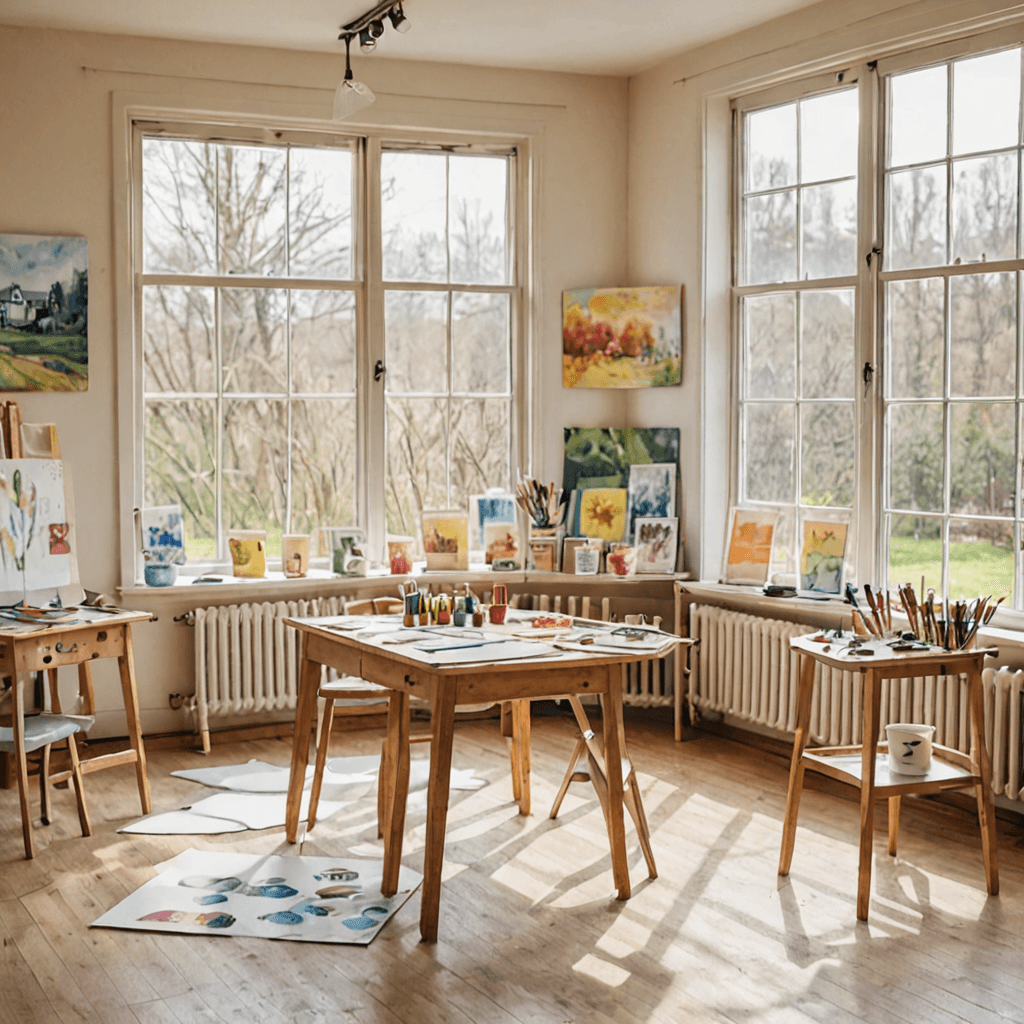
A real art space with proper materials. Painting requires actual easels, brushes in good condition, quality paint (cheap paint behaves badly and frustrates children unnecessarily), and surfaces appropriate to the medium. A program running painting classes out of a multi-purpose room with paper plates and craft-store brushes isn’t running serious painting classes.
Age-appropriate cohorts. A six-year-old and an eleven-year-old should not be in the same class together for the most part. Both kids will be poorly served — the curriculum can’t simultaneously meet the developmental needs of both.
Instruction that emphasizes both skill and creativity. The best children’s painting classes balance two things: teaching real technique (how to mix colour, how to use a brush, how to plan a composition) and giving kids genuine creative freedom within those lessons. Programs that lean too far in either direction — pure technique with no creativity, or pure free play with no instruction — leave kids stuck.
A teacher who genuinely enjoys teaching children. This is the variable that matters most and is hardest to assess from a website. The trial class is the way to assess it. A teacher who lights up when kids walk into the room and who treats children’s work with seriousness is the kind of teacher who builds lifelong artists.
The Group Format: Why It Works for Children’s Painting
Group art classes are the right format for children for several reasons. Children genuinely benefit from working alongside peers — they see other approaches to the same prompt, develop social comfort around art-making, and often push each other in productive ways. A child working alone with a private teacher can become tentative; the same child in a small group becomes braver, because the social context normalizes the messiness of painting.
That said, group classes are only the right choice for children — and only for art. At Muzart Music and Art School we offer art classes in Etobicoke as group classes for children specifically, while keeping all music instruction private regardless of age, and offering private art lessons for adults. The group dynamic that works beautifully for nine-year-olds painting watercolour landscapes wouldn’t serve a forty-five-year-old learning to paint — different stage of life, different needs.
Pricing and Practical Information
Group painting classes for children at Muzart run as part of the broader group art program, with all materials — paint, brushes, paper, canvases, mixed media supplies — included in the monthly tuition. The trial class is a low-commitment way to assess fit; ongoing tuition is structured monthly so families can plan around the school year. Pricing details, current schedule openings, and registration availability are easiest to confirm directly through a request for more information.
Frequently Asked Questions
What age should children start painting classes?
Most children are ready for structured painting classes around age five, though informal painting at home can start much earlier. Five-year-olds benefit from short, sensory-focused sessions; the deeper skill-building begins around age seven or eight. There’s no upper limit — children who don’t start painting until ages nine or ten still develop strongly with the right instruction.
Should my child take drawing classes before painting classes?
Not necessarily. Drawing and painting develop different skills, and there’s no rule that drawing has to come first. Many children develop best when they study both concurrently — drawing for observation and line, painting for colour and material. If you have to choose one to start with, choose the medium your child is most drawn to; engagement matters more than sequence at this age.
How long should a painting class for children be?
For ages five to seven, 45 to 60 minutes is appropriate — beyond an hour, most younger children lose focus. For ages eight to ten, 60 to 90 minutes works well. For ages eleven to thirteen, full 90-minute classes are productive, and these older children often want longer sessions, not shorter ones.
Do children’s painting classes need to be private?
No. For children, group classes are typically the better choice — the social dynamic supports creative bravery and exposes kids to other approaches. Private painting lessons for children are only useful in specific situations (significant skill gaps, intense pre-portfolio work, sensory sensitivities). For most kids, group classes deliver more.
What if my child says they “can’t paint”?
Almost every child can paint, and “I can’t” usually means “I’ve tried and didn’t like how it looked.” A good children’s painting program teaches process and removes the pressure to produce impressive finished pieces. Children who arrive saying they can’t paint often become some of the most enthusiastic painters within a few months.
Does painting practice as a child help with art portfolios later?
Significantly. Children who’ve painted consistently from age six or seven enter the portfolio-prep years with foundations that other students take a full year to build. The watercolour technique, colour literacy, and brush control developed in childhood directly support audition work for arts high schools and, later, university art programs. Strong portfolios are built over years, not months.
Ready to Try?
If you’re considering painting classes for your child in Etobicoke, the simplest first step is the trial class — a chance to see whether your child responds to the teacher, the materials, and the group environment before committing to ongoing enrolment.
You can book a trial class directly online, or request more information about pricing, scheduling, and which age group would be the right fit. Our studio is located in Etobicoke near Cloverdale Mall, with easy parking and convenient access for families across west Toronto, Etobicoke, and east Mississauga.