
ESA Art Portfolio: What Reviewers Look For in a Visual Arts Audition
Table of Contents
The Etobicoke School of the Arts is one of the most competitive arts-focused public high schools in Ontario, and the visual arts program is among its most demanding entry points. Every year, hundreds of grade 8 students audition for a relatively small number of seats — and the difference between successful and unsuccessful applicants almost never comes down to raw talent. It comes down to whether the audition portfolio shows the qualities reviewers are actually looking for, and whether the on-site test and interview reveal a student who’s ready for an intensive arts environment. Below is what an ESA visual arts audition actually involves, what reviewers respond to, and how to build toward a standout submission.
What the ESA Visual Arts Audition Actually Includes
ESA’s audition process for the visual arts program typically involves three components, though specifics shift year to year and applicants should always verify the current year’s requirements directly with the school:
A portfolio of original artwork. Usually ten to fifteen pieces in a range of media, submitted as part of the application package. The portfolio is the foundation of the audition — strong portfolios open the door, weak ones close it before the on-site components matter.
An on-site visual arts test. A timed in-person exercise where applicants produce artwork under observation, often involving observational drawing from a still life or model setup. This tests whether your portfolio reflects skills you actually have, or pieces produced with significant outside help.
An interview. A conversation with art faculty about your portfolio, your artistic interests, and your reasons for applying to ESA specifically. The interview tests articulation — can you talk about your own work, your influences, and your goals?
Strong applicants prepare deliberately for all three. Treating the portfolio as the only meaningful component is one of the most common mistakes — applicants with brilliant submitted work routinely fail at the on-site test because they’ve never produced art under time pressure with someone watching.
What Reviewers Are Actually Looking For
ESA reviewers are not selecting the most technically polished applicants. They’re selecting students who will thrive in a four-year intensive arts program. The qualities that distinguish successful auditions:
Observational skill. Can the applicant see clearly and translate what they see onto paper? Observational drawing — still lifes, figure work, environment studies — is a non-negotiable foundation. A portfolio without strong observational pieces signals an applicant who only draws from imagination, which doesn’t develop the visual literacy ESA’s curriculum demands.
Range across media. Pencil, charcoal, ink, watercolour, acrylic, mixed media, sculpture, sometimes digital. Reviewers want evidence that you’ve explored beyond your comfort zone. A portfolio that’s only pencil drawings — however accomplished — reads as a narrower applicant than one showing thoughtful work across four or five media.
Genuine personal voice. Pieces that feel like the applicant rather than like a teacher’s assignment. Reviewers see hundreds of portfolios full of the same fruit bowls, the same gesture drawings, the same self-portrait. A piece that shows real personal interest — even if technically less refined — often outperforms a polished but generic submission.
Process and exploration. Sketchbook pages, ideation work, experiments that didn’t quite succeed. ESA wants students who think with their materials, not just students who can execute finished pieces.
Conceptual depth at the appropriate level. Reviewers aren’t expecting grade 8 students to make conceptually sophisticated art. They are looking for evidence that the applicant thinks about why they make what they make — what interests them, what they’re trying to communicate, what questions their work is exploring.
What to Include in Your ESA Visual Arts Portfolio
While the exact specifications vary, here’s the composition that consistently aligns with what ESA reviewers value:
Observational drawing (3–5 pieces). A still life, a figure study, an interior scene, a self-portrait from a mirror, a detailed observational study of an object. Pencil or charcoal is fine, though showing more than one drawing medium strengthens the portfolio.
Colour work (2–4 pieces). Watercolour, acrylic, gouache, marker, or coloured pencil. Reviewers want to see that you can think in colour, not just in tone. A still life rendered in watercolour reads more sophisticated than the same still life in graphite.
Personal or self-directed work (2–3 pieces). Art you made because you wanted to. A theme that interests you, a place that matters to you, a story you wanted to tell visually. These pieces are usually the most revealing parts of the portfolio.
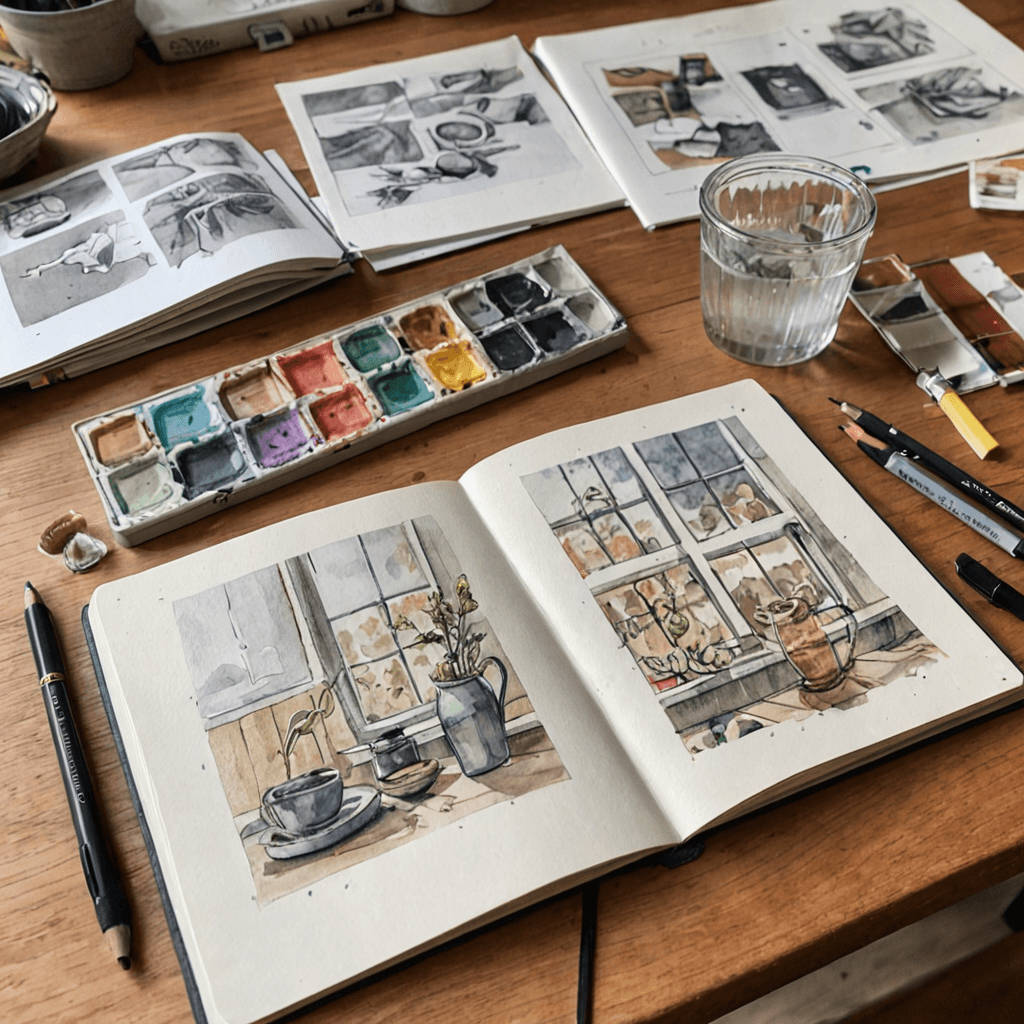
Sketchbook pages or process work (3–5 pages, or one curated sketchbook). This is the piece many applicants leave out, and it’s often the difference-maker. A sketchbook spread showing how you developed an idea — from rough thumbnails to refined composition — tells reviewers more about your artistic thinking than any finished piece can.
One ambitious or experimental piece (1 piece). Something where you tried a new medium, a complex composition, or a challenging subject. The piece doesn’t need to be your best technically — what matters is that it shows you’re willing to attempt difficult things.
Optional: a 3D or mixed media piece (1 piece). Not strictly required, but a paper sculpture, small clay piece, mixed media collage, or photographed installation broadens the portfolio meaningfully.
Twelve to fifteen pieces total, photographed cleanly against neutral backgrounds in even light. Quality matters more than quantity — a tighter portfolio of strong work consistently outperforms a larger portfolio padded with weaker pieces.
Preparing for the On-Site Visual Arts Test
The on-site test is where many strong portfolio applicants stumble. It typically involves a timed observational drawing exercise — sometimes with multiple short prompts, sometimes one extended piece. Students who haven’t practised drawing under pressure often produce noticeably weaker work than their portfolio suggests they’re capable of, which reviewers correctly read as evidence that the portfolio overstates the applicant’s actual skill.
The preparation strategy that works:
Practise observational drawing under time pressure. Set up still lifes at home, give yourself 20 to 45 minutes, and complete a piece in that window. Repeat weekly for at least three months before the audition. The goal is to make drawing-under-time-pressure feel familiar rather than panic-inducing.
Get comfortable being watched while drawing. Have a parent, sibling, or teacher sit nearby while you draw. The on-site test will involve faculty observing you — applicants who’ve only ever drawn alone often freeze.
Learn to recover from early mistakes. A common failure mode is starting the piece, making a mistake in the first ten minutes, and then mentally giving up. Practise pieces where you intentionally start poorly and have to recover.
Bring the right materials. Verify exactly what supplies you’re permitted to bring on test day and arrive with them organized. Borrowing materials from another student or using unfamiliar tools during a high-stakes test produces avoidable disasters.
Preparing for the Interview
The interview component tests whether you can talk about art — your own and others’. Reviewers are listening for genuine engagement, not rehearsed answers. A few patterns that consistently work:
Be ready to discuss specific pieces in your portfolio. Why you made each piece, what you were trying to achieve, what worked and what didn’t. Avoid generic answers like “I just thought it looked cool.”
Have an artist (or several) you can speak about thoughtfully. Pick artists whose work genuinely interests you — not the most famous artists, but ones you’ve actually thought about. Reviewers respond to specificity.
Be honest about your weaknesses. Reviewers ask about weaknesses to see whether applicants have self-awareness. “I struggle with figure drawing, and I’ve been practising it weekly for three months because I know it’s a gap” is a much stronger answer than “I don’t really have weaknesses.”
Have a real answer for why ESA specifically. “It’s a good school” or “my parents suggested it” are weak. Reviewers want applicants who’ve actually thought about why ESA — what about the program, the environment, the curriculum.
Common Mistakes That Sink ESA Visual Arts Auditions
Submitting a parent-curated portfolio. Reviewers can usually tell when a portfolio reflects what an adult thinks looks impressive rather than what the student actually does. Pieces feel disconnected from each other. The student can’t speak coherently about the work in the interview. The on-site test produces noticeably weaker work than the portfolio.
Heavy reliance on copied work. Recreations of anime characters, photorealistic portraits copied from photographs, intricate Pinterest-style designs — these pieces don’t reveal artistic thinking, just patience and copying skill. They consistently underperform original work.
No range. A portfolio of fifteen pencil drawings, however good, signals an applicant with a narrow practice. ESA wants students ready to explore multiple media seriously.
Missing the on-site test preparation. Strong portfolio + weak on-site performance = rejection. The gap between the two reads as parental help on the portfolio.
Generic interview answers. Reviewers conduct dozens of interviews. Applicants who say the same things every other applicant says — “I love art,” “I’ve always been creative,” “I want to develop my skills” — are forgettable. Specificity wins.
Late preparation. Students who begin focused preparation in grade 8 for a grade 9 audition often produce rushed work. Students who began consistent art practice in grade 6 or 7 enter the audition year with deeper foundations.
Building Toward an ESA Audition: A Realistic Timeline
For families targeting an ESA audition, the timeline that produces the strongest applicants:
Grade 6 to early grade 7: Build observational drawing foundations. Try multiple media. Develop a sketchbook habit. This is where artistic identity starts forming.
Late grade 7 to early grade 8: Begin focused portfolio work. Identify the gaps in your skill set and address them deliberately. Start practising drawing under time pressure.
Mid grade 8 (audition year): Refine final portfolio pieces, prepare for the on-site test, practise interview articulation, photograph and submit work.
This is why our portfolio preparation in Etobicoke program runs year-round with one-hour weekly private lessons — students who begin a full year before their audition consistently produce stronger submissions than students cramming portfolio work into three months. The same structured approach to portfolio preparation supports applicants targeting university art schools later on, so the foundations built for an ESA audition feed directly into OCAD-readiness years later. The portfolio prep program is $310 per month with all materials included, beginning with a $70 trial lesson.
Many families auditioning for ESA’s visual arts program also have a child considering the music audition track — for the vocal stream specifically, our singing lessons in Etobicoke program supports ESA voice auditioners directly.
Frequently Asked Questions
How competitive is the ESA visual arts audition?
ESA receives several hundred applications for its visual arts program each year and accepts a substantially smaller number. The exact ratio varies, but the program is genuinely competitive and applicants benefit from beginning preparation well before grade 8.
Does my child need to take portfolio prep classes to audition for ESA?
Not strictly, but the data is clear: students who’ve had structured portfolio preparation with feedback consistently outperform those who prepared alone or with general art classes. The benefit isn’t just technique — it’s specific exposure to what reviewers look for in arts high school auditions.
What if my child is talented but has only ever drawn from imagination?
This is a common pattern and a real risk for ESA auditions. Imagination-only artists often struggle on the on-site observational test. We recommend starting observational drawing practice at least six to twelve months before the audition to build the skill that reviewers expect to see.
Can my child apply to ESA’s visual arts program even if they haven’t taken art classes before?
Yes, but it’s an uphill climb. Most successful applicants have had at least a few years of consistent art practice, whether through school art programs, private art lessons, or self-directed work. A student starting from zero in grade 8 will need exceptionally focused preparation.
How important is the interview compared to the portfolio?
The portfolio gets you the interview. The interview can confirm or undermine what the portfolio suggested. A weak portfolio rarely recovers in the interview, but a strong portfolio can be hurt by a weak interview — especially if the student can’t speak coherently about their own work.
What’s the difference between auditioning for ESA visual arts and applying to other arts high schools like Wexford or Cardinal Carter?
Each school has its own audition format and emphasis. ESA is known for its visual arts intensity and academic rigour; Wexford has a different cultural tone; Cardinal Carter focuses on Catholic arts education; Karen Kain is dance-focused. If you’re auditioning for multiple programs, prepare for each one specifically — a single portfolio sent unchanged to all of them is rarely the strongest strategy.
Ready to Start Preparing?
The students who succeed at ESA’s visual arts audition aren’t necessarily the most naturally talented — they’re the ones who started preparing early, got specific feedback, and built portfolios that demonstrated exactly the qualities reviewers look for. If your family is targeting a future ESA audition, the time to start is earlier than feels necessary.
You can book a portfolio prep trial to assess fit with an instructor, or request more information about the full audition-preparation path. Strong audition portfolios start with strong foundations — and those foundations are built over years, not weeks.