
Drawing Classes for Kids in Etobicoke: Skills Built in Year One
Table of Contents
Most parents think of drawing classes as a place where their child will produce nice pictures to put on the fridge. Quality drawing instruction does far more than that — it builds observational skills, fine motor control, visual problem-solving, and creative confidence that translate into school, sports, and eventually portfolio work years later. This guide walks through what actual drawing classes for kids cover in the first year, how group instruction differs from private lessons for this age group, and what Etobicoke families should look for when choosing a program.
Here’s what real drawing instruction looks like for children.
What Drawing Classes for Kids Actually Cover
A well-designed drawing program for children isn’t a series of craft projects. It’s a structured curriculum that builds specific observational and technical skills in a particular order, even when individual classes look fun and exploratory from the outside.
At Muzart Music and Art School, the foundation for young drawers (ages five through twelve) is built on five core skill areas. Hand-eye coordination develops through tracing, copying, and free drawing exercises that gradually move from heavily guided to fully independent. Observational drawing teaches children to look — really look — at what’s in front of them before putting pencil to paper, which is a skill very few children develop on their own. Line quality and pressure control build from heavy beginner marks to confident varied lines that carry expression. Basic shape recognition and construction teaches children to see complex objects as combinations of simpler shapes (a cat is an oval, two triangles, and a tail), which unlocks their ability to draw almost anything. And colour and shading fundamentals introduce light direction, basic value, and how shadows reveal three-dimensional form.
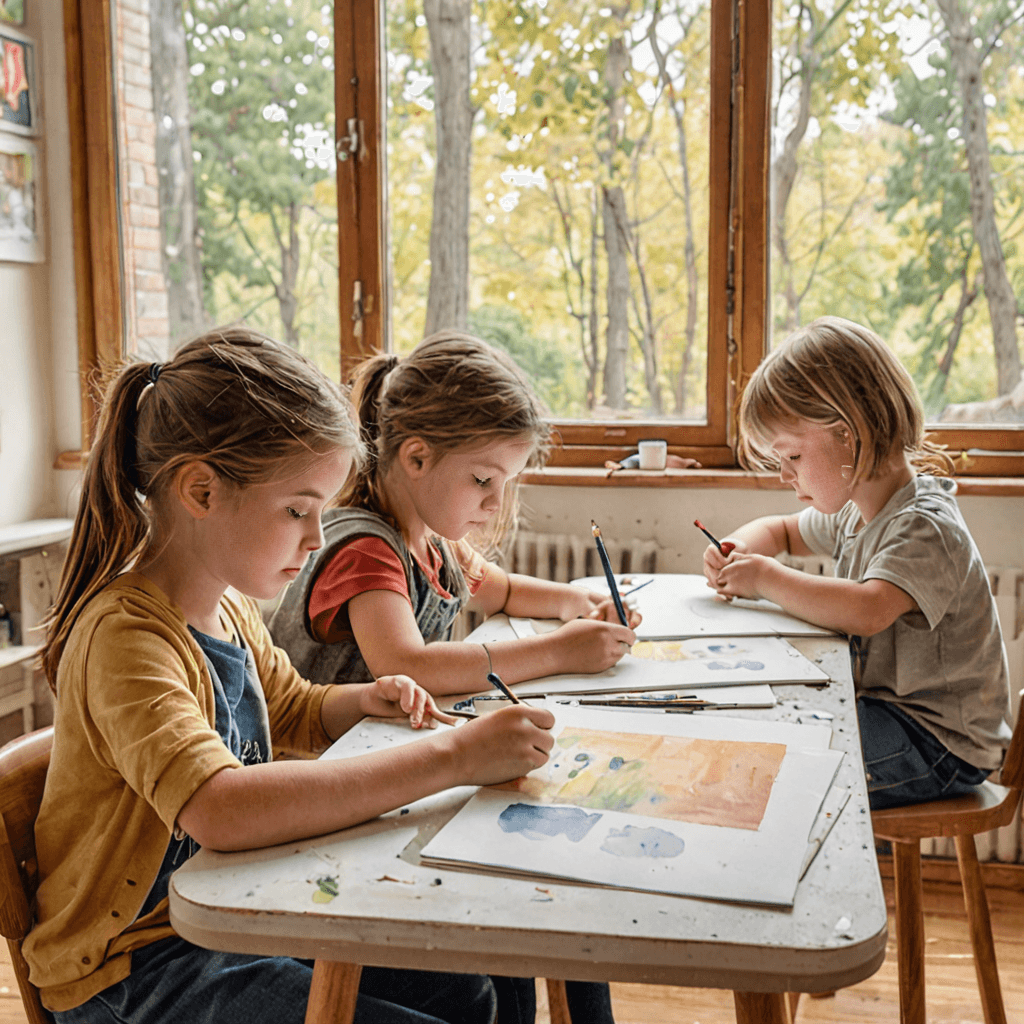
Most of this happens in classes that, to a parent watching from the doorway, look like children quietly working on drawings. The structure is invisible from the outside. The progress is visible six months later when those drawings look noticeably different.
The First Six Months: Core Skills Built
What does a year of weekly drawing instruction actually produce? Here’s the typical arc.
In months one and two, the focus is on building drawing comfort and basic line control. Children work on grip, pressure variation, and unhurried mark-making. Exercises move from highly guided (trace this, copy this) toward freer composition. By the end of month two, most children can draw recognizable subjects with deliberate line work — not realistic, but intentional.
In months three and four, observational drawing enters the curriculum. Children work from real objects placed in front of them — a leaf, a piece of fruit, a shoe — and learn to slow down enough to actually see what they’re looking at. This is a turning point. Children who previously drew symbols of objects (the cartoon idea of a flower) begin drawing the specific flower in front of them.
In months five and six, basic shape construction and proportion are introduced. Children learn to see complex subjects as combinations of ovals, rectangles, and triangles, which is the skill that turns “I can’t draw that” into “I can break that down.” Simple shading and light direction round out the half year. By month six, parents typically notice their child drawing at home more often and with more confidence — and the drawings look meaningfully different from what they were producing a few months earlier.
The second half of the year extends these foundations into colour work, more complex compositions, and the early introduction of different media (markers, coloured pencils, basic watercolour). Children who continue beyond their first year start to develop personal style and subject preferences.
Why Group Classes Work Especially Well for Drawing
For children specifically, group art classes have real advantages over private art lessons that aren’t always obvious to parents at first.
Children draw differently when they’re around other children drawing. They see what their peers are working on. They get inspired. They take small risks they wouldn’t take alone — trying a new subject, attempting a different medium, working larger than usual. The social context of art-making at this age is part of how skills get built.
Group classes also expose children to a wider range of subjects and techniques than a private lesson typically can, simply because the curriculum is built around a class arc rather than one child’s interests. A nine-year-old who loves drawing dragons benefits enormously from a class that also covers still life, portrait, landscape, and abstract work — they’d never choose those subjects on their own, but exposure builds the skill foundation they’ll later need for any subject.
That said, group art at Muzart is for children only. We offer private art lessons for all ages, including adults — but our group art classes are designed for the social and developmental context of children specifically. Adult learners who want to develop drawing skills work in private lessons, which is a different and more appropriate format for adult learning.
More information about our group art classes and the full curriculum arc is available on our art lessons in Etobicoke page.
What Six-to-Ten-Year-Olds Should Be Drawing
Parents sometimes ask whether their child’s drawings are “where they should be” for their age. The honest answer is that there’s enormous variation among children, and the most useful comparison is not your child to other children but your child six months from now versus your child today.
That said, a general guideline for what a quality drawing program produces in a child between ages six and ten over the first year: drawings of real objects (not just symbols) showing observed detail, drawings of people with proportional body parts and recognizable poses, drawings showing some sense of light and shadow (even if simplified), willingness to start over or revise rather than declaring “I can’t draw,” and an emerging ability to talk about their own work — what’s working, what they want to fix, what they’re proud of.
These are the markers of genuine skill development. A child producing competent symbolic drawings — a stick figure, a square house with a triangle roof — at the end of a year of weekly classes hasn’t actually progressed; they’ve stayed at the entry point. A child who can now draw what they actually see has gained a foundational visual literacy that will support every form of art they pursue going forward.
From Drawing Classes Toward Portfolio Work Later
For families thinking long-term, the drawing skills built in childhood are the foundation that supports more advanced work later — including art portfolio preparation for high school applications, arts-focused schools like ESA, Cardinal Carter, and Wexford, and eventually post-secondary programs like OCAD or Sheridan. Strong observational drawing in childhood is what allows a sixteen-year-old to build a portfolio that gets noticed in admissions.
This isn’t a reason to push young children into portfolio-oriented work prematurely. It’s a reason to make sure the foundational years are spent on real skill-building rather than craft projects, so the foundation is there when more advanced work becomes age-appropriate later. Families with longer-term ambitions can read more about how we structure later-stage work on our portfolio preparation in Etobicoke page.
Investment, Schedule, and Trial Classes
Group drawing and art classes at Muzart for children are priced as part of our broader art program. We recommend booking a trial class — typically $35 for the music programs and a similar entry point for art — so you and your child can see the class in action, meet the instructor, and decide whether the fit feels right before committing to an ongoing schedule.
Classes are weekly and grouped by age range, with after-school and weekend availability. Materials are included, so families don’t need to assemble supplies before starting. For specific class days, ages, and openings, request more information or book a trial class directly.
Frequently Asked Questions
What age can my child start drawing classes?
Most children are ready for structured group art classes between ages five and six, when they can sit and focus for the class duration and follow basic instructions. Some children are ready a bit earlier; others benefit from waiting until they’re a little older. The trial class is the best way to assess readiness for your specific child.
What’s the difference between group art classes and private art lessons?
At Muzart, group art classes are for children, and they’re built around peer learning, varied curriculum, and the social context that benefits young artists. Private art lessons are available for all ages — children, teens, and adults — and offer fully individualized instruction. Most children do well in the group format; private lessons are appropriate when a child has specific goals (like portfolio prep) or thrives with one-on-one attention.
Do you offer drawing classes for adults?
Not in a group format — group art classes at Muzart are for children only. Adults who want to develop drawing skills work with us in private art lessons, which suits the way adults typically learn art (more goal-oriented, often working toward specific projects or styles).
What kind of materials does my child need?
Materials are included in our art programs. You don’t need to buy supplies in advance of starting. If your child develops a strong interest and wants to draw at home between classes, we can recommend basic supplies (good pencils, a sketchbook, an eraser, a sharpener) that cover most beginner needs.
How long until I’ll see real progress in my child’s drawings?
Most parents notice meaningful change between months three and four — drawings start looking more deliberate, more observed, more confident. By the end of the first year, the change is usually unmistakable. Progress depends on consistent attendance and at least a little drawing at home between classes.
Does my child need to be “artistic” to enjoy drawing classes?
No. Drawing is a skill that’s built, not a talent some children have and others don’t. Children who arrive convinced they “can’t draw” often become some of the most engaged students once they discover that drawing is a craft they can actually learn — not a magical ability they’re missing.