
OCAD Environmental Design Portfolio: Required Pieces and Common Mistakes
Table of Contents
Most teens applying to OCAD Environmental Design come in with a strong general art portfolio — and that’s often the problem. Environmental Design reviewers aren’t looking for the same submission a strong illustration applicant would build. They’re looking for evidence that you think about space, environments, and how people move through them. Below is a breakdown of what an OCAD environmental design portfolio actually needs, the mistakes that quietly sink otherwise strong applications, and how to build the right body of work over the next twelve months.
What Environmental Design at OCAD Actually Is
Environmental Design at OCAD University is a four-year BDes program focused on the design of spatial experiences — interiors, exhibitions, retail and hospitality environments, urban design, and the relationship between people and the spaces they inhabit. It sits adjacent to interior design, architecture, and industrial design without being identical to any of them. Graduates work in interior design firms, exhibition design studios, set design, retail strategy, urban planning consultancies, and increasingly in experience design for technology companies.
This matters for your portfolio because reviewers aren’t just assessing whether you can draw or paint. They’re assessing whether you think spatially — whether your eye is drawn to how rooms feel, how light moves, how furniture organizes social interaction, how exhibitions guide visitors through narratives. A portfolio full of beautiful observational charcoal drawings of fruit might earn you a spot in OCAD Drawing and Painting. It won’t necessarily get you into Environmental Design.
What Reviewers Are Actually Looking For
The five qualities that distinguish strong Environmental Design submissions from generic art portfolios:
Spatial awareness. Pieces that show you noticing space — interior compositions, architectural sketches, perspective studies, scenes that demonstrate you see environments as designed rather than incidental. A still life painted in a thoughtfully lit corner of a room is more interesting to ED reviewers than a still life painted on a blank white background.
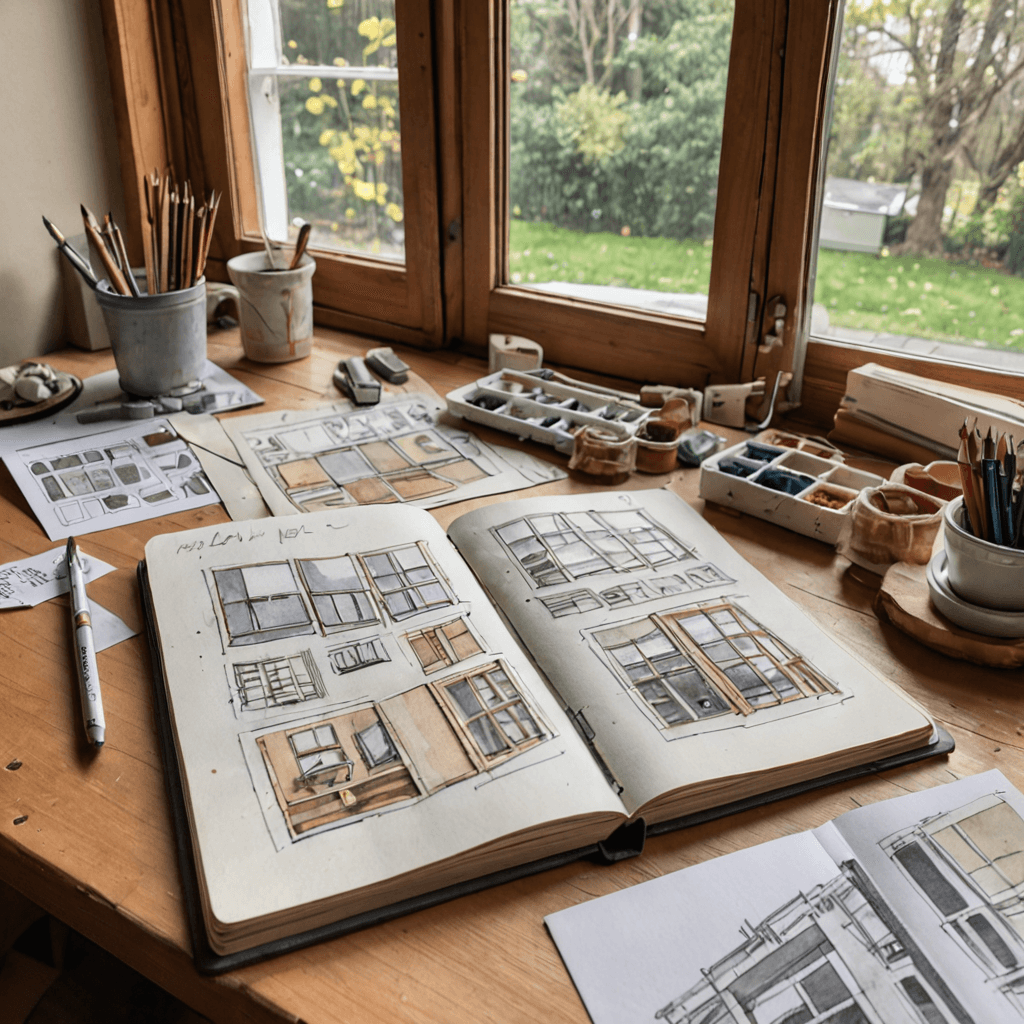
Process and thinking. Sketchbook pages, idea development, iterations, plans, sections, axonometric drawings, mood boards, material studies. Reviewers want to see how your mind works, not just polished final pieces. The work that didn’t quite succeed but shows interesting thinking often does more for an Environmental Design application than a single perfect finished piece.
Three-dimensional thinking. Some kind of 3D work is strongly recommended. This doesn’t mean you need to build architectural models — paper sculpture, cardboard maquettes, photographed installations, even a small designed object will demonstrate that you think beyond the picture plane.
Range of media. A portfolio that’s only graphite drawings reads as a drawing portfolio. Strong Environmental Design portfolios typically show pencil, ink, watercolour or marker, digital work, photography, and at least one piece of 3D work — even if some of these are represented by only a single example.
A point of view. What environments interest you? Small spaces, public spaces, commercial spaces, sacred spaces, theatrical spaces, sustainable spaces, accessible spaces? A portfolio with a quiet thematic thread reads more sophisticated than one assembled from whatever you happened to make in art class.
Required and Recommended Portfolio Pieces
OCAD’s portfolio requirements shift slightly year to year and you should always verify current specifications at ocadu.ca before submitting. As of the most recent guidance, Environmental Design applicants are expected to submit a body of work that demonstrates the qualities above. Here is the breakdown that aligns with what reviewers consistently value:
Observational drawing pieces (3–5 works). These prove you can see and translate three-dimensional space onto a two-dimensional surface. Strong choices include interior scenes, architectural exteriors, a complex still life arranged in a specific environment, or a portrait set within a clearly defined room. Avoid generic isolated objects on blank backgrounds.
Perspective and spatial studies (2–3 works). One-point or two-point perspective drawings of rooms, streets, courtyards, or imagined spaces. These can be from observation or from imagination. The point is to show that you understand how to construct space on paper.
Concept development / process work (a sketchbook or 3–5 pages of process). This is the piece that most applicants underweight. Reviewers want to see brainstorming, thumbnails, mood boards, material exploration, and failed first attempts that led to better second attempts. A clean, finished sketchbook is less compelling than a working one.
At least one three-dimensional piece (1–2 works). A paper sculpture, a cardboard maquette of an imagined room, a photographed installation, a small designed object, an experiment in textile or wood. Photograph it well from multiple angles.
A personal project (1–2 works). Something you made because you wanted to, not because it was assigned. Personal projects tell reviewers who you are. A redesigned bus stop in your neighbourhood, a documented exploration of a public space, a designed reading nook in your bedroom — these read as evidence of genuine interest in environmental design.
A statement of intent. Most applicants write something generic about loving art since childhood. Strong statements specifically identify what kind of spaces interest you, what questions you want to explore, and why Environmental Design at OCAD specifically (not just “any design program”) is the right fit.
The total typically lands at ten to fifteen pieces. Quality beats quantity — twelve thoughtfully selected pieces will outperform twenty mediocre ones every time.
Common Mistakes That Sink Otherwise Strong Portfolios
Submitting an illustration portfolio by accident. Many applicants have built up a strong body of figurative or character-based work and submit it without adapting. If your portfolio could be sent unchanged to OCAD Illustration or Drawing and Painting, it’s not an Environmental Design portfolio. At Muzart Music and Art School, we see this pattern constantly during portfolio preparation intake — strong artists with the wrong portfolio for the program they’re applying to.
No 3D work. This is the single most common gap. If a reviewer flips through fifteen pages of beautifully rendered 2D work and never sees evidence that the applicant has thought in three dimensions, the application reads as a mismatch for the program.
Only finished pieces, no process. Polished work tells reviewers what you can produce. Process work tells them how you think. Environmental Design is fundamentally a thinking discipline — leave the thinking out and you’ve removed the most important part.
Generic personal statement. “I love art and want to study design” is the most-written sentence in portfolio statements. It says nothing. Replace it with specific observations: a building you’ve been thinking about, a space that affected you, a question you want to explore in your design practice.
Poor photography. Brilliant work photographed under harsh phone-flash lighting against a cluttered background loses thirty percent of its impact instantly. Photograph work flat, in even natural light, against a neutral background. 3D pieces deserve multiple angles.
Too narrow a media range. Six pieces in graphite, three in charcoal, two in ink wash. Reviewers see this as evidence of either a single very strong drawing teacher or a comfort zone you haven’t pushed past.
Submitting class assignments unchanged. If a piece was clearly made to a school assignment brief — and especially if the same brief produced ten visually similar pieces in your portfolio — reviewers can tell. Adapt class work into something more personal, or replace it with personal work entirely.
Missing the deadline window. OCAD’s portfolio deadlines fall in February for September entry. Building a strong portfolio takes a minimum of eight to twelve months of deliberate work, which means starting in the spring or summer before your application year. Applicants who begin portfolio prep in November are usually rushed into the same mistakes above.
A Realistic Timeline for Building Your Portfolio
For applicants targeting February submission, the ideal timeline starts approximately fourteen months earlier:
Months 14–10 (foundation): Build observational drawing skills, understand basic perspective, begin sketchbook habit, expose yourself to a range of media.
Months 10–6 (exploration): Start a personal project. Experiment with 3D work. Visit interesting spaces and document them. Begin building a focused body of work that reflects your specific interest in environments.
Months 6–3 (deepening): Develop three to five strong final pieces. Refine your portfolio’s thematic thread. Get external feedback — ideally from a teacher who knows OCAD’s standards specifically.
Months 3–0 (assembly and submission): Final piece refinement, photography, statement of intent drafting and editing, SlideRoom submission, attendance at the OCAD portfolio review event if your timeline allows.
This is why we run a structured 12-month portfolio path through portfolio preparation in Etobicoke — students who begin a year out, with weekly one-hour private lessons, consistently submit stronger portfolios than students cramming the same work into three months. The portfolio prep program is $310 per month with one-hour lessons and all materials included, and starts with a $70 trial.
Frequently Asked Questions
Does OCAD prefer applicants who already know they want Environmental Design?
Yes, but they’re realistic. A portfolio that clearly demonstrates interest in space, environments, and design thinking reads stronger than a generic art portfolio. But you don’t need a five-year career plan — you need evidence that environmental design genuinely interests you and that you’ve started exploring it on your own time.
Can I use photography in my Environmental Design portfolio?
Photography is welcome and can be excellent — especially documentary photography of spaces, architectural photography, or photography that shows you thinking about composition, light, and environment. It should not replace drawing entirely. A portfolio with three or four strong photographs alongside drawing and 3D work is well-balanced; one made up of fifteen photographs is unlikely to compete well.
How many pieces should be in an OCAD portfolio?
OCAD’s official guidance has historically asked for ten to fifteen pieces. Verify the current year’s specifications at ocadu.ca, but the principle stays consistent: aim for the higher end with quality, not the lower end with weakness. Twelve to fifteen strong pieces is typical for competitive applicants.
Do I need to take art classes to build an Environmental Design portfolio?
You don’t strictly need formal classes, but most successful applicants have had some structured instruction. The benefit isn’t just technique — it’s external feedback. Building a portfolio in isolation often leads to repeating the same mistakes for months. A teacher who knows OCAD’s standards can identify gaps in weeks that would take you a year to find on your own.
What if I’m strong in drawing but have never made anything 3D?
Start now. Paper sculpture, cardboard maquettes of imagined rooms, simple model-making with foamcore — none of these require expensive materials or specialized skills. Spend a weekend on a 3D experiment, document it well, and you’ve meaningfully improved your portfolio for a program that values exactly this kind of thinking.
Should I apply to OCAD’s portfolio review events?
Yes. OCAD typically runs portfolio review sessions in the fall and winter before submission. Even if you only attend one, getting feedback from an actual OCAD reviewer before final submission is invaluable. Ask specifically what’s working, what’s missing, and what you should remove.
Ready to Start Building Your Portfolio?
The applicants who get into OCAD Environmental Design aren’t the ones with the most natural artistic talent — they’re the ones who started early, got specific feedback, and built a portfolio that demonstrably understood what the program is looking for. If your teen is targeting a future application year, the time to start is now, not when grade twelve begins.
You can book a portfolio prep trial lesson to assess fit with a portfolio instructor, or request more information about the 12-month portfolio path. We also run group art classes for younger students building toward portfolio readiness — strong portfolios start with strong foundations, often years before the application year.