
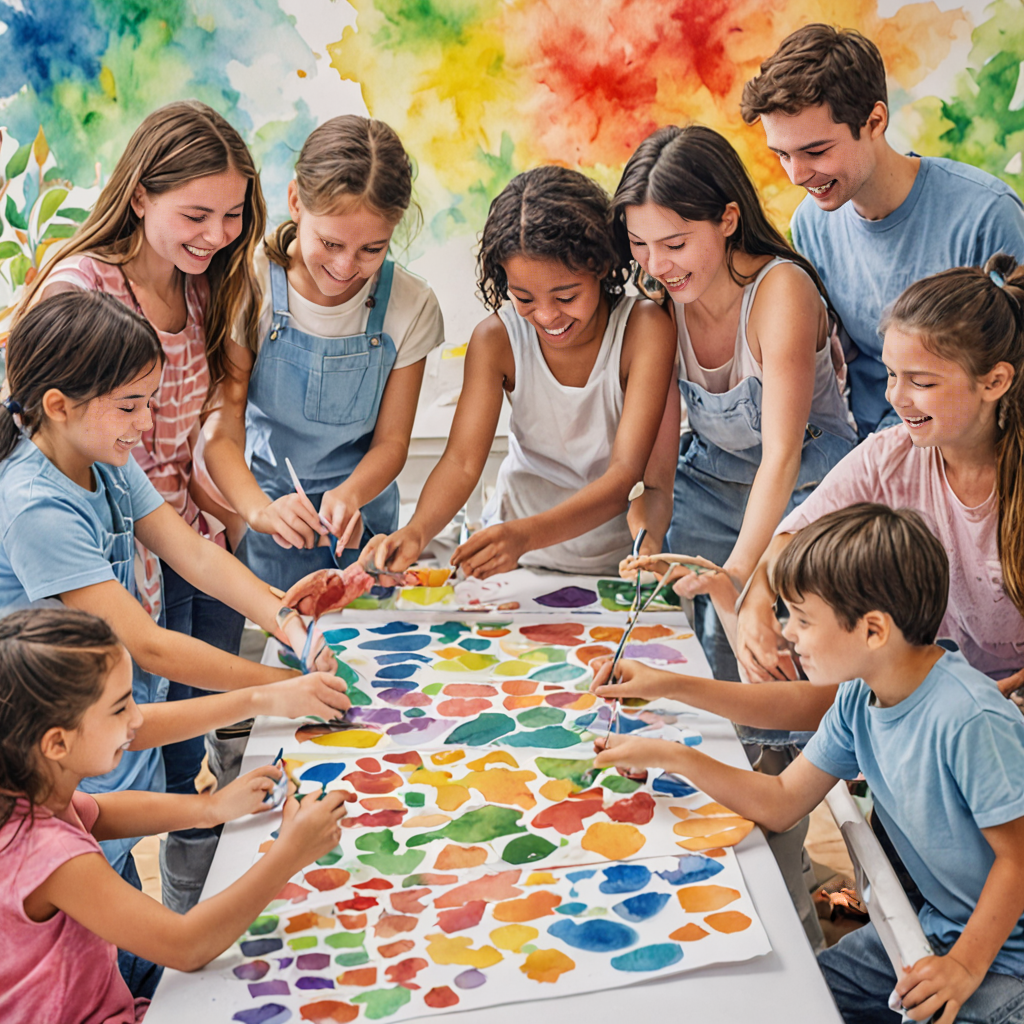
Collaborative Art Projects in Toronto Group Classes: Learning Together
Table of Contents
Collaborative art projects offer young artists unique learning experiences that complement individual creative work. At Muzart Music & Art School, located in Etobicoke near Cloverdale Mall, our group art classes incorporate thoughtfully designed collaborative projects that develop not only artistic skills but also essential social capabilities, problem-solving abilities, and appreciation for diverse creative perspectives.
While individual artistic expression remains foundational to art education, collaborative projects provide distinctive learning opportunities unavailable through solo work. Young artists discover how to negotiate creative decisions with peers, combine individual visions into unified compositions, and appreciate how collaboration can produce results beyond what any single artist might create alone. These experiences prepare students for real-world creative environments where teamwork and collaboration frequently characterize professional artistic practice.
Whether your child is naturally outgoing or more reserved, collaborative art experiences in supportive group settings provide valuable developmental opportunities. Our experienced instructors at our Etobicoke studio design collaborative projects that ensure every student contributes meaningfully while building confidence, communication skills, and creative flexibility. These group learning experiences complement the focused attention available in private art lessons, creating comprehensive artistic education.
The Unique Benefits of Collaborative Art Making
Collaborative art projects develop capabilities and perspectives that individual work alone cannot provide. Understanding these distinct benefits helps families appreciate why group art classes offer valuable dimensions beyond solo creative work.
Social skill development occurs naturally through collaborative creative work. Young artists practice negotiation as they discuss whose ideas to implement, compromise when visions differ, and encouragement when supporting peers through creative challenges. These interpersonal skills transfer far beyond art class, serving students in all areas of life where cooperation and communication matter.
Exposure to diverse creative approaches expands artistic thinking. When children work only individually, they develop within the boundaries of their own creative preferences and habits. Collaborative projects expose them to peers who think differently, approach problems alternatively, and value different aspects of artistic work. This exposure broadens creative thinking and challenges limiting assumptions about “the right way” to make art.
Problem-solving skills develop uniquely through group creative challenges. How do we create unified composition from individual elements? How can we combine different styles cohesively? How do we resolve disagreements about creative direction? Wrestling with these questions builds flexible thinking and creative problem-solving applicable far beyond visual art.
Confidence building occurs as students see their contributions valued within group contexts. Children who might feel tentative about their individual work often discover that their ideas and efforts receive appreciation from peers, building self-assurance that carries into all creative work.
Reduced performance pressure accompanies group work. While individual pieces put complete responsibility for success or failure on single students, collaborative projects distribute that pressure across the group. This reduced individual burden allows some children to take creative risks they might avoid in solo work, expanding their artistic comfort zones.
Authentic audience experiences emerge naturally as students create work their peers will see and respond to. This immediate, genuine audience provides more meaningful creative motivation than abstract future appreciation. Young artists learn to consider viewer experience and to value communication alongside pure expression.
At Muzart in Etobicoke, group art classes integrate collaborative projects thoughtfully into curricula that balance individual and group work, ensuring students receive comprehensive artistic education addressing all developmental dimensions.
Age-Appropriate Collaborative Projects
Effective collaborative art projects match children’s developmental stages, ensuring appropriate challenge and success at different ages.
Early Elementary Collaborations (Ages 5-8)
Young children thrive with collaborative projects structured to minimize conflict while maximizing creative participation. Simple shared projects where each child creates one component that joins others in larger composition work well—perhaps each student creates one fish that becomes part of a collective underwater scene, or one flower that joins a classroom garden.
Sequential collaboration where students work on shared piece one at a time develops patience and appreciation for others’ contributions. A class painting might pass between students, each adding specific elements according to instructor guidance. This approach prevents overwhelming group dynamics while introducing collaborative concepts.
Partner projects provide manageable introduction to shared creative decision-making. Working with just one peer proves less socially complex than larger group dynamics, allowing children to develop collaborative skills in simplified contexts before attempting more complex group work.
Collage projects where students each contribute materials or elements work beautifully at this age. Individual creative agency remains high—each child chooses their contribution—while the collective result demonstrates how individual efforts create something larger together.
Upper Elementary Collaborations (Ages 9-12)
Older elementary students can handle more complex collaborative dynamics and extended project timelines. Mural projects where students plan, design, and execute large-scale artworks develop sophisticated collaborative capabilities. They must negotiate composition, divide labor, maintain stylistic consistency, and coordinate efforts over multiple sessions.
Themed collaborative challenges provide creative frameworks within which students work. Perhaps the class creates collaborative artwork interpreting a story, historical event, or abstract concept. This thematic structure guides collaboration while leaving substantial room for creative decision-making.
Mixed-media group sculptures or installations combine various artistic skills within single collaborative pieces. Students might contribute different elements—some create painted components, others work in clay, others construct paper elements—that join into unified three-dimensional artworks.
Group design projects introducing elements of client relationship develop real-world collaborative capabilities. Perhaps the class designs artwork for specific location in the school, works with actual audience or purpose in mind. These authentic creative contexts make collaboration feel meaningful and applicable beyond art class alone.
Teen Collaborative Projects (Ages 13+)
Advanced students benefit from complex, sophisticated collaborative challenges that mirror professional creative practices. Gallery exhibition projects where students collaboratively curate, design, and install group shows develop professional-level collaborative capabilities alongside artistic skills.
Social justice or community art projects engage students’ developing social consciousness while building collaborative skills. Creating artwork addressing issues they care about provides authentic motivation for working through collaborative challenges.
Cross-disciplinary collaborations combining art with other subjects—perhaps creating visual responses to literature, historical events, or scientific concepts—develop integrative thinking alongside collaborative skills. These complex projects prepare students for collegiate and professional environments where disciplinary boundaries blur.
Extended portfolio development collaborations where advanced students provide peer critique and support develop both collaborative and analytical capabilities. Learning to give and receive constructive feedback represents essential professional skill that collaborative studio experiences cultivate.
Our group art classes in Etobicoke offer age-appropriate collaborative projects that develop both artistic and interpersonal capabilities progressively through students’ creative development.
Designing Effective Collaborative Art Experiences
Successful collaborative projects balance individual creative agency with genuine group cooperation. Several design elements support productive collaborative art making.
Clear structure prevents chaos while preserving creativity. Effective collaborative projects provide frameworks—perhaps specific roles, defined stages, or particular constraints—that guide cooperation without dictating exact outcomes. This structure helps students navigate collaboration successfully while maintaining creative freedom.
Individual accountability ensures all students contribute meaningfully. Projects designed so each student’s contribution remains identifiable motivate full participation and prevent some students from dominating while others withdraw. This accountability also allows instructors to assess individual growth even within group contexts.
Appropriate group sizing affects project success dramatically. Pairs work well for younger children or initial collaborative experiences. Groups of three to five suit most elementary collaborative projects, large enough for interesting interaction but small enough for all voices to be heard. Whole-class collaborations work best with highly structured approaches where individual contributions are clearly defined.
Sufficient time allocation prevents rushing. Collaborative projects require time for discussion, planning, execution, and reflection that individual projects don’t need. Underscheduled collaborative work often produces frustration as students feel pressured to make hasty decisions or compromise quality for speed.
Materials that accommodate multiple users support collaboration physically. Large paper or canvas, shared paint supplies, multiple tools allowing simultaneous work—these practical considerations enable smooth collaborative process. Inadequate materials create unnecessary conflict that undermines collaborative learning.
Instructor facilitation guides without controlling. Skilled art teachers know when to step in with suggestions or conflict resolution support and when to step back allowing students to navigate challenges independently. This balanced facilitation develops students’ collaborative capabilities while preventing projects from derailing.
The comprehensive art programs at Muzart include all materials, ensuring collaborative projects have adequate supplies to support multiple students working together effectively.
Managing Group Dynamics in Collaborative Art
Collaborative projects inevitably involve navigating interpersonal dynamics alongside creative challenges. Proactive approaches help students develop skills for productive collaboration.
Establishing group norms before beginning collaborative work sets expectations for respectful interaction. Students might collectively develop guidelines for listening to all ideas, trying suggestions before dismissing them, and resolving disagreements respectfully. These student-generated norms carry more weight than instructor-imposed rules.
Role rotation ensures all students experience different collaborative responsibilities. If one project has a designated “idea generator,” “material manager,” and “quality controller,” rotating these roles across multiple projects prevents students from becoming locked into limiting collaborative identities.
Structured brainstorming processes democratize idea generation. Rather than allowing loudest or most confident students to dominate creative direction, structured approaches—perhaps having all students sketch individual ideas before group discussion, or using silent brainstorming where ideas are written rather than shouted—ensure quieter students’ contributions receive equal consideration.
Conflict resolution frameworks provide tools for managing inevitable disagreements. Students learn to articulate what they want and why, to listen genuinely to alternative perspectives, and to seek creative solutions that honor multiple viewpoints. These structured approaches transform conflicts from relationship threats into learning opportunities.
Celebration of diverse contributions helps students appreciate how different skills and perspectives strengthen collaborative work. Explicitly noting how Sarah’s attention to detail, Miguel’s bold color choices, and Aisha’s compositional thinking all contributed essential elements to the collaborative piece validates diverse creative approaches.
Reflection opportunities after collaborative projects help students process what they learned about cooperation, identify what worked well and what proved challenging, and develop strategies for future collaborative experiences. This metacognitive processing consolidates learning from collaborative experiences.
Instructors at our Etobicoke studio facilitate these dynamics skillfully, ensuring group art classes provide positive, productive collaborative experiences that build both artistic and social capabilities.
Types of Collaborative Art Projects for Group Classes
Different collaborative project structures offer distinct learning opportunities and suit different learning objectives and group dynamics.
Sequential Collaboration
Exquisite corpse and similar sequential drawing games introduce collaborative concepts playfully. Each student draws one section of a figure or composition without seeing what previous artists created, then passes the paper to the next student. The reveal of completed collaborative pieces generates excitement while demonstrating how individual contributions combine unpredictably.
Story illustration chains where each student illustrates consecutive page in collaborative book develop narrative art skills alongside collaboration. Students must maintain some stylistic consistency while adding individual creative interpretation.
Collaborative animation where each student creates frames that join into moving sequence combines technology with traditional art collaboration. The necessity for consistency across frames develops planning and communication skills.
Simultaneous Collaboration
Large mural projects where students work simultaneously on different sections develop real-time collaborative negotiation skills. Students must coordinate color palettes, maintain stylistic unity, and integrate their sections with adjacent areas their peers are creating concurrently.
Group paintings where multiple students work on single canvas simultaneously require sophisticated communication and spatial awareness. This intense collaboration develops comfort with shared creative space and negotiation of literal and figurative territory.
Installation projects involving multiple simultaneous elements—perhaps some students create sculptural components while others develop painted backdrops—require coordination of different media and work modes within unified artistic vision.
Parallel Collaboration
Theme-and-variation projects where each student creates individual interpretation of shared theme demonstrate unity within diversity. The collective display of parallel works explores how different artists approach identical starting points, developing appreciation for artistic diversity.
Modular collaborative pieces where each student creates standardized unit that joins others in pattern or structure balance individual creativity with collaborative coherence. Perhaps each student decorates single square that joins others in collaborative quilt, or creates one sculptural element that combines with peers’ elements in installation.
Exhibition co-curation where students each create individual pieces but collaborate on display, arrangement, and presentation develops collaborative skills in contexts beyond creation itself. This approach introduces professional gallery practices while maintaining individual creative agency.
Complementary Collaboration
Skill-based collaboration where students contribute expertise in different areas mirrors professional creative practice. Perhaps student strong in drawing creates outlines, student skilled in painting adds color, and student talented in detail work adds finishing touches. This approach validates diverse skills while demonstrating how complementary abilities strengthen collective work.
Mixed-media collaboration where different students work in different media that combine in finished piece develops appreciation for diverse artistic approaches. Student working in collage, student painting, and student drawing might each contribute layers to unified mixed-media composition.
These varied collaborative approaches, integrated throughout curricula in our art lessons in Etobicoke, ensure students experience diverse collaborative structures developing versatile cooperative capabilities.
Assessing Learning in Collaborative Projects
Evaluating student growth within collaborative contexts requires approaches different from assessing individual work.
Process observation matters as much as final products. Instructors note how students negotiate creative decisions, whether they listen to peers’ ideas, how they handle disagreements, and whether they contribute actively to group efforts. These process observations reveal social and collaborative learning that finished artworks alone don’t demonstrate.
Individual contribution identification allows assessment of each student’s learning even within group work. When collaborative projects are designed to make individual contributions visible, instructors can evaluate each student’s artistic growth while appreciating the collaborative whole.
Self-assessment encourages students to reflect on their collaborative experiences. Questions like “What did you contribute to this project?” “What did you learn from working with peers?” and “What would you do differently next time?” develop metacognitive awareness of collaborative learning.
Peer feedback structured appropriately develops students’ ability to recognize and articulate others’ contributions. Learning to appreciate peers’ efforts and communicate that appreciation constructively represents valuable social and collaborative skill.
Documentation through photographs, videos, or journals creates records of collaborative processes and products. These artifacts allow students, families, and instructors to revisit learning and growth across multiple collaborative experiences.
Celebrating collaborative achievements validates effort and learning. Displaying collaborative artworks prominently, sharing them with broader school community, or exhibiting them publicly demonstrates that collaborative work receives recognition and appreciation equal to individual pieces.
Our instructors provide comprehensive feedback addressing both artistic development and collaborative capability growth, ensuring students and families understand the multidimensional learning occurring through group art classes.
Frequently Asked Questions About Collaborative Art Projects
Will my child’s individual artistic voice be lost if they focus on collaborative projects?
This common concern is understandable but unfounded when collaborative work is balanced appropriately with individual creative time. Quality group art programs, like those at Muzart Music & Art School in Etobicoke, integrate collaborative projects into curricula that predominantly feature individual work, ensuring students develop personal artistic voices alongside collaborative capabilities. Research consistently shows that exposure to collaborative work actually enriches rather than diminishes individual creativity—students exposed to peers’ diverse approaches and perspectives expand their own creative thinking and develop more flexible artistic problem-solving. The negotiation and compromise required in collaboration help students clarify their own creative preferences and values by articulating them to others. Additionally, collaborative skills prove essential for many professional creative contexts—graphic designers collaborate with clients and colleagues, illustrators work with art directors, muralists coordinate with communities. Developing collaborative capabilities alongside individual expression prepares students for real-world creative practice. The key is balance, not choosing between individual and collaborative work. At our Etobicoke studio, group art classes include both individual projects where students develop personal vision and collaborative projects where they learn to work creatively with others. This comprehensive approach develops well-rounded young artists prepared for diverse creative contexts.
What if my child is shy and struggles with group work?
Shyness or social hesitancy doesn’t prevent benefiting from collaborative art experiences—in fact, thoughtfully structured group art work often helps reserved children develop social confidence in lower-pressure contexts than many academic or social settings. Art provides shared focus that takes pressure off direct social interaction; children can engage collaboratively around creative tasks without the intense face-to-face social demand of, say, free play. Several strategies support shy children in group art contexts. Starting with partner projects rather than larger groups provides manageable introduction to collaboration. Providing clear roles and structures reduces ambiguity that can overwhelm hesitant children. Ensuring all students take turns sharing ideas through structured processes prevents confident children from dominating and gives quieter students protected space for contribution. Explicitly validating diverse collaborative styles—some students lead through verbal contribution while others lead through demonstrating techniques or providing thoughtful feedback—helps reserved children recognize that meaningful participation takes many forms. Many naturally shy children discover that creative contexts bring out confidence that doesn’t emerge in other settings; their artistic capabilities provide foundation for social engagement that feels authentic and comfortable. At Muzart, instructors recognize diverse social comfort levels and facilitate collaborative projects in ways that support all students successfully. Small group sizes, structured processes, and individualized support ensure every child can participate meaningfully regardless of social temperament. Book a trial lesson to see how we create inclusive collaborative environments where all students thrive.
How do collaborative projects work when students have different skill levels?
Effective collaborative art projects leverage different skill levels as strengths rather than treating them as problems requiring remediation. Several approaches support productive mixed-ability collaboration. Role differentiation allows students to contribute according to their capabilities—perhaps more advanced students handle complex elements while developing artists contribute components matching their skill levels. This division of labor isn’t about hierarchy but about ensuring all students experience appropriate challenge and success. Peer mentoring structures where more experienced students support developing artists benefits both groups—mentors consolidate learning by teaching others, while learners receive patient, peer-delivered guidance. Complementary skill sets mean students strong in different areas contribute their particular strengths—one student might excel at color mixing, another at composition, another at detail work—creating collaboration where diverse abilities combine productively. Process-focused projects where effort and creative thinking matter more than technical execution level the playing field, allowing students at all skill levels to contribute meaningfully. Importantly, skill differences in group classes tend to be moderate rather than extreme; children grouped by age typically have relatively similar developmental capabilities even if specific skill levels vary. At our Etobicoke studio, instructors design collaborative projects that honor diverse skill levels while ensuring all students contribute authentically. The comprehensive curriculum in our group classes includes both collaborative and individual work, allowing students to develop at their own pace while also experiencing the benefits of working with peers at various levels.
Can parents be involved in collaborative art projects, or are they only for classroom settings?
While formal collaborative art projects typically occur in instructional settings like group art classes, families can absolutely extend collaborative art making into home contexts, enriching both artistic and family experiences. Family collaborative art projects provide wonderful bonding opportunities while developing creative and social skills in low-pressure contexts. Simple approaches include creating collaborative family paintings where each family member adds elements to shared canvas, perhaps over extended periods like vacation weeks. Collaborative scrapbooks or memory books where different family members contribute different pages or elements document family experiences creatively. Seasonal decorative projects like collaborative holiday decorations or birthday banners engage whole families in shared creative work. Extended collaborative projects like decorating family members’ bedroom doors, creating collaborative garden decorations, or making gifts for relatives provide purposeful creative collaboration. The key to successful family collaborative art is managing power dynamics thoughtfully—adults should participate as creative equals rather than directing or judging children’s contributions. Setting clear expectations that all contributions are valued, that there’s no single “right” outcome, and that process matters as much as product creates psychologically safe space for family creative collaboration. These home extensions complement rather than replace professional art instruction, where trained instructors facilitate collaborative learning systematically. At Muzart, we encourage families to extend artistic learning beyond formal lessons while providing the expert guidance through group classes that develops collaborative capabilities systematically.
How do collaborative art projects prepare children for future academic and career success?
Collaborative art projects develop capabilities increasingly recognized as essential for twenty-first century academic and professional success. Communication skills practiced through artistic collaboration—articulating ideas clearly, listening actively to others, negotiating differences respectfully—transfer directly to all collaborative academic and professional contexts. Problem-solving abilities developed when students figure out how to combine different artistic visions, resolve creative disagreements, or overcome technical challenges apply to countless real-world situations requiring creative solutions. Teamwork capabilities central to collaborative art mirror professional creative practice across fields—graphic designers collaborate with marketing teams, architects work with engineers and clients, product designers coordinate with manufacturers. Early experience with productive collaboration provides foundation for these professional competencies. Creative confidence built through successful collaborative experiences encourages students to contribute ideas and take intellectual risks in other academic and professional contexts. Appreciation for diverse perspectives developed when students see how peers’ different approaches strengthen collaborative work translates to valuing intellectual and cultural diversity broadly. Comfort with ambiguity and emergent outcomes—collaborative projects rarely turn out exactly as initially imagined—develops adaptive thinking valuable in rapidly changing academic and professional landscapes. These transferable capabilities matter at least as much as artistic skills alone. At Muzart in Etobicoke, we design collaborative projects intentionally to develop these broader capabilities alongside artistic skills, understanding that comprehensive education prepares students for thriving across all aspects of life.
Experience the Power of Collaborative Art Learning
Collaborative art projects offer young artists unique learning experiences that complement individual creative work, developing not only artistic capabilities but also essential social skills, creative problem-solving abilities, and appreciation for diverse perspectives. These experiences prepare students for real-world creative practice while building confidence and communication skills that serve them far beyond art class.
At Muzart Music & Art School in Etobicoke, our group art classes integrate thoughtfully designed collaborative projects into comprehensive curricula that balance individual and shared creative work. Our experienced instructors facilitate collaborative experiences that ensure all students contribute meaningfully while developing both artistic and interpersonal capabilities.
Located near Cloverdale Mall and serving families throughout Toronto, Etobicoke, and Mississauga, our group art classes provide dynamic learning environments where children share inspiration, learn from peers, and develop social skills alongside artistic growth. All art materials are included in our programs, ensuring collaborative projects have adequate supplies to support multiple students working together effectively.
Our small group sizes ensure every student receives attention and support while experiencing the unique benefits of collaborative learning. The combination of individual projects where students develop personal artistic voices and collaborative projects where they learn to create with others produces well-rounded young artists prepared for diverse creative contexts.
Spring represents an ideal time to introduce your child to the social and creative benefits of group art instruction. Whether seeking community and peer learning for social children or supportive structure helping reserved children develop confidence, our group art classes provide inclusive environments where all students thrive.
Book a trial group art class to experience our approach to collaborative learning and comprehensive art education. Your trial provides an opportunity to see our collaborative projects in action, meet our instructors and current students, and understand how we create positive group dynamics that support all learners.
Don’t let your child miss the unique learning opportunities that collaborative art experiences provide. Request more information about our group art programs, or schedule your trial lesson today. The creative and social skills your child develops through collaborative art making will serve them throughout their educational journey and beyond.