
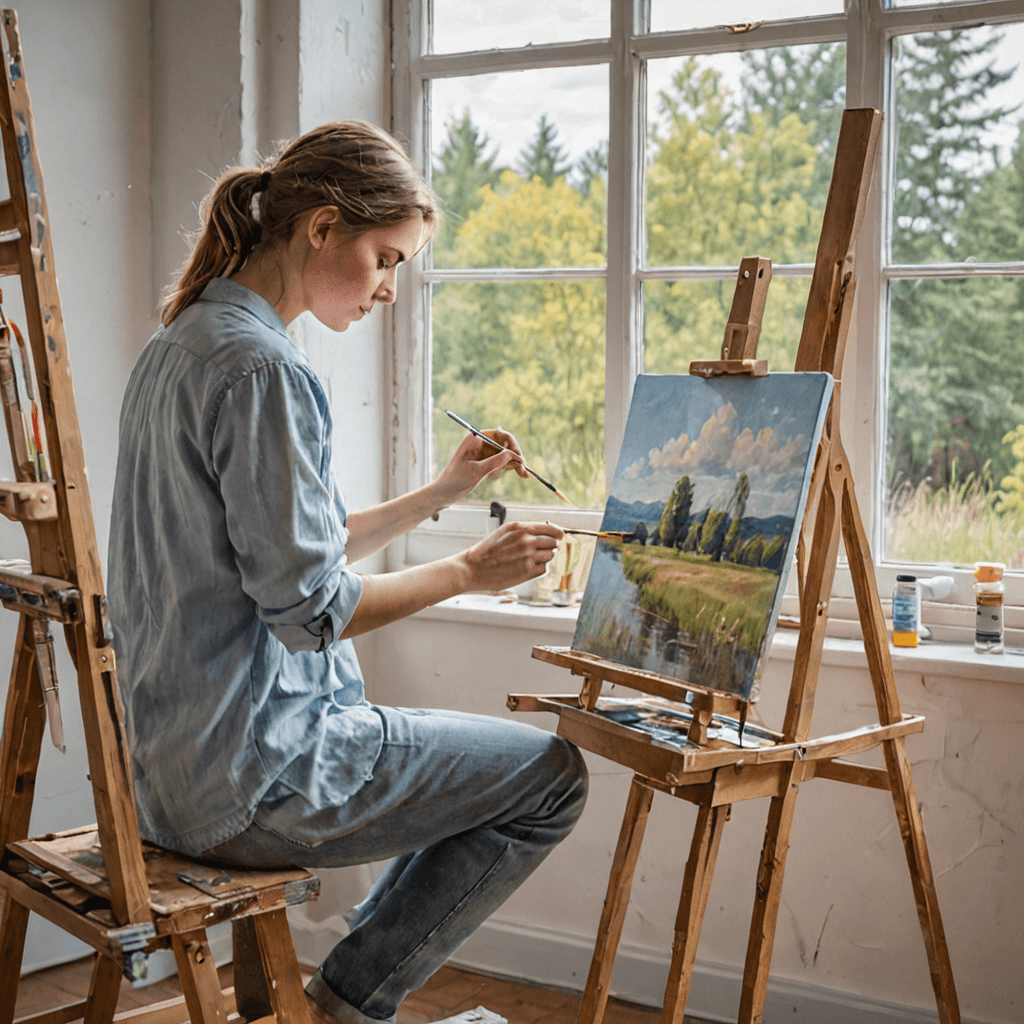
Art Lessons for Adults in Etobicoke: It’s Never Too Late to Start
Table of Contents
Adults who stop themselves from taking art lessons usually do so with some version of the same sentence: “I’m probably too old to start.” Sometimes it is said as a joke. Sometimes it carries genuine regret. Sometimes it is phrased as a question with a hopeful edge, as if waiting for someone to contradict it. So let us contradict it clearly: no, you are not too old. You were not too old at thirty, you are not too old at fifty, and you will not be too old at seventy. Art is one of the most accessible disciplines to take up at any age, and the adults who do so routinely become the most committed, thoughtful, and rewarding students in the studio.
At Muzart Music and Art School, we have taught adults across Etobicoke, Toronto, and Mississauga who picked up a paintbrush for the first time in their forties, fifties, and sixties. Some had dabbled as children and set it aside. Some had always wanted to try and never made the time. Some discovered the desire later in life without any prior hint of it. All of them had the same question: is this really something I can do? And all of them, within a few months, had their answer.
The Quiet Advantage Adults Bring
There is a cultural assumption that learning creative skills is primarily for the young, and that older learners face insurmountable disadvantages. The assumption is almost entirely wrong. Adult learners bring considerable advantages to art instruction that children simply do not have.
Adults can concentrate for longer periods. Children’s art lessons are structured in short bursts with built-in energy breaks because younger attention spans require it. Adults can work productively for an hour or two at a stretch, which means every lesson produces more progress per session.
Adults understand abstraction. Colour theory, perspective, composition — the concepts that make art instruction possible — are easier to absorb when the student already thinks abstractly. Children grasp these ideas eventually, but adults often get there in a single explanation.
Adults are better self-directed practicers. They know how to schedule time, how to maintain a routine, how to work through difficulty without a parent monitoring them. The discipline that is an effort for children is often second nature for adults.
Adults have life experience to draw on. Art is, at its core, about noticing the world and responding to it. Adult students have seen more of the world than young students have. Their observations tend to be richer, their aesthetic responses more developed, their subjects more interesting.
The only real disadvantage adults face is the expectation — their own — that they should already be good at things. Children accept being beginners. Adults often resist it. Getting past this psychological barrier is the hardest part of starting art instruction in midlife, and it is entirely a matter of time and persistence.
What Adult Art Instruction Looks Like
Adult art lessons at our studio are conducted privately, not in group formats. Group art classes in Etobicoke at Muzart are specifically for children — the social dynamic suits younger learners. Adults benefit more from private art lessons, where the instruction can be calibrated to the specific student’s goals, prior experience, and pace.
A typical adult beginner might start with observational drawing — still life arrangements of simple objects — before progressing to more complex subjects like portraits, figures, or landscapes. The progression is not rigid; instructors adjust based on what the student is drawn to and what they need to build. An adult who wants to paint landscapes in watercolour can begin there, learning observational and technical skills through that subject rather than going through a generic curriculum.
Lessons are one hour in length. Most adult students attend weekly, though some prefer every two weeks with more independent practice in between. The rhythm settles into something sustainable within the first couple of months.
Materials depend on the medium the student chooses to pursue. Graphite and charcoal drawing are inexpensive starting points. Watercolour requires a modest initial investment in paints, paper, and brushes. Oil painting or acrylic painting requires more substantial materials. Instructors help students select appropriate supplies without overspending early, which is a common mistake for enthusiastic beginners.
Finding the Right Medium
One of the first decisions adult students face is which medium to focus on. This is less important than it feels — most adult learners benefit from trying several media during their first year — but some guidance helps.
Graphite pencil is the universal starting point for a reason. It is inexpensive, forgiving, erasable, and teaches foundational drawing skills that transfer to every other medium. Adults who begin with pencil drawing build the observational and technical base that makes later media easier.
Charcoal moves faster than pencil and produces more dramatic tonal contrasts. Adult students often love charcoal because it rewards bold decisions and does not tempt them into fiddling endlessly with small details.
Watercolour is emotionally appealing — the soft, luminous results are beautiful — but technically unforgiving. Watercolour requires commitment; once a stroke is laid down, it largely cannot be corrected. Adults who have patience for the medium’s demands often fall in love with it.
Acrylic is more forgiving than watercolour. It allows corrections, builds up in layers, and produces vibrant results quickly. Many adult learners choose acrylic as their primary medium because it rewards experimentation.
Oil is the richest traditional painting medium and the one with the deepest history. It has a steeper technical learning curve but produces results that few other media can match. Adult learners who commit to oil often continue with it for the rest of their lives.
Students at our Etobicoke studio can work across several of these media over the course of instruction. Those taking art lessons in Etobicoke with us often discover, through experimentation, which medium suits their temperament — sometimes it is the one they expected, sometimes a surprise.
The Question of Time
Adults considering art lessons frequently worry about time commitment. The honest answer is that meaningful progress requires real time, but the amount is less than most adults fear.
One hour per week of instruction, combined with two to four hours of independent practice, produces steady visible progress. The practice does not need to happen in long blocks — half an hour at a kitchen table in the evening, an hour on a weekend morning, a sketchbook carried to a coffee shop for a few minutes during lunch. These small commitments compound over months.
Adults without regular practice between lessons progress more slowly, but progress nonetheless. Those who cannot commit to independent practice still benefit from weekly instruction. The teacher meets each student where they are.
Most adults find that once they start art lessons, practice time becomes something they protect rather than something they have to force. The activity itself is grounding, meditative, often the quietest and most restorative hour of the week. Students describe it as the thing they look forward to more than any other part of their schedule.
Pricing and Practical Details
Adult art instruction at our studio runs through private art lessons. The monthly program rate — which includes all materials — is structured to be accessible for ongoing study. Portfolio preparation for teens aiming at art school has its own pricing (trial $70, monthly $310), but adult learners not preparing portfolios follow the private art lesson structure.
Our studio is located in Etobicoke near Cloverdale Mall. Adult students come from across Etobicoke, Toronto, and Mississauga, with weekly or bi-weekly lessons fitting into working schedules because evening and weekend slots are available. Families and couples sometimes take lessons on the same day, one after another, turning art instruction into a shared experience.
You can request more information about availability and pricing, or book a trial lesson to see whether the teaching style and environment work for you before committing.
The Changes Adults Notice
Adult students typically notice specific changes within the first few months of consistent art practice:
- Visual attention shifts. They start noticing light, colour, and form in their daily surroundings differently. A morning commute reveals compositions they had never seen before.
- Stress patterns change. The meditative focus of drawing or painting activates a different part of the nervous system than work or screens. Many adults describe art lessons as their most reliable stress reducer.
- Confidence transfers. The discipline of learning something new as an adult — accepting early clumsiness, working through frustration, celebrating slow progress — carries into other areas of life.
- Creative identity solidifies. Adults who never thought of themselves as “artistic” begin to recognize that they are. This is sometimes a quiet revelation, sometimes a revelatory one.
These effects happen without being forced. They emerge naturally from the work itself.
Frequently Asked Questions
Is it too late to start art lessons as an adult?
It is not too late. Adults have successfully begun art instruction in their thirties, forties, fifties, sixties, and beyond. The physical skills involved in drawing and painting do not meaningfully deteriorate until very late in life, and the cognitive and emotional qualities adults bring to learning often accelerate progress compared to children. The only thing that is ever too late is waiting indefinitely.
Do I need any prior experience to start?
No. Most adult beginners at our studio have no formal art training beyond whatever they may have done in elementary school. Instruction starts from wherever the student is, including from zero. Some adult students actually progress faster than students who had prior training, because they have fewer bad habits to unlearn.
How often should adult students attend lessons?
Weekly lessons produce the most consistent progress, though every two weeks works for adults who prefer more time for independent practice between sessions. Monthly is typically too infrequent — the gap between lessons is long enough that continuity suffers. Find a cadence that is sustainable for your schedule and commit to it.
What should I expect to spend on materials as an adult beginner?
For drawing-focused instruction, you can get started for under $50 on pencils, paper, and a sketchbook. Painting media require more — $100 to $300 is a reasonable starting budget for watercolour or acrylic, more for oil. Teachers advise students on cost-effective starter kits so you do not overspend before you know which medium you want to pursue.
Does Muzart teach specific art styles or is instruction generalized?
Our instruction is classical and observational at its foundation — drawing and painting from life, developing technical skills before stylistic voice. Once a student has those fundamentals, they can pursue whatever style appeals to them: realism, impressionism, expressionism, abstraction. The foundation supports all of it. Teachers adapt instruction to each student’s goals and interests.
Can I take art lessons with a spouse, friend, or family member?
Yes. Many adult students book lessons at back-to-back times so they can share the experience of coming to and from the studio. Some couples or friends specifically use art lessons as shared time. While lessons themselves are individual, the broader experience can be social if students want it to be. Group art classes at our studio are limited to children, but adult friends attending private lessons in adjacent time slots is a regular occurrence.
Starting Now Is Better Than Starting Later
The single best moment to begin art lessons as an adult is the moment the question first occurs to you. Waiting does nothing productive. Lives are full, schedules are busy, and the right moment to start rarely arrives on its own — it has to be made.
If you have been considering art lessons in Etobicoke and wondering whether you might actually be capable of this, you almost certainly are. Book a trial lesson and find out for yourself.